
Welcome to the updated NEW NCERT solutions and notes for Class 9 Science Ch 2 Is Matter Around Us Pure-NCERT. As per the latest CBSE curriculum for the 2025-26 academic year, this chapter was formerly titled “Class 9 Science Ch 2 Is Matter Around Us Pure-NCERT. While the core scientific concepts remain the same, the chapter has been reorganized to focus more on the practical application of separation techniques and data interpretation.
In this guide, you will find detailed explanations of:
- The Nature of Mixtures: Understanding the difference between homogeneous and heterogeneous mixtures.
- Solutions, Colloids, and Suspensions: Comprehensive comparisons of particle size and the Tyndall Effect.
- Advanced Separation Techniques: Step-by-step guides for distillation, centrifugation, chromatography, and more.
- Solubility Analysis: Solved numerical problems based on the latest textbook data (Table 5.4).
Whether you are preparing for school exams or building a foundation for competitive exams like NEET, these resources are designed to help you master the separation of substances with ease.
Understanding Mixtures: Homogeneous vs. Heterogeneous
The core of this chapter involves distinguishing between substances that are uniform throughout and those that are not.
- Homogeneous Mixtures: These have a uniform composition throughout. Examples include air, brass (an alloy of copper and zinc), and salt solutions.
- Heterogeneous Mixtures: These have a non-uniform composition where different components are visible. Examples include muddy water, milk, and blood.
Solutions, Suspensions, and Colloids
Mixtures are further categorized based on the size of their particles and how they interact with light.
- Solutions: These are homogeneous mixtures with very small particles (less than 1nm). They are transparent and do not scatter light.
- Colloids: These mixtures contain moderate-sized particles (1-1000 nm) that are large enough to scatter a beam of light, a phenomenon known as the Tyndall Effect. Examples include milk, fog, and smoke.
- Suspensions: These are heterogeneous mixtures with large particles (greater than 1000 nm}) that eventually settle down when left undisturbed. Examples include muddy water and chalk powder in water.
Essential Separation Techniques
A major focus of the updated curriculum is the practical application of methods used to separate these mixtures.
- Evaporation: Used to separate a non-volatile solid (like salt) from a volatile solvent (like water).
- Centrifugation: Utilizes high-speed rotation to separate denser particles from lighter ones, such as separating plasma from blood or cream from milk.
- Separating Funnel: Used for separating immiscible liquids (liquids that do not mix), such as oil and water.
- Sublimation: Ideal for separating a mixture containing a component that changes directly from solid to gas, like naphthalene or ammonium chloride.
- Distillation: Used to separate miscible liquids with different boiling points, such as acetone and water.
- Chromatography: A technique used to separate different pigments or components of a dye based on their solubility.
Solubility and Concentration Calculations
This chapter introduces numerical problems to calculate how much solute is present in a solution.
- Mass Percentage: This formula is a key focus of the updated Chapter 5: Exploring Mixtures and Their Separation. It is used to solve practical problems, such as calculating the concentration of ingredients in a cake recipe or determining the amount of metal in an alloy.
The Tyndall Effect: Why Some Mixtures Scatter Light
One of the most important characteristics of colloids and suspensions discussed in the new curriculum is the Tyndall Effect. This phenomenon occurs when a beam of light passes through a mixture and the path of the light becomes visible due to the scattering of light by relatively large particles.
- Solutions: Solutions do not show the Tyndall effect because their particles are extremely small (<1 nm) and cannot scatter light.
- Colloids and Suspensions: Colloids and suspensions show the Tyndall effect because their particles are large enough to scatter and deflect light rays.
Step-by-Step Separation of Complex Mixtures
Modern NCERT questions often require the use of multiple separation techniques in the correct sequence to separate a mixture containing three components. For example, to separate a mixture of naphthalene, common salt, and sand, the following steps are used:
- Sublimation: Heat the dry mixture first. Naphthalene sublimes, changing directly from solid to vapour, and can be collected separately.
- Filtration: Add water to the remaining mixture of sand and salt. Salt dissolves in water, while sand remains insoluble. Filter the mixture to separate the sand as residue.
- Evaporation: Heat the salt solution obtained after filtration. Water evaporates, leaving behind pure salt crystals.
Analyzing Solubility Data
Understanding how temperature affects the solubility of substances is an important concept in Chapter 5. Different salts show different patterns of solubility with changing temperature.
- High Sensitivity: Salts such as potassium nitrate show a large increase in solubility with rise in temperature (from 21 g to 167 g per 100 g of water).
- Low Sensitivity: Salts like sodium chloride show very little change in solubility with temperature.
- Crystallization: When a hot saturated solution of potassium chloride is cooled, its solubility decreases. As a result, the excess dissolved salt separates out in the form of crystals.
Class 9 Science Ch 2 Is Matter Around Us Pure-NCERT – Page 1 – OLD SYLLABUS
Question 1. What is meant by a substance?
Answer: A pure substance consists of a single type of particles.
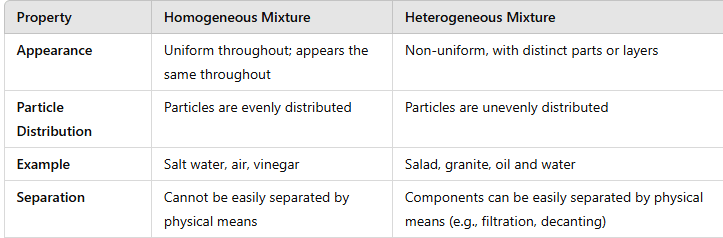
Question 2. List the points of differences between homogeneous and heterogeneous mixtures.
Answer:
Class 9 Science Ch 2 Is Matter Around Us Pure-NCERT– Page 18
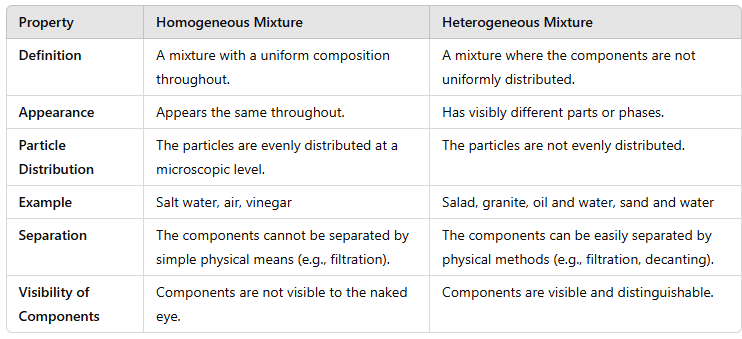
Question 1. Differentiate between homogeneous and heterogeneous mixtures with examples.
Answer:
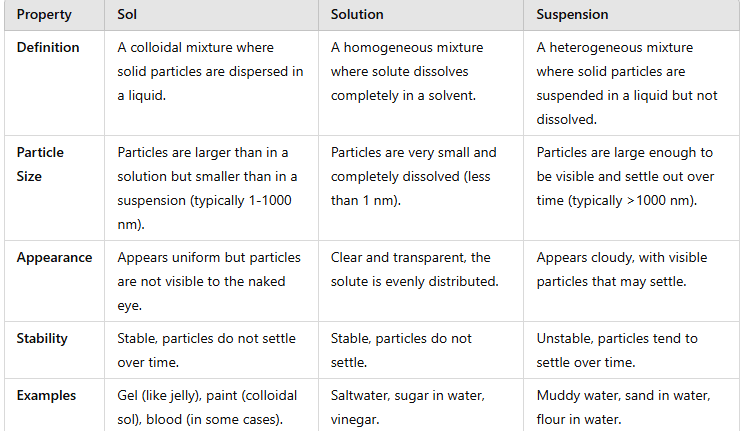
Question 2. How are sol, solution and suspension different from each other?
Answer:
Question 3. To make a saturated solution, 36 g of sodium chloride is dissolved in 100 g of water at 293 K. Find its concentration at this temperature.
Answer: Given:
Mass of solute (sodium chloride) = 36 g
Mass of solvent (water) = 100 g
Total mass of solution = 36 g + 100 g = 136 g
Concentration (by mass) = (Mass of solute / Mass of solution) × 100
= (36 / 136) × 100
= 26.47%
Answer:
The concentration of the solution is 26.47% by mass.
Class 9 Science Ch 2 Is Matter Around Us Pure-NCERT– Textbook Page 24
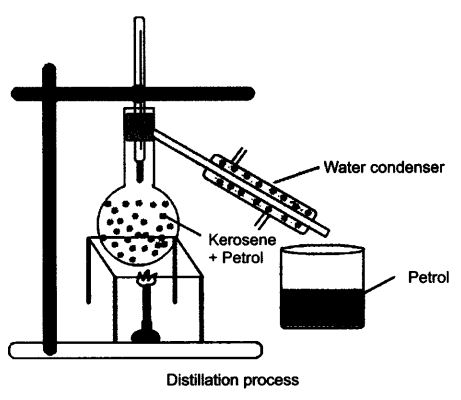
Question 1. How will you separate a mixture containing kerosene and petrol (difference in their boiling points is more than 25°C), which are miscible with each other?
Answer: A mixture of kerosene and petrol which are miscible with each other can be separated by distillation.
Method
- Take a mixture in a distillation flask.
- Fit it with a thermometer.
- Arrange the apparatus as shown in the figure.
- Heat the mixture slowly.
- Petrol vaporises first as it has lower boiling point. It condenses in the condenser and is collected from the condenser outlet.
- Kerosene is left behind in the distillation flask.

Question 2. Name the technique to separate
(i) butter from curd,
(ii) salt from sea-water,
(iii) camphor from salt.
Answer: (i) Centrifugation,
(ii) Evaporation,
(iii) Sublimation.
Question 3. What type of mixtures are separated by the technique of crystallisation?
Answer: Crystallisation technique is used to purify solid with some impurities in it. Example: Salt from sea-water.
NCERT Textbook Questions Page 24
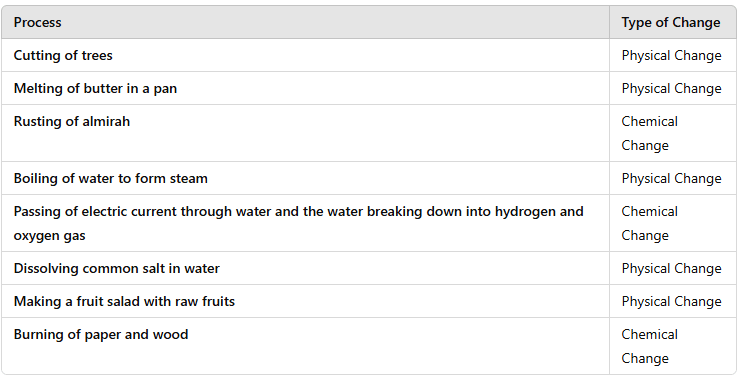
Question 2. Classify the following as chemical or physical changes:
- cutting of trees,
- melting of butter in a pan,
- rusting of almirah,
- boiling of water to form steam,
- passing of electric current, through water and the water breaking down into hydrogen and oxygen gas,
- dissolving common salt in water,
- making a fruit salad with raw fruits and
- burning of paper and wood.
Answer:
Question 3. Try segregating the things around you as pure substances or mixtures
Answer: Pure substances—Water, bread, sugar and gold.
Mixtures—Steel, plastic, paper, talc, milk and air.
Text book
Question 1. Which separation techniques will you apply for the separation of the following?
(a) Sodium chloride from its solution in water.
(b) Ammonium chloride from a mixture containing sodium chloride and ammonium chloride.
(c) Small pieces of metal in the engine oil of a car.
(d) Different pigments from an extract of flower petals.
(e) Butter from curd.
(f) Oil from water.
(g) Tea leaves from tea.
(h) Iron pins from sand.
(i) Wheat grains from husk.
(j) Fine mud particles suspended in water.
Answer: (a) Evaporation
(b) Sublimation
(c) Filtration
(d) Chromatography
(e) Centrifugation
(f) Separating funnel
(g) Filtration
(h) Magnetic separation
(i) Winnowing/ sedimentation
(j) Decantation and filtration
Question 2. Write the steps you would use for making tea. Use the words, solution, solvent, solute, dissolve, soluble, insoluble, filtrate and residue.
Answer: 1. Take a cup of water in a container as solvent and heat it.
2. Add sugar in it which is solute. Heat it till all sugar dissolves.
3. You get a solution of water and sugar.
4. Sugar is soluble in water completely.
5. Add half a tea-spoon of tea-leaves, it is insoluble in water.
6. Boil the content, add milk which is also soluble in water, boil again.
7. Filter the tea with the help of strainer, the tea collected in cup is filtrate and the tea leaves collected on the strainer is residue.
Question 3:
Pragya tested the solubility of three different substances at different temperatures and collected the data as given below (results are given in the following table, as grams of substance dissolved in 100 grams of water to form a saturated solution).
| Substance Dissolved | 283 K | 293 K | 313 K | 333 K | 353 K |
|---|---|---|---|---|---|
| Potassium nitrate | 21 | 32 | 62 | 106 | 167 |
| Sodium chloride | 36 | 36 | 36 | 37 | 37 |
| Potassium chloride | 35 | 35 | 40 | 46 | 54 |
| Ammonium chloride | 24 | 37 | 41 | 55 | 66 |
(a) What mass of potassium nitrate would be needed to produce a saturated solution of potassium nitrate in 50 grams of water at 313 K?
Answer:
Solubility of potassium nitrate at 313 K = 62 g per 100 g water.
So, in 50 g of water:
(62 / 100) × 50 = 31 g
Therefore, 31 grams of potassium nitrate are needed.
(b) Pragya makes a saturated solution of potassium chloride in water at 353 K and leaves the solution to cool at room temperature. What would she observe as the solution cools? Explain.
Answer:
Solubility of potassium chloride at 353 K = 54 g
Solubility at room temperature (approx. 293 K) = 35 g
As the temperature decreases, excess potassium chloride (54 g − 35 g = 19 g) will crystallize out.
Therefore, Pragya will observe that some of the salt settles at the bottom as crystals.
(c) Find the solubility of each salt at 293 K. Which salt has the highest solubility at this temperature?
Answer:
Solubility at 293 K:
- Potassium nitrate = 32 g
- Sodium chloride = 36 g
- Potassium chloride = 35 g
- Ammonium chloride = 37 g
Ammonium chloride has the highest solubility (37 g) at 293 K.
(d) What is the effect of change of temperature on the solubility of a salt?
Question 4. Explain the following giving examples:
(a) Saturated solution
(b) Pure substance
(c) Colloid
(d) Suspension
Answer: (a) Saturated solution: In a given solvent when no more solute can dissolve further at a given temperature is called saturated solution.
(b) Pure substance: A pure substance consists of a single type of particles. E.g., gold, silver.
(c) Colloid: A colloid is a solution in which the size of solute particles are bigger than that of true solution. These particles cannot be seen with our naked eyes, they are stable, e.g., ink, blood.
(d) Suspension: It is a heterogeneous mixture in which the solute particles are big enough to settle down, e.g., chalk-water, paints, etc.
Question 5. Classify each of the following as a homogeneous or heterogeneous mixture: soda water, wood, air. soil, vinegar, filtered tea.
Answer: Homogeneous: Soda water, vinegar, filtered tea.
Heterogeneous: Wood, air, soil.
Question 6. How would, you confirm that a colourless liquid given to you is pure water?
Answer: By finding the boiling point of a given colourless liquid. If the liquid boils at 100°C at atmospheric pressure, then it is pure water. This is because pure substances have fixed melting and boiling point.
Question 7. Which of the following materials fall in the category of a “pure substance”?
(a) Ice (b) Milk (c) Iron
(d) Hydrochloric acid (e) Calcium oxide (f) Mercury
(g) Back (h) Wood (i) Air.
Answer: Pure substances are: Ice, iron, hydrochloric acid, calcium oxide and mercury.
Question 8. Identify the solutions among the following mixtures.
(a) Soil (b) Sea water
(c) Air (d) Coal
(e) Soda water.
Answer: Solutions are: Sea water soda water and air.
Question 9. Which of the following will show “Tyndall effect”?
(a) Salt solution (b) Milk
(c) Copper sulphate solution (d) Starch solution.
Answer: Milk and starch solution.
Question 10. Classify the following into elements, compounds and mixtures.
(a) Sodium (b) Soil (c) Sugar solution
(d) Silver (e) Calcium carbonate (f) Tin
(g) Silicon (h) Coal (i) Air
(j) Soap (k) Methane (l) Carbon dioxide
(m) Blood
Answer: Elements – Compounds – Mixtures
Sodium – Calcium carbonate – Sugar solution
Silver – Methane – Soil
Tin – Carbon dioxide – Coal
Silicon – Soap – Air ,Blood
Question 11. Which of the following are chemical changes?
(a) Growth of a plant (b) Rusting of iron
(c) Mixing of iron filings and sand (d) Cooking of food
(e) Digestion of food (f) Freezing of water
(g) Burning of a candle.
Answer: Chemical changes are:
(a) Growth of a plant (b) Rusting of iron
(c) Cooking of food (d) Digestion of food
(e) Burning of a candle
EXTRA QUESTIONS
1.What is a pure substance? Explain with examples.
Answer:
A pure substance is a material that consists of only one type of particle. It has uniform composition and properties throughout. Examples include elements like oxygen (O₂) and compounds like water (H₂O). These substances cannot be separated into other materials by physical means.
2. What is a mixture? How is it different from a pure substance?
Answer:
A mixture is a combination of two or more substances that are physically combined, and each substance retains its properties. Unlike pure substances, mixtures can be separated into their components by physical methods like filtration or evaporation. Examples include air (a mixture of gases) and a salad (a mixture of vegetables).
3. Explain homogeneous mixtures with an example.
Answer:
Homogeneous mixtures are those in which the components are uniformly distributed, and the composition is the same throughout. An example is a salt solution in water. In such mixtures, individual components cannot be seen or separated easily.
4. What is a heterogeneous mixture? Give an example.
Answer:
Heterogeneous mixtures are those in which the components are not uniformly distributed, and different substances can be easily distinguished. An example is a mixture of sand and water. The components are not evenly mixed, and you can clearly see and separate them.
5. Define solution. What are its components?
Answer:
A solution is a homogeneous mixture of two or more substances where one substance dissolves in another. The components of a solution are:
- Solute: The substance that dissolves (e.g., salt).
- Solvent: The substance in which the solute dissolves (e.g., water).
6. Explain the process of filtration. Where is it used?
Answer:
Filtration is a physical method used to separate solid particles from a liquid or gas by passing the mixture through a filter. The solid particles are retained by the filter, and the liquid or gas passes through. It is used in purifying water or separating sand from water.
7. What is distillation? Explain with an example.
Answer:
Distillation is a process used to separate components of a liquid mixture based on their different boiling points. For example, in the distillation of seawater, water is boiled to form steam, which is then condensed back into liquid water, leaving behind impurities like salt.
8. What is the difference between a solution and a suspension?
Answer:
A solution is a homogeneous mixture where the solute completely dissolves in the solvent, and the particles are not visible. A suspension, on the other hand, is a heterogeneous mixture where solid particles are suspended in a liquid, and they can be seen and settle over time. An example of a suspension is muddy water.
9. What are colloids? Give examples.
Answer:
Colloids are mixtures where one substance is dispersed evenly throughout another, but the particles are larger than in a solution and do not settle over time. Examples include milk, fog, and gel. Colloids are homogeneous at the microscopic level but may appear heterogeneous.
10. Why is the separation of mixtures important in daily life?
Answer:
The separation of mixtures is important for various practical reasons, such as purifying drinking water, separating useful substances from waste, and extracting valuable components from natural resources. For example, oil and water can be separated to obtain pure oil for consumption.
11. Describe the method of separating a mixture of sand and salt.
Answer:
To separate a mixture of sand and salt:
- Dissolve the salt: Add water to the mixture to dissolve the salt.
- Filter the sand: Use a filter to separate the sand from the salt solution.
- Evaporate the water: Heat the salt solution to evaporate the water, leaving behind the salt.
12. What is the importance of purity in substances like water and food?
Answer:
Purity is crucial in substances like water and food because impurities can affect health and the quality of consumption. Contaminants in water, for instance, can lead to diseases, and adulterants in food can affect nutrition and taste.
13. Explain how the process of chromatography is used to separate mixtures.
Answer:
Chromatography is a method used to separate different components of a mixture based on their movement through a stationary phase, usually a paper or a column. For example, it can be used to separate different pigments in a dye. As the solvent moves through the mixture, components with different solubility levels separate.
14. What are the differences between a solution, a colloid, and a suspension?
Answer:
The differences between the three are:
- Solution: Homogeneous, particles are dissolved and cannot be seen.
- Colloid: Particles are larger than in a solution but do not settle over time (e.g., milk).
- Suspension: Heterogeneous, particles are large, can be seen, and settle over time (e.g., muddy water).
15. What is an example of a colloidal solution, and what are its characteristics?
Answer:
An example of a colloidal solution is milk. Its characteristics include:
- Particles that do not settle over time.
- Can scatter light (Tyndall effect).
- Have particle sizes between 1 nm and 1000 nm.
16. What do you understand by the term ‘Tyndall effect’?
Answer:
The Tyndall effect refers to the scattering of light by the particles in a colloid or a suspension. This effect makes the path of light visible through the mixture. For example, when sunlight passes through fog, the beams of light can be seen due to the scattering by water droplets in the fog.
17. What is the role of solubility in forming a solution?
Answer:
Solubility is the property of a substance that determines how well it can dissolve in a solvent to form a solution. The higher the solubility of a substance in a solvent, the more of the solute can dissolve, forming a concentrated solution. For example, salt has high solubility in water.
18. How can we separate a mixture of iron filings and sulfur powder?
Answer:
A mixture of iron filings and sulfur powder can be separated using a magnet. Iron filings are magnetic and will be attracted to the magnet, while sulfur, being non-magnetic, will remain behind.
19. What is the difference between evaporation and boiling?
Answer:
Evaporation is the process by which liquid turns into vapor at the surface without reaching its boiling point. Boiling, however, occurs throughout the liquid when it reaches a specific temperature. Evaporation happens at all temperatures, while boiling happens at a fixed temperature (e.g., 100°C for water).
20. What is the significance of separating mixtures in industry?
Answer:
In industries, separating mixtures is essential for refining products, purifying materials, and ensuring the production of high-quality goods. For example, in the oil industry, crude oil is separated into different useful components (like gasoline, diesel, etc.) using fractional distillation.
Class 12:
Class 11:
- Class 11 Physics – NCERT Solutions
- Class 11 Chemistry – NCERT Solutions
- Class 11 Biology – NCERT Solutions
- Class 11 Math – NCERT Solutions
Class 10:
Class 9:
Class 8:
Class 7:
Class 6:
Subject-wise Solutions
Physics:
Chemistry:
Biology:
Math:
- Class 11 Math – NCERT Solutions
- Class 10 Math – NCERT Solutions
- Class 9 Math – NCERT Solutions
- Class 8 Math – NCERT Solutions
Science:
- Class 10 Science – NCERT Solutions
- Class 9 Science – NCERT Solutions
- Class 8 Science – Oxford Solutions
- Class 7 Science – Oxford Solutions
- Class 6 Science – Oxford Solutions