
The chapter Tissues (class 9 science ch 6 tissues, NCERT Chapter 6 / High School Biology – Grade 9) explains how groups of similar cells work together to perform specific functions in plants and animals. Instead of each cell working alone, cells organize into tissues to make the body more efficient.
In this lesson, you will learn:
- What tissues are and why they are important in multicellular organisms
- Types of plant tissues – meristematic and permanent
- Types of animal tissues – epithelial, connective, muscular, and nervous
- Diagrams, examples, and simple explanations for easy understanding
This guide includes notes, NCERT solutions, questions & answers, and diagrams to help both Indian students (Class 9 NCERT/CBSE) and foreign students (High School Grade 9 Biology) prepare for exams and build strong concepts.
Tissues – Class 9 Science Chapter 6 / High School Biology (Grade 9)
Every living organism is made up of cells. In unicellular organisms like Amoeba or Paramecium, a single cell performs all life processes. But in multicellular organisms such as plants and animals, different functions are divided among different groups of cells.
A tissue is defined as:
👉 “A group of similar or dissimilar cells that work together to perform a specific function in the body.”
This division of labour makes the organism more efficient, just like a company where different departments (finance, HR, production) work together for smooth functioning.
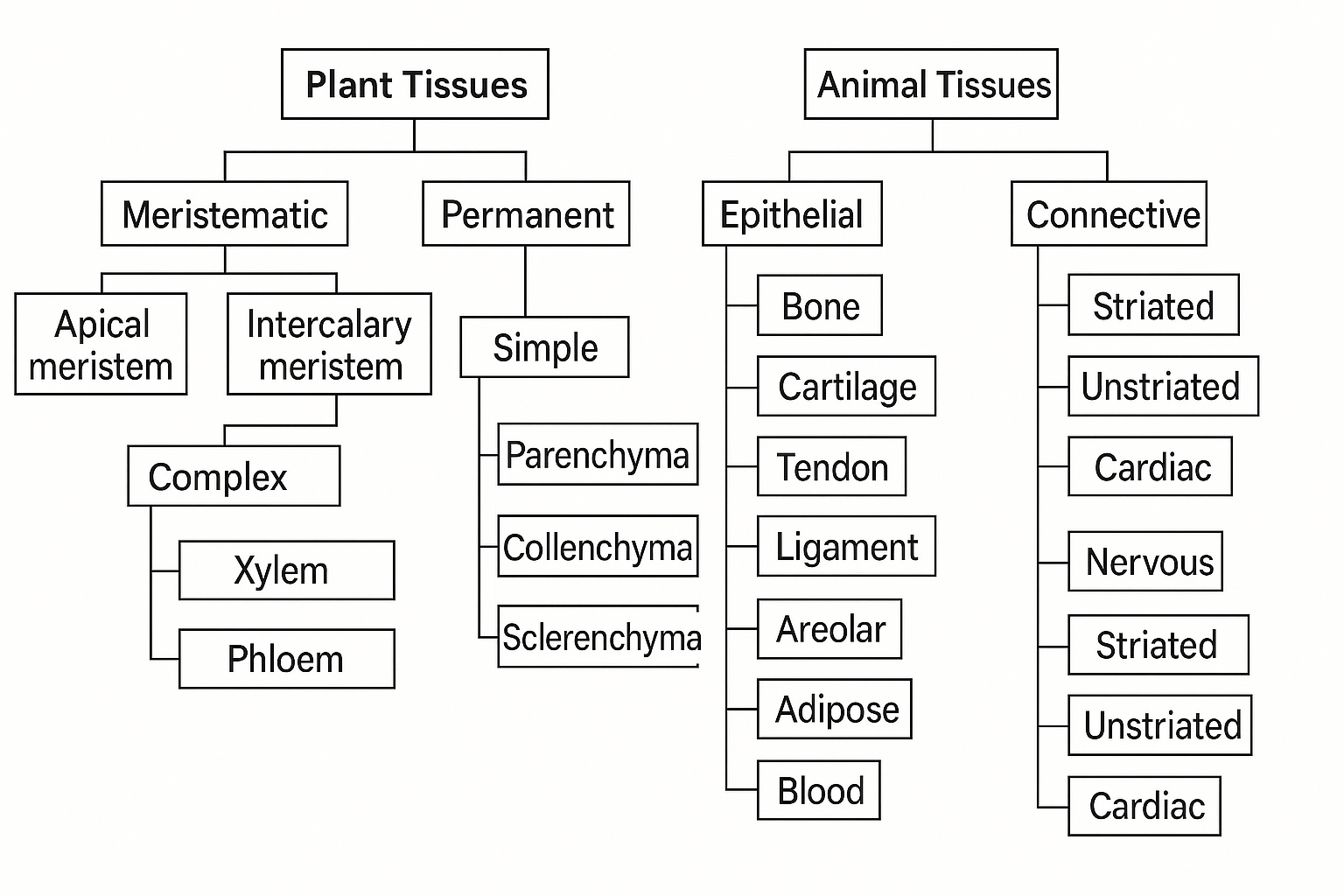
Plant Tissues
Plants are autotrophic and stationary organisms, so their tissues are mainly designed for growth, support, transport, storage, and protection.
Plant tissues are broadly classified into:
- Meristematic Tissue (growth tissues)
- Permanent Tissue (specialized functions)
- Protective Tissue (protection and water conservation)
1. Meristematic Tissue
These are actively dividing tissues responsible for plant growth. Cells are small, thin-walled, and rich in cytoplasm.
Types of Meristems:
- Apical Meristem – Found at the tips of roots and shoots. Increases length (primary growth). Example: new leaves or flowers arise due to apical meristem.
- Intercalary Meristem – Present at nodes or base of leaves. Helps in elongation of stems and leaves. Example: grass grows quickly after being cut because of intercalary meristem.
- Lateral Meristem (Cambium) – Found on the sides of roots and stems. Helps in increasing thickness (secondary growth). Example: wood formation in trees.
2. Permanent Tissue
These tissues are derived from meristems but lose the ability to divide. They become specialized to perform specific functions.
(a) Simple Permanent Tissue (made of one type of cell):
- Parenchyma – Living cells with thin cell walls. Functions: storage of food, photosynthesis (chlorenchyma), and buoyancy (aerenchyma in aquatic plants like lotus).
- Collenchyma – Living cells with uneven thickening at corners. Provides flexibility and mechanical support. Example: present in stems and leaf stalks, allows bending without breaking.
- Sclerenchyma – Dead cells with thick, lignified walls. Provides rigidity and hardness. Example: husk of coconut is sclerenchyma.
(b) Complex Permanent Tissue (made of more than one type of cell):
- Xylem – Transports water and minerals from roots to other parts. Components: tracheids, vessels, xylem parenchyma, xylem fibres. Mostly dead cells (except parenchyma).
- Phloem – Transports food from leaves to other parts (translocation). Components: sieve tubes, companion cells, phloem parenchyma, phloem fibres. Mostly living cells (except fibres).
3. Protective Tissue
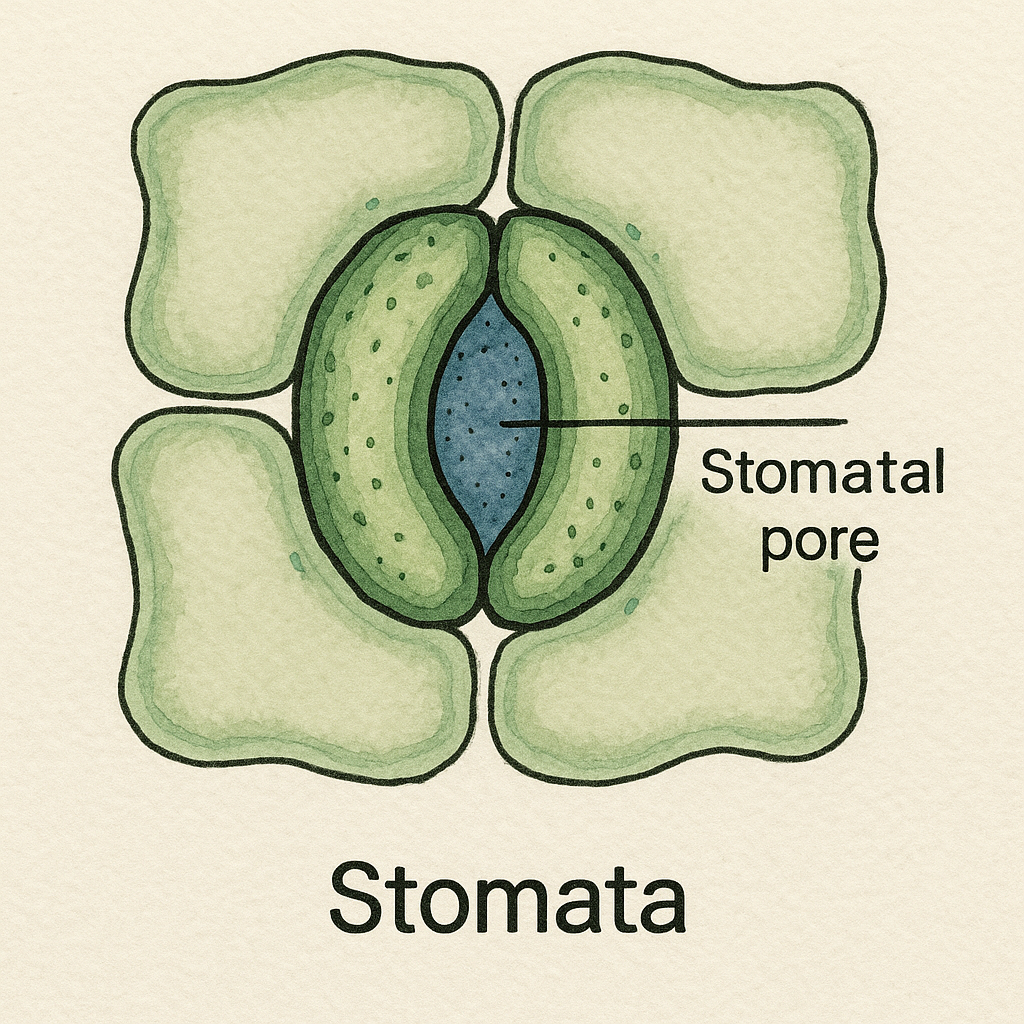
- Epidermis – Outer protective covering. In leaves, it has stomata for gas exchange and transpiration. In roots, it helps absorb water.
- Cork (Phellem) – Replaces epidermis in older stems and roots. Made of dead, suberized cells. Prevents water loss and protects against injury.
Animal Tissues
Animals show greater movement and have complex organ systems. Their tissues are specialized for protection, movement, transport, communication, and storage.
Animal tissues are divided into four main types:
1. Epithelial Tissue – The Covering Tissue
- Covers body surfaces and lines internal organs.
- Cells are tightly packed with minimal intercellular space.
Types of Epithelium:
- Squamous – Flat cells, thin lining (e.g., alveoli in lungs).
- Cuboidal – Cube-shaped (e.g., kidney tubules, glands).
- Columnar – Tall cells, for absorption/secretion (e.g., intestine).
- Ciliated – With cilia, moves substances (e.g., trachea, oviduct).
- Glandular – Specialized for secretion (e.g., sweat glands, salivary glands).
2. Connective Tissue – The Binding Tissue
Joins and supports different parts of the body. Has a large intercellular matrix.
Types of Connective Tissue:
- Bone – Hard matrix of calcium and phosphorus, gives structure.
- Cartilage – Flexible, smooth, at joints, nose, ear.
- Ligaments – Connect bone to bone (strong but flexible).
- Tendons – Connect muscle to bone (strong but less flexible).
- Areolar Tissue – Fills space between organs.
- Adipose Tissue – Stores fat, insulates the body.
- Blood – Fluid connective tissue; transports gases, nutrients, hormones.
3. Muscular Tissue – The Movement Tissue
Muscles help in voluntary and involuntary movements. They can contract and relax.
Types of Muscles:
- Striated (Skeletal Muscle) – Long, cylindrical, multinucleated, with striations. Voluntary, attached to bones, helps in movement.
- Unstriated (Smooth Muscle) – Spindle-shaped, uninucleated, no striations. Involuntary, found in stomach, intestine, blood vessels.
- Cardiac Muscle – Branched, striated, with intercalated discs. Involuntary, found only in heart, contracts rhythmically.
4. Nervous Tissue – The Communication Tissue
- Made of neurons (nerve cells).
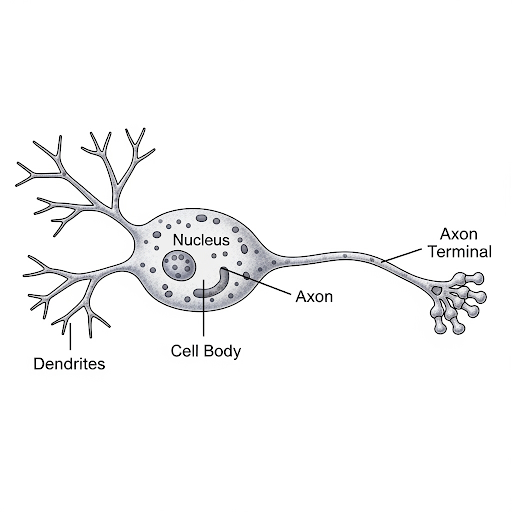
- Each neuron has a cell body, dendrites, and an axon.
- Function: transmits signals between brain, spinal cord, and body parts.
- Location: brain, spinal cord, nerves.
Importance of Tissues in Multicellular Organisms
- Provide division of labour (specialized functions).
- Ensure efficiency in complex processes.
- Help in growth, repair, and coordination.
- Allow higher organisms to survive and adapt.
class 9 science ch 6 tissues – Textbook Answers ( CBSE Old Syllabus Book)
intext question – Page 61
Question 1. What is a tissue?
Answer: A tissue is a group of cells that are similar in structure and work together to perform a specific function in an organism.
For example:
In animals, muscle tissue helps in movement.
In plants, xylem tissue helps in the transport of water.
Question 2. What is the utility of tissues in multicellular organisms?
Answer: In multicellular organisms, tissues provide division of labour. Similar cells group together to form tissues, and each tissue performs a specific function such as transport, protection, support, or movement. This makes the functioning of the organism more efficient and systematic.
Example: Xylem transports water in plants, while muscle tissue helps in movement in animals.
intext question – Page 65
Question 1. Name types of simple tissues.
Answer: The three types of simple tissues in plants are:
- Parenchyma
- Collenchyma
- Sclerenchyma
These are called simple tissues because they are made up of only one type of cell.
Question 2. Where is apical meristem found?
Answer: Apical meristem is found at the tips of roots and shoots in plants.
Its main function is to help in the increase of length of the plant (primary growth).
Question 3. Which tissue makes up the husk of coconut?
Answer: The husk of coconut is made up of sclerenchyma tissue.
These are dead cells with thick, lignified walls that provide hardness and toughness.
Question 4. What are the constituents of phloem?
Answer: The constituents of phloem are:
- Sieve tubes
- Companion cells
- Phloem fibres
- Phloem parenchyma
Together, these tissues help in the transport of food in plants.
Class 9 Science NCERT Textbook – Page 69
Question 1. Name the tissue responsible for movement in our body.
Answer: The tissue responsible for movement in our body is muscular tissue.
It contracts and relaxes to bring about movement.
Question 2. What does a neuron look like?
Answer: A neuron consists of a cell body with a nucleus and cytoplasm, from which long thin hair like parts arise. Each neuron has a single long part called the axon, and many small, short branched parts called dendrite. An individual nerve cell is called neuron, it may be up to a metre long.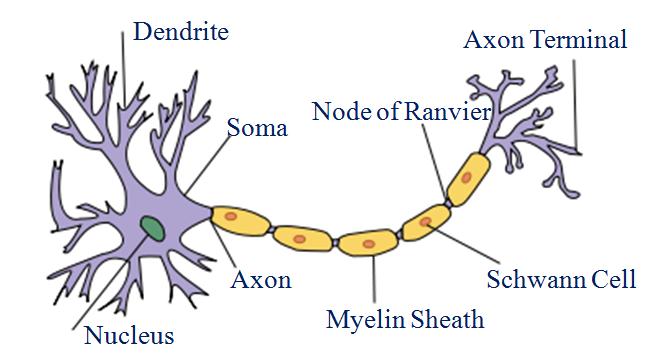
Question 3. Give three features of cardiac muscles.
Answer: Feature of cardiac muscles
(1) Heart muscles (cardiac muscles) are cylindrical, branched and uninucleated
(2) They are striated muscle fibres.
(3) They are involuntary muscles, cannot be controlled by us.
Question 4. What are the Junctions of areolar tissue?
Answer: Areolar tissue are connective tissues found in animal. It is found between skin and muscles, around blood vessels and nerves and in the bone marrow.
It fills the space inside the organs, supports internal organs and helps in the repair of tissues.
Questions From NCERT Textbook for Class 9 Science – Page 70
Question 1. Define the term “tissue”.
Answer: A tissue is a group of similar cells that are organized to perform a specific function efficiently in a multicellular organism.
Example: Xylem tissue in plants transports water, and muscle tissue in animals helps in movement.
Question 2. How many types of elements together make up the xylem tissue? Name them.
Answer: Xylem tissue is made up of four types of elements. They are:
- Tracheids
- Vessels
- Xylem parenchyma
- Xylem fibres
Together, these help in the transport of water and minerals in plants
Question 3. How are simple tissues different from complex tissues in plants?
Answer:
| Feature | Simple Tissue | Complex Tissue |
|---|---|---|
| Cell type | Made up of only one type of cell | Made up of more than one type of cell |
| Function | Performs similar functions | Performs different but related functions |
| Examples | Parenchyma, Collenchyma, Sclerenchyma | Xylem, Phloem |
Question 4. Differentiate between parenchyma, collenchyma and sclerenchyma on the basis of their cell wall.
Answer:
| Tissue | Cell Wall Characteristic |
|---|---|
| Parenchyma | Thin and made up of cellulose |
| Collenchyma | Unevenly thickened at corners due to cellulose and pectin |
| Sclerenchyma | Thick, lignified walls (makes cells hard and rigid) |
Question 5. What are the functions of stomata?
Answer: The main functions of stomata are:
- Exchange of gases – They allow entry of carbon dioxide and release of oxygen during photosynthesis and respiration.
- Transpiration – They help in the loss of water vapour from the plant surface, which also aids in cooling and maintaining water movement.
So, stomata play a vital role in photosynthesis, respiration, and transpiration.
Question 6. Diagrammatically show the difference between the three types of muscle fibres.
Answer:
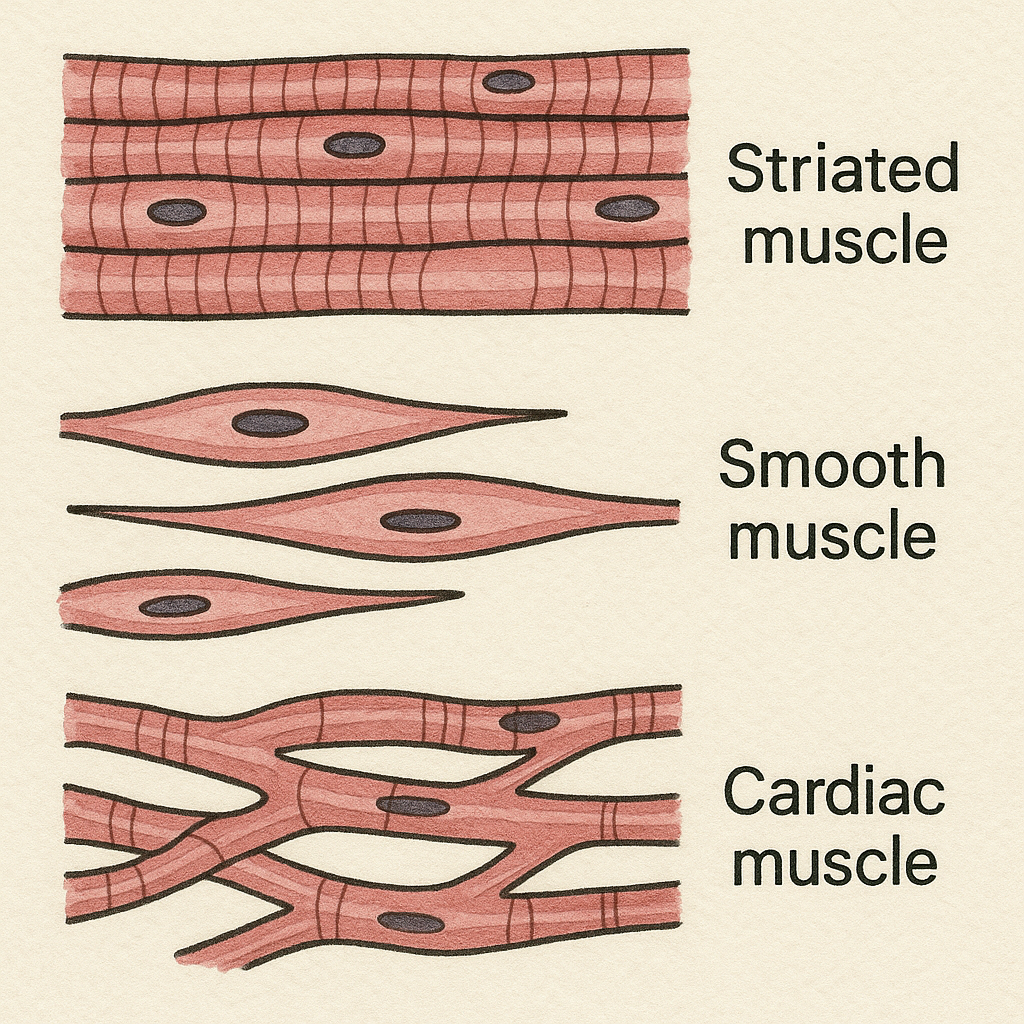
Striated muscles
(1) They are connected to bones (Skeletal muscles).
(2) They are voluntary muscles.
(3) The cells are long, cylindrical with many nucleus and are unbranched.
Smooth muscles
(1) They are found in alimentary canal and lungs.
(2) They are involuntary muscles.
(3) They are spindle in shape and have single nucleus.
Cardiac muscles
(1) They are found in heart.
(2) They are involuntary in action.
(3) They are branched and have one nucleus.
Question 7. What is the specific function of the cardiac muscle?
Answer: (1) Cardiac muscles cells are cylindrical, branched and uninucleated.
(2) They are involuntary muscles.
(3) They show rhythmically contraction and relaxation throughout life.
(4) Their rhythmic contraction and relaxation helps in pumping action of heart.
Question 8. Differentiate between striated, unstriated and cardiac muscles on the basis of their structure and location in the body.
Answer:
| Feature | Striated Muscle | Unstriated Muscle (Smooth) | Cardiac Muscle |
|---|---|---|---|
| Structure | Long, cylindrical, multinucleated, with light and dark bands (striations) | Spindle-shaped, uninucleated, no striations | Cylindrical, branched, uninucleated, with faint striations and intercalated discs |
| Location | Attached to bones (skeletal muscles) | Found in walls of internal organs (stomach, intestine, blood vessels, etc.) | Found only in the walls of the heart |
Question 9. Draw a labelled diagram of neuron.
Answer:
Question 10. Name the following:
(1) Tissue that forms the inner lining of our mouth.
(2) Tissue that connect muscle to bone in humans.
(3) Tissue that trar-carts food in plants.
(4) Tissue that siwea j’ut in our body.
(5) Connective tissue with a fluid matrix.
(6) Tissue present in the brain.
Answer:
- Tissue that forms the inner lining of our mouth → Epithelial tissue
- Tissue that connects muscle to bone in humans → Tendon
- Tissue that transports food in plants → Phloem
- Tissue that joins two bones in our body → Ligament
- Connective tissue with a fluid matrix → Blood
- Tissue present in the brain → Nervous tissue
Question 11. Identify the type of tissue in the following: Skin, bark of tree, bone, lining of kidney tubule, vascular bundle.
Ans:
(a) Skin—Striated squamous epithelium
(b) Bark of tree—Cork, protective tissue
(c) Bone—Connective tissue
(d) Lining of kidney tubule—Cuboidal epithelium tissue
(e) Vascular bundle—Conducting tissue
Question 12. Name the regions in which parenchyma tissue is present.
Answer: Parenchyma tissue is present in the following regions of plants:
- Cortex and pith of stems and roots
- Mesophyll of leaves (palisade and spongy parenchyma)
- Fruits and flowers (as storage tissue)
- In vascular tissues as xylem parenchyma and phloem parenchyma
Thus, parenchyma is the most common and widely distributed plant tissue.
Question 13. What is the role of epidermis in plants?
Answer: The epidermis in plants plays the following roles:
- It forms a protective outer covering of the plant body.
- It prevents water loss by having a waxy layer called cuticle.
- In roots, the epidermis helps in the absorption of water and minerals.
- In leaves, the epidermis contains stomata for exchange of gases and transpiration.
So, the epidermis mainly protects the plant and helps in regulating exchange with the environment.
Question 14. How does the cork act as a protective tissue?
Answer: Cork acts as a protective tissue in plants because:
- Its cells are dead, closely packed, and have walls thickened with suberin, a waterproof substance.
- It is impermeable to water and gases, thus preventing water loss and protecting against infections.
- It forms the outer protective layer of older stems and roots, replacing the epidermis.
Hence, cork protects plants from mechanical injury, water loss, and pathogen attack
📥 Download Worksheet with Answers
Practice the full set of MCQs, short questions, long questions, and diagrams from this chapter. Use the worksheet to test your understanding and check the answer key for self-assessment.
👉 Download Class 9 Science Ch 6 – Tissues Worksheet (PDF)
You can access the official NCERT Solutions for Class 10 Mathematics on the NCERT website at the following link:
NCERT Class 10 Mathematics Solutions
This page will guide you to the textbook and solutions, as provided by the National Council of Educational Research and Training (NCERT).
Class-wise Solutions
Class 12:
Class 12 Physics – NCERT Solutions
Class 12 Chemistry – NCERT Solutions
Class 11:
- Class 11 Physics – NCERT Solutions
- Class 11 Chemistry – NCERT Solutions
- Class 11 Biology – NCERT Solutions
- Class 11 Math – NCERT Solutions
Class 10:
Class 9:
Class 8:
Class 7:
Class 6:
Subject-wise Solutions
Physics:
Chemistry:
Biology:
Math:
- Class 11 Math – NCERT Solutions
- Class 10 Math – NCERT Solutions
- Class 9 Math – NCERT Solutions
- Class 8 Math – NCERT Solutions
Science:
- Class 10 Science – NCERT Solutions
- Class 9 Science – NCERT Solutions
- Class 8 Science – Oxford Solutions
- Class 7 Science – Oxford Solutions
- Class 6 Science – Oxford Solutions