
Linear Inequalities Class 11 NCERT Solutions provides clear and step-by-step answers to all the questions of Chapter 6. This chapter explains the concept of linear inequalities in one variable and two variables, graphical representation, and solution sets. On this page, you will find detailed solutions for every exercise to help you understand the concepts easily and score high in your exams.
Linear Inequalities Class 11 NCERT Solutions
EXERCISE 6.1
1.Solve 24x < 100
24x < 100
x < 100/24
x < 25/6
x < 4.166…
(i) If x is a natural number
Natural numbers: 1, 2, 3, 4, …
So x = 1, 2, 3, 4
(ii) If x is an integer
Integers: …, –2, –1, 0, 1, 2, 3, 4
So x ≤ 4
2. Solve –12x > 30
Divide by –12 (inequality sign changes):
x < –30/12
x < –5/2
x < –2.5
(i) If x is a natural number
No solution (natural numbers are positive)
(ii) If x is an integer
x = …, –5, –4, –3
3. Solve 5x – 3 < 7
5x < 10
x < 2
(i) If x is an integer
x = …, –1, 0, 1
(ii) If x is a real number
x < 2
4. Solve 3x + 8 > 2
3x > –6
x > –2
(i) If x is an integer
x = –1, 0, 1, 2, …
(ii) If x is a real number
x > –2
Solve for real x
- 4x + 3 < 5x + 7
3 – 7 < x
–4 < x
x > –4 - 3x – 7 > 5x – 1
–6 > 2x
x < –3 - 3(x – 1) ≤ 2(x – 3)
3x – 3 ≤ 2x – 6
x ≤ –3 - 3(2 – x) ≥ 2(1 – x)
6 – 3x ≥ 2 – 2x
4 ≥ x
x ≤ 4 - x + x/2 + x/3 < 11
(11x)/6 < 11
11x < 66
x < 6 - x/3 > x/2 + 1
Multiply by 6:
2x > 3x + 6
–x > 6
x < –6 - 3(x – 2)/5 ≤ 5(2 – x)/3
Multiply by 15:
9(x – 2) ≤ 25(2 – x)
9x – 18 ≤ 50 – 25x
34x ≤ 68
x ≤ 2 - (1/2)(3x/5 + 4) ≥ (1/3)(x – 6)
Multiply by 30:
3(3x + 20) ≥ 10(x – 6)
9x + 60 ≥ 10x – 60
120 ≥ x
x ≤ 120 - 2(2x + 3) – 10 < 6(x – 2)
4x + 6 – 10 < 6x – 12
4x – 4 < 6x – 12
8 < 2x
x > 4 - 37 – (3x + 5) ≥ 9x – 8(x – 3)
32 – 3x ≥ x + 24
8 ≥ 4x
x ≤ 2 - x/4 < (5x – 2)/3 – (7x – 3)/5
Multiply by 60:
15x < 100x – 40 – 84x + 36
15x < 16x – 4
x > 4 - (2x – 1)/3 ≥ (3x – 2)/4 – (2 – x)/5
Multiply by 60:
40x – 20 ≥ 45x – 30 – 24 + 12x
40x – 20 ≥ 57x – 54
34 ≥ 17x
x ≤ 2
Exercises 17–20 (with solution intervals)
Solve the inequalities in Exercises 17 to 20 and show the graph of the solution in each case on the number line.
- 3x – 2 < 2x + 1
- 5x – 3 > 3x – 5
- 3(1 – x) < 2(x + 4)
- x/2 ≥ (5x – 2)/3 – (7x – 3)/5
Solution:
- 3x – 2 < 2x + 1
x < 3
(Number line: open circle at 3, shade left) - 5x – 3 ≥ 3x – 5
2x ≥ –2
x ≥ –1
(Number line: closed circle at –1, shade right) - 3(1 – x) < 2(x + 4)
3 – 3x < 2x + 8
–5 < 5x
x > –1
(Open circle at –1, shade right) - x/2 ≥ (5x – 2)/3 – (7x – 3)/5
Multiply by 30:
15x ≥ 50x – 20 – 42x + 18
15x ≥ 8x – 2
7x ≥ –2
x ≥ –2/7
(Closed circle at –2/7, shade right)
Word Problems
21. Ravi obtained 70 and 75 marks in first two unit test. Find the minimum marks he should get in the third test to have an average of at least 60 marks
Solution: Ravi’s marks: 70, 75, x
Average ≥ 60
(70 + 75 + x)/3 ≥ 60
145 + x ≥ 180
x ≥ 35
Minimum marks = 35
22. To receive Grade ‘A’ in a course, one must obtain an average of 90 marks or
more in five examinations (each of 100 marks). If Sunita’s marks in first four
examinations are 87, 92, 94 and 95, find minimum marks that Sunita must obtain
in fiftha examination to get grade ‘A’ in the course
Sunita’s marks: 87, 92, 94, 95, x
Average ≥ 90
(87 + 92 + 94 + 95 + x)/5 ≥ 90
368 + x ≥ 450
x ≥ 82
Minimum marks = 82
23. Find all pairs of consecutive odd positive integers both of which are smaller than
10 such that their sum is more than 11
Possible pairs:
(1,3), (3,5), (5,7), (7,9)
Sum > 11
(1,3) = 4
(3,5) = 8
(5,7) = 12 ✓
(7,9) = 16 ✓
Answer: (5,7) and (7,9)
24. Find all pairs of consecutive even positive integers, both of which are larger than 5 such that their sum is less than 23.
Solution: Consecutive even positive integers > 5
Possible pairs:
(6,8), (8,10), (10,12), (12,14)…
Sum < 23
(6,8) = 14 ✓
(8,10) = 18 ✓
(10,12) = 22 ✓
(12,14) = 26 ✗
Answer: (6,8), (8,10), (10,12)
- The longest side of a triangle is 3 times the shortest side and the third side is 2 cm shorter than the longest side. If the perimeter of the triangle is at least 61 cm, find the minimum length of the shortest side.
Solution: Let the shortest side = x cm
Longest side = 3x
Third side = 3x – 2
Perimeter ≥ 61
x + 3x + (3x – 2) ≥ 61
7x – 2 ≥ 61
7x ≥ 63
x ≥ 9
Now check triangle condition (sum of any two sides > third side):
x + (3x – 2) > 3x
4x – 2 > 3x
x > 2 (satisfied since x ≥ 9)
Thus, the minimum length of the shortest side is:
9 cm
26. A man wants to cut three lengths from a single piece of board of length 91cm. The second length is to be 3cm longer than the shortest and the third length is to be twice as long as the shortest. What are the possible lengths of the shortest board if the third piece is to be at least 5cm longer than the second?
Let the shortest piece = x
Second piece = x + 3
Third piece = 2x
Condition 1 (Total length ≤ 91):
x + (x + 3) + 2x ≤ 91
4x + 3 ≤ 91
4x ≤ 88
x ≤ 22
Condition 2 (Third piece at least 5 cm longer than second):
2x ≥ (x + 3) + 5
2x ≥ x + 8
x ≥ 8
Now combine both conditions:
8 ≤ x ≤ 22
Therefore, the possible lengths of the shortest board are:
8 cm ≤ x ≤ 22 cm
If natural numbers are required:
x = 8, 9, 10, … , 22
Solve the following inequalities graphically in two-dimensional plane
👉 Method for each question:
- Replace inequality sign (<, >, ≤, ≥) with “=” to get the boundary line.
- Draw the straight line.
- Use dotted line for < or > (boundary not included).
- Use solid line for ≤ or ≥ (boundary included).
- Test a point (usually (0,0)) to decide shading.
1.x + y < 5
Boundary line: x + y = 5
Intercepts:
If x = 0 → y = 5
If y = 0 → x = 5
Draw line joining (0,5) and (5,0).
Since sign is “<“, draw dotted line.
Test (0,0):
0 + 0 < 5 → True
Shade region containing origin (below the line).
2. 2x + y ≥ 6
Boundary line: 2x + y = 6
Intercepts:
If x = 0 → y = 6
If y = 0 → x = 3
Draw solid line through (0,6) and (3,0).
Test (0,0):
0 ≥ 6 → False
Shade region not containing origin (above the line).
3. 3x + 4y ≤ 12
Boundary line: 3x + 4y = 12
Intercepts:
If x = 0 → y = 3
If y = 0 → x = 4
Draw solid line through (0,3) and (4,0).
Test (0,0):
0 ≤ 12 → True
Shade region containing origin.
4. y + 8 ≥ 2x
Rewrite:
y ≥ 2x – 8
Boundary line: y = 2x – 8
Intercepts:
If x = 0 → y = –8
If y = 0 → x = 4
Draw solid line.
Test (0,0):
0 ≥ –8 → True
Shade region containing origin (above line).
5. x – y ≤ 2
Rewrite:
y ≥ x – 2
Boundary line: y = x – 2
Draw solid line.
Test (0,0):
0 ≤ 2 → True
Shade region containing origin (above line).
6. 2x – 3y > 6
Boundary line: 2x – 3y = 6
Rewrite:
y = (2x – 6)/3
Intercepts:
If x = 0 → y = –2
If y = 0 → x = 3
Draw dotted line.
Test (0,0):
0 > 6 → False
Shade region not containing origin.
7. –3x + 2y ≥ –6
Boundary line:
–3x + 2y = –6
Rewrite:
2y = 3x – 6
y = (3/2)x – 3
Draw solid line.
Test (0,0):
0 ≥ –6 → True
Shade region containing origin.
8. 3y – 5x < 30
Boundary line:
3y – 5x = 30
Rewrite:
y = (5/3)x + 10
Draw dotted line.
Test (0,0):
0 < 30 → True
Shade region containing origin.
9. y < –2
Boundary line: y = –2
Horizontal line through y = –2
Dotted line (since <).
Shade region below the line.
10. x > –3
Boundary line: x = –3
Vertical line through x = –3
Dotted line (since >).
Shade region to the right of the line.
EXERCISE 6.3
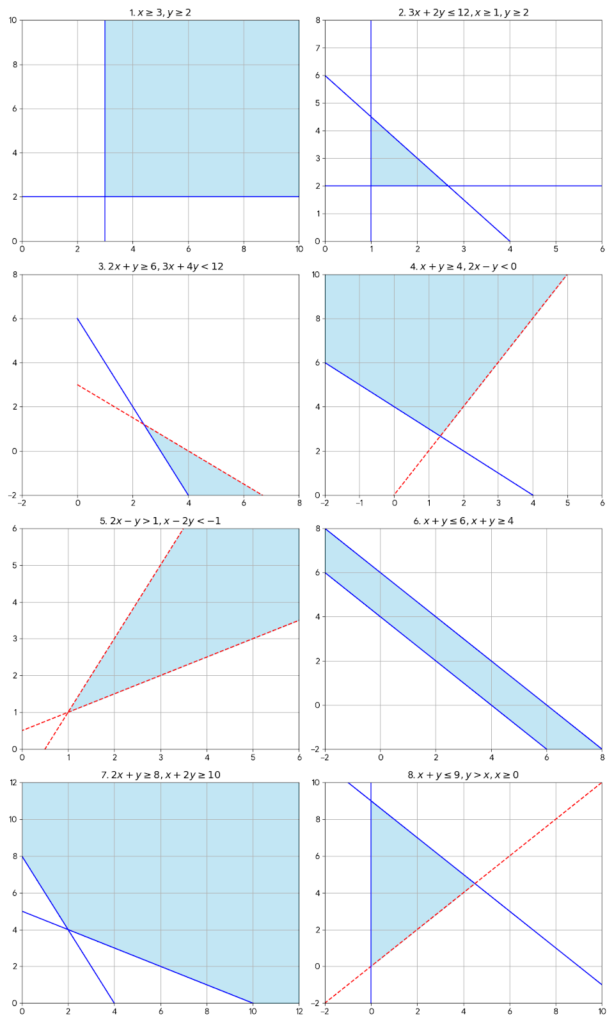
Solve the following system of inequalities graphically:
- x ≥ 3, y ≥ 2 2. 3x + 2y ≤ 12, x ≥ 1, y ≥ 2
- 2x + y ≥ 6, 3x + 4y < 12 4. x + y ≥ 4, 2x – y < 0
- 2x – y >1, x – 2y < – 1 6. x + y ≤ 6, x + y ≥ 4
- 2x + y ≥ 8, x + 2y ≥ 10 8. x + y ≤ 9, y > x, x ≥ 0
- 5x + 4y ≤ 20, x ≥ 1, y ≥ 2
- 3x + 4y ≤ 60, x +3y ≤ 30, x ≥ 0, y ≥ 0
- 2x + y ≥ 4, x + y ≤ 3, 2x – 3y ≤ 6
- x – 2y ≤ 3, 3x + 4y ≥ 12, x ≥ 0 , y ≥ 1
- 4x + 3y ≤ 60, y ≥ 2x, x ≥ 3, x, y ≥ 0
- 3x + 2y ≤ 150, x + 4y ≤ 80, x ≤ 15, y ≥ 0, x ≥ 0
- x + 2y ≤ 10, x + y ≥ 1, x – y ≤ 0, x ≥ 0, y ≥ 0
Answer:
Miscellaneous Exercise – Chapter 6
Solve the inequalities in Exercises 1 to 6.
1.
Add 4 to all parts:
Divide by 3:
2.
Subtract 12:
Divide by
3.
Multiply by 2:
Add 4:
Divide by 3:
4.
Multiply by 5:
Divide by 2:
5.
Multiply by 5:
First inequality:
Second inequality:
6.
Multiply by 2:
Subtract 7:
Divide by 11:
Solve the inequalities in Exercises 7–10 and represent on number line.
7.
8.
First inequality:
Second inequality:
9.
First inequality:
Second inequality:
Common solution:
10.
First inequality:
Second inequality:
Word Problems
11. A solution is to be kept between 68° F and 77° F. What is the range in temperature in degree Celsius (C) if the Celsius / Fahrenheit (F) conversion formula is given by F =9/5C + 32 ?
Subtract 32:
Multiply by
12. A solution of 8% boric acid is to be diluted by adding a 2% boric acid solution to it. The resulting mixture is to be more than 4% but less than 6% boric acid. If we have 640 litres of the 8% solution, how many litres of the 2% solution will have to be added?
Solving gives:
13. How many litres of water will have to be added to 1125 litres of the 45% solution of acid so that the resulting mixture will contain more than 25% but less than 30% acid content?
Solving gives:
14. IQ of a person is given by the formula IQ =MA/CA × 100, where MA is mental age and CA is chronological age. If 80 ≤ IQ ≤ 140 for a group of 12 years old children, find the range of their mental age.
Given For the official Class 11 Physics Solutions, you can visit:
- NCERT Textbooks
Class-wise Solutions
Class 12:
Class 12 Physics – NCERT Solutions
Class 12 Chemistry – NCERT Solutions
Class 11:
- Class 11 Physics – NCERT Solutions
- Class 11 Chemistry – NCERT Solutions
- Class 11 Biology – NCERT Solutions
- Class 11 Math – NCERT Solutions
Class 10:
Class 10 Science – CBSE SQP 2024