
Mastering Light Class 10 numerical problems is essential for scoring high in Physics. In this guide, we provide step-by-step solutions for mirror and lens formulas using the correct sign conventions.
Solved Light Class 10 Numerical Problems (Mirror & Lens)
The Sign Convention (Very Important)
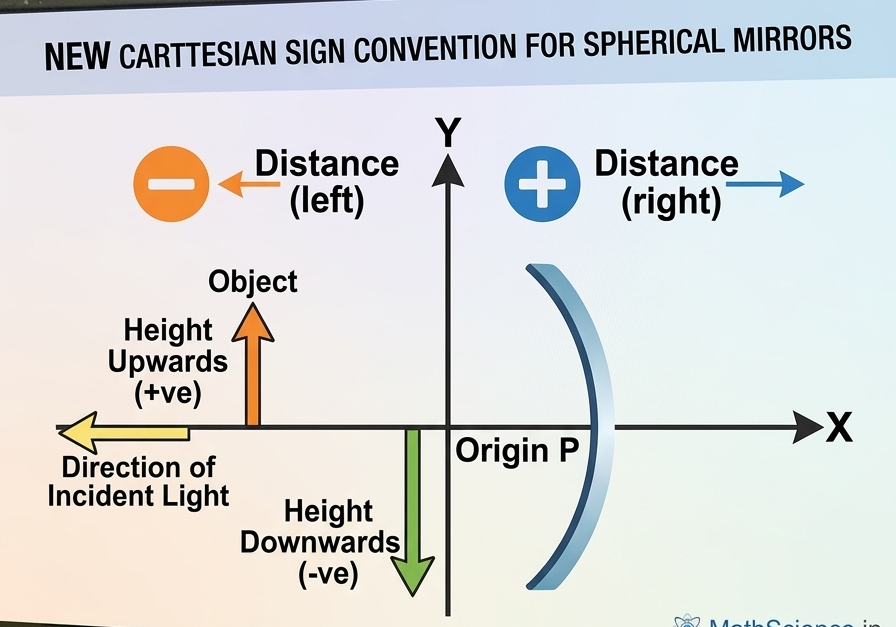
Before solving any numerical, it is essential to understand the New Cartesian Sign Convention:
- All distances are measured from the pole (mirror) or optical center (lens)
- Distances measured in the direction of incident light → Positive (+)
- Distances measured opposite to the direction of light → Negative (−)
- Height above principal axis → Positive (+)
- Height below principal axis → Negative (−)
👉 Tip: Add a diagram here to improve understanding and increase engagement.
Important Formulas
Use these formulas in almost every numerical:
Mirror Formula:
Lens Formula:
Magnification:
- For mirrors:
- For lenses:
Mirror Numerical (Solved Example)
Question:
An object is placed at a distance of 10 cm from a convex mirror. The focal length of the mirror is 15 cm. Find the position of the image.
Solution:
Given:
Object distance,
Focal length, (positive for convex mirror)
Using mirror formula:
Substitute values:
Take LCM:
So,
Final Answer:
The image is formed 6 cm behind the mirror, and it is virtual and erect.
Quick Calculation Trick (Pro Tip)
You can directly use this shortcut formula to save time:
👉 This trick works for quick calculations in exams, but only if you apply the correct sign convention.
1. Concave Mirror (Image Position)
Question:
An object is placed 20 cm in front of a concave mirror of focal length 10 cm. Find the image distance.
Solution:
Using mirror formula:
Answer: Image at 20 cm in front of mirror (real, inverted)
2. Convex Mirror (Magnification)
Question:
An object is placed 15 cm from a convex mirror (f = 10 cm). Find magnification.
Solution:
Answer: Magnification = +0.4 (virtual, erect, diminished)
3. Concave Mirror (Focal Length)
Question:
An image is formed at 30 cm for an object at 15 cm. Find focal length.
Solution:
Answer:
4. Convex Lens (Image Distance)
Question:
Object at 30 cm from convex lens (f = 15 cm). Find image distance.
Solution:
Answer: Image at 30 cm (real, inverted)
5. Convex Lens (Magnification)
Question:
Object at 20 cm, image at 40 cm. Find magnification.
Solution:
Answer: Magnification = −2 (real, inverted, enlarged)
6. Concave Lens (Image Distance)
Question:
Object at 25 cm from concave lens (f = −10 cm). Find image distance.
Solution:
Answer: Image at 7.14 cm (virtual, erect)
7. Convex Lens (Focal Length)
Question:
Object at 10 cm, image at 20 cm. Find focal length.
Solution:
Answer:
8. Concave Mirror (Magnification)
Question:
Object at 15 cm, image at 30 cm. Find magnification.
Solution:
Answer: Magnification = −2 (real, inverted)
9. Convex Mirror (Image Distance)
Question:
Object at 12 cm, focal length 8 cm. Find image position.
Solution:
Answer: Image at 4.8 cm (virtual)
10. Concave Lens (Magnification)
Question:
Object at 30 cm, image at 10 cm. Find magnification.
Solution:
Answer: Magnification = +0.33 (virtual, erect, diminished)
Pro Tip for Students
Always remember:
- Check sign convention first
- Then apply formula
- Then calculate carefully
This simple habit will help you avoid 90% of mistakes in exams.
NCERT TEXTBOOK EXAMPLES | Light Class 10 Numerical Problems
Example 9.1 (Convex Mirror)
Question:
A convex mirror used for rear-view on an automobile has a radius of curvature of 3.00 m. If a bus is located at 5.00 m from this mirror, find the position, nature and size of the image.
Solution:
Radius of curvature,
So,
Object distance,
Using mirror formula:
Magnification:
Answer:
- Image position: 1.15 m behind the mirror
- Nature: Virtual, erect
- Size: Diminished (m = 0.23)
Example 9.2 (Concave Mirror)
Question:
An object, 4.0 cm in size, is placed at 25.0 cm in front of a concave mirror of focal length 15.0 cm. Find image position, nature and size.
Solution:
Magnification:
Image height:
Answer:
- Image position: 37.5 cm in front of mirror
- Nature: Real, inverted
- Size: 6 cm (enlarged)
- Screen should be placed at 37.5 cm
Example 9.3 (Concave Lens)
Question:
A concave lens has focal length of 15 cm. At what distance should the object be placed so that image is formed at 10 cm? Also find magnification.
Solution:
Using lens formula:
Magnification:
Answer:
- Object distance: 30 cm in front of lens
- Magnification: +0.33
- Nature: Virtual, erect, diminished
Example 9.4 (Convex Lens)
Question:
A 2.0 cm tall object is placed 15 cm from a convex lens (f = 10 cm). Find position, nature, size and magnification.
Solution:
Magnification:
Image height:
Answer:
- Image position: 30 cm on opposite side of lens
- Nature: Real, inverted
- Size: 4 cm (enlarged)
- Magnification: −2
Featured Practice Papers & Numerical Solutions
🔹 Class 10
🔹 Class 9
🔹 Class 8
🔹 Class 7
🔹 Class 6
🔹 Class 12
🔹 Class 11
- Class 11 Math Solutions
- Class 11 Physics Solutions
- Class 11 Chemistry Solutions
- Class 11 Biology Solutions
For the official Class 10 Mathematics Solutions, you can visit:
- NCERT Textbooks (for Class 10):