
This chapter introduces the concept of coordinate geometry, which combines algebra and geometry. It helps us locate points on a plane using coordinates (x, y) and understand the geometric properties of shapes.
Students learn to calculate the distance between two points, the midpoint of a line segment, and the area of a triangle formed by given points. These concepts are essential for solving real-life problems involving maps, construction, and design.
Class 10 Math Ch 7 Coordinate Geometry Ex 7.1 – Textbook
Ex 7.1 Class 10 Maths Question 1.
Find the distance between the following pairs of points:
(i) (2, 3), (4, 1)
(ii) (-5, 7), (-1, 3)
(iii) (a, b), (-a, -b)
Solution:
To find the distance between two points (x1,y1)(x_1, y_1)(x1,y1) and (x2,y2)(x_2, y_2)(x2,y2), we use the formula:
Distance = √[(x₂ − x₁)² + (y₂ − y₁)²]
(i) Points: (2, 3) and (4, 1)
Distance = √[(4 − 2)² + (1 − 3)²]
= √[2² + (−2)²]
= √[4 + 4]
= √8
= 2√2
(ii) Points: (−5, 7) and (−1, 3)
Distance = √[(−1 + 5)² + (3 − 7)²]
= √[4² + (−4)²]
= √[16 + 16]
= √32
= 4√2
(iii) Points: (a, b) and (−a, −b)
Distance = √[(−a − a)² + (−b − b)²]
= √[(−2a)² + (−2b)²]
= √[4a² + 4b²]
= √[4(a² + b²)]
= 2√(a² + b²)
Ex 7.1 Class 10 Maths Question 2.
Find the distance between the points (0, 0) and (36, 15).
Solution:
Given points: (0, 0) and (36, 15)
Use the distance formula:
Distance = √[(x₂ − x₁)² + (y₂ − y₁)²]
Distance = √[(36 − 0)² + (15 − 0)²]
= √[36² + 15²]
= √[1296 + 225]
= √1521
= 39
Ex 7.1 Class 10 Maths Question 3.
Determine if the points (1, 5), (2, 3) and (-2, -11) are collinear.
Solution:
Given points:
A(1, 5), B(2, 3), C(−2, −11)
To check if the points are collinear, we find the distances AB, BC, and AC.
If the sum of the lengths of any two sides equals the third, the points are collinear.
Step 1: Find AB
AB = √[(2 − 1)² + (3 − 5)²]
= √[1² + (−2)²]
= √[1 + 4]
= √5
Step 2: Find BC
BC = √[(−2 − 2)² + (−11 − 3)²]
= √[(−4)² + (−14)²]
= √[16 + 196]
= √212
Step 3: Find AC
AC = √[(−2 − 1)² + (−11 − 5)²]
= √[(−3)² + (−16)²]
= √[9 + 256]
= √265
Now check if AB + BC = AC:
AB + BC = √5 + √212 ≠ √265
Since the sum of two distances is not equal to the third, the points are not collinear.
Ex 7.1 Class 10 Maths Question 4.
Check whether (5, -2), (6, 4) and (7, -2) are the vertices of an isosceles triangle.
Solution:
Given points:
A(5, –2), B(6, 4), C(7, –2)
To check if the triangle formed is isosceles, we calculate the lengths of all three sides AB, BC, and AC.
If any two sides are equal, then the triangle is isosceles.
Step 1: AB
AB = √[(6 – 5)² + (4 – (–2))²]
= √[1² + 6²]
= √[1 + 36]
= √37
Step 2: BC
BC = √[(7 – 6)² + (–2 – 4)²]
= √[1² + (–6)²]
= √[1 + 36]
= √37
Step 3: AC
AC = √[(7 – 5)² + (–2 – (–2))²]
= √[2² + 0²]
= √4
= 2
Now compare the sides:
AB = √37
BC = √37
AC = 2
Since AB = BC, two sides are equal.
Final Answer: Yes, the given points form an isosceles triangle.
Ex 7.1 Class 10 Maths Question 5.
In a classroom, 4 friends are seated at the points A, B, C and D as shown in the given figure. Champa and Chameli walk into the class and after observing for a few minutes Champa asks Chameli, “Don’t you think ABCD is a square?” Chameli disagrees. Using distance formula, find which of them is correct.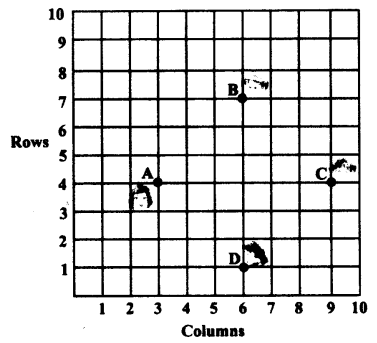
Solution: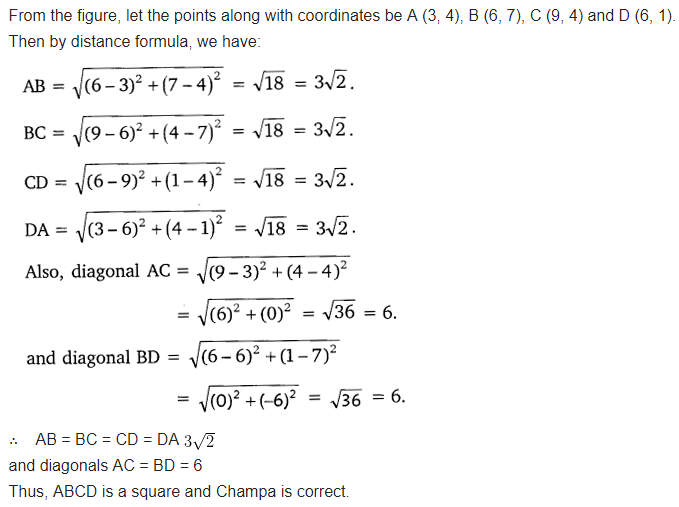
Ex 7.1 Class 10 Maths Question 6.
Name the type of quadrilateral formed, if any, by the following points, and give reasons for your answer.
(i) (-1, -2), (1, 0), (-1, 2), (-3, 0)
(ii) (-3, 5), (3, 1), (0, 3), (-1, -4)
(iii) (4, 5), (7, 6), (4, 3), (1, 2)
Solution:
To identify the type of quadrilateral formed by four given points, we calculate the lengths of all sides and diagonals using the distance formula:
Distance between (x1,y1)(x_1, y_1)(x1,y1) and (x2,y2)(x_2, y_2)(x2,y2) is:
D = √[(x₂ − x₁)² + (y₂ − y₁)²]
(i) Points: (–1, –2), (1, 0), (–1, 2), (–3, 0)
Let A = (–1, –2), B = (1, 0), C = (–1, 2), D = (–3, 0)
AB = √[(1 + 1)² + (0 + 2)²] = √[4 + 4] = √8
BC = √[(–1 – 1)² + (2 – 0)²] = √[4 + 4] = √8
CD = √[(–3 + 1)² + (0 – 2)²] = √[4 + 4] = √8
DA = √[(–3 + 1)² + (0 + 2)²] = √[4 + 4] = √8
AC = √[(–1 + 1)² + (2 + 2)²] = √[0 + 16] = √16 = 4
BD = √[(1 + 3)² + (0 – 0)²] = √[16 + 0] = √16 = 4
All sides are equal and both diagonals are equal.
Therefore, the quadrilateral is a square.
(ii) Points: (–3, 5), (3, 1), (0, 3), (–1, –4)
Let A = (–3, 5), B = (3, 1), C = (0, 3), D = (–1, –4)
AB = √[(3 + 3)² + (1 – 5)²] = √[36 + 16] = √52
BC = √[(0 – 3)² + (3 – 1)²] = √[9 + 4] = √13
CD = √[(–1 – 0)² + (–4 – 3)²] = √[1 + 49] = √50
DA = √[(–1 + 3)² + (–4 – 5)²] = √[4 + 81] = √85
Since all sides are of different lengths and no special conditions are satisfied,
the quadrilateral is an irregular quadrilateral (no special type).
(iii) Points: (4, 5), (7, 6), (4, 3), (1, 2)
Let A = (4, 5), B = (7, 6), C = (4, 3), D = (1, 2)
AB = √[(7 – 4)² + (6 – 5)²] = √[9 + 1] = √10
BC = √[(4 – 7)² + (3 – 6)²] = √[9 + 9] = √18
CD = √[(1 – 4)² + (2 – 3)²] = √[9 + 1] = √10
DA = √[(4 – 1)² + (5 – 2)²] = √[9 + 9] = √18
AB = CD = √10 and BC = DA = √18
Opposite sides are equal in length
Hence, the quadrilateral is a parallelogram.
Ex 7.1 Class 10 Maths Question 7.
Find the point on the x-axis which is equidistant from (2, -5) and (-2, 9).
Solution:
Let the required point on the x-axis be P(x, 0)
Given points: A(2, –5) and B(–2, 9)
P is equidistant from A and B
Distance PA = √[(x – 2)² + (0 + 5)²] = √[(x – 2)² + 25]
Distance PB = √[(x + 2)² + (0 – 9)²] = √[(x + 2)² + 81]
Since PA = PB:
√[(x – 2)² + 25] = √[(x + 2)² + 81]
Squaring both sides:
(x – 2)² + 25 = (x + 2)² + 81
Expanding both sides:
x² – 4x + 4 + 25 = x² + 4x + 4 + 81
x² – 4x + 29 = x² + 4x + 85
Cancel x² from both sides:
–4x + 29 = 4x + 85
–8x = 56
x = –7
Final Answer: (–7, 0)
Ex 7.1 Class 10 Maths Question 8.
Find the values of y for which the distance between the points P (2, -3) and Q (10, y) is 10 units.
Solution:
Given:
Points P(2, –3) and Q(10, y)
Distance between P and Q = 10 units
Use the distance formula:
Distance = √[(x₂ − x₁)² + (y₂ − y₁)²]
So,
√[(10 − 2)² + (y + 3)²] = 10
√[8² + (y + 3)²] = 10
√[64 + (y + 3)²] = 10
Now square both sides:
64 + (y + 3)² = 100
(y + 3)² = 100 – 64
(y + 3)² = 36
Take square root on both sides:
y + 3 = ±6
So,
y + 3 = 6 ⟹ y = 3
y + 3 = –6 ⟹ y = –9
Final Answer: y = 3 or y = –9
Ex 7.1 Class 10 Maths Question 9.
If Q (0, 1) is equidistant from P (5, -3), and R (x, 6), find the values of x. Also, find the distances QR and PR.
Solution:
Given:
Q(0, 1) is equidistant from P(5, –3) and R(x, 6)
So,
Distance PQ = QR
Use the distance formula:
Step 1: Find PQ
PQ = √[(0 – 5)² + (1 + 3)²]
= √[25 + 16]
= √41
Step 2: Find QR
QR = √[(x – 0)² + (6 – 1)²]
= √[x² + 25]
Since PQ = QR:
√41 = √(x² + 25)
Squaring both sides:
41 = x² + 25
x² = 41 – 25
x² = 16
x = ±4
So, x = 4 or x = –4
Step 3: Find QR when x = 4 or –4
QR = √[x² + 25] = √[16 + 25] = √41
PR = Distance between P(5, –3) and R(x, 6)
When x = 4:
PR = √[(4 – 5)² + (6 + 3)²] = √[1 + 81] = √82
When x = –4:
PR = √[(–4 – 5)² + (6 + 3)²] = √[81 + 81] = √162
Ex 7.1 Class 10 Maths Question 10.
Find a relation between x and y such that the point (x, y) is equidistant from the points (3, 6) and (-3, 4).
Solution:
Given:
Point (x, y) is equidistant from (3, 6) and (–3, 4)
Using the distance formula:
√[(x – 3)² + (y – 6)²] = √[(x + 3)² + (y – 4)²]
Squaring both sides:
(x – 3)² + (y – 6)² = (x + 3)² + (y – 4)²
Expanding both sides:
x² – 6x + 9 + y² – 12y + 36 = x² + 6x + 9 + y² – 8y + 16
Simplify both sides:
x² + y² – 6x – 12y + 45 = x² + y² + 6x – 8y + 25
Cancel x² and y²:
–6x – 12y + 45 = 6x – 8y + 25
Bring all terms to one side:
–6x – 12y – 6x + 8y + 45 – 25 = 0
–12x – 4y + 20 = 0
Divide by –1:
12x + 4y – 20 = 0
Now divide the whole equation by 4:
3x + y = 5
Class 10 Maths Coordinate Geometry Mind Maths
Coordinate of a Point in XY – Plane
The Perpendicular distance of x a point from the y-axis is called its x-coordinate or abscissa. The perpendicular distance y of a point from the x-axis is called its y-coordinate or ordinate. The x and y taken together in order is called coordinte of point denoted by (x, y).
The coordinate of the points on x-axis are of the form (x, 0) and the points on the y-axis are of the form(0, y). Coordinate of origin is (0, 0).
Sign-conventions in the XY-Plane
The x and y-axis divide the plane into four parts known as quadrants denoted by I, II, III and IV. The sign of x and y-coordinates in each of the quadrant is shown below: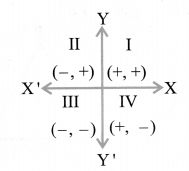
Distance Formula
The distance between any two points
P(x1, y1) and Q(x2, y2) in the plane is given by,
Also the distance of the point P(x1, y1) from the origin is
Section Formula

The coordinates of the point P(x, y) which divides the line segment joining the points A(x1, y1) and B(x2, y2) internally in the ratio m1 : m2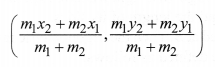
The coordinates of the point P(x, y) which divides the line segment joining the points A(x1, y1) and B(x2, y2) externally in the ratio, m1 : m2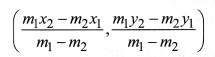
(iii) If the ratio in which P divides AB is K : 1, then the coordinates of the point P will be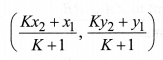
Mid-Point Formula
The coordinates of the mid point P of the line segment joining the points A(x1, y1) and B(x2, y2) is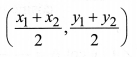
Area of a Triangle
The area of ∆ABC formed by the vertices A(x1, y1), B(x2, y2) is given by
Note:
(i) Area of triangle = 1/2× base × Altitude
(ii) Area of polygon can be calculated by dividing it into the triangular region.
(iii) If three points are collinear then area of the triangle formed by them is zero.
📘 Math & Science Solutions by Class
🔹 Class 10
🔹 Class 9
🔹 Class 8
🔹 Class 7
🔹 Class 6
🔹 Class 12
🔹 Class 11
- Class 11 Math Solutions
- Class 11 Physics Solutions
- Class 11 Chemistry Solutions
- Class 11 Biology Solutions
For the official Class 10 Mathematics Solutions, you can visit:
- NCERT Textbooks (for Class 10):