
Class 11 Physics Mechanical Properties of Solids
question section —
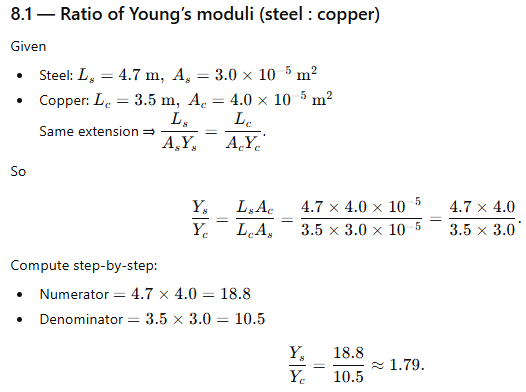
8.1
A steel wire of length 4.7 m and cross-sectional area 3.0×10⁻⁵ m² stretches by the same amount as a copper wire of length 3.5 m and cross-sectional area 4.0×10⁻⁵ m² under a given load.
What is the ratio of Young’s modulus of steel to that of copper?
8.2
Figure 8.9 shows the stress–strain curve for a material.
(a) What is Young’s modulus?
(b) What is the approximate yield strength?
8.3
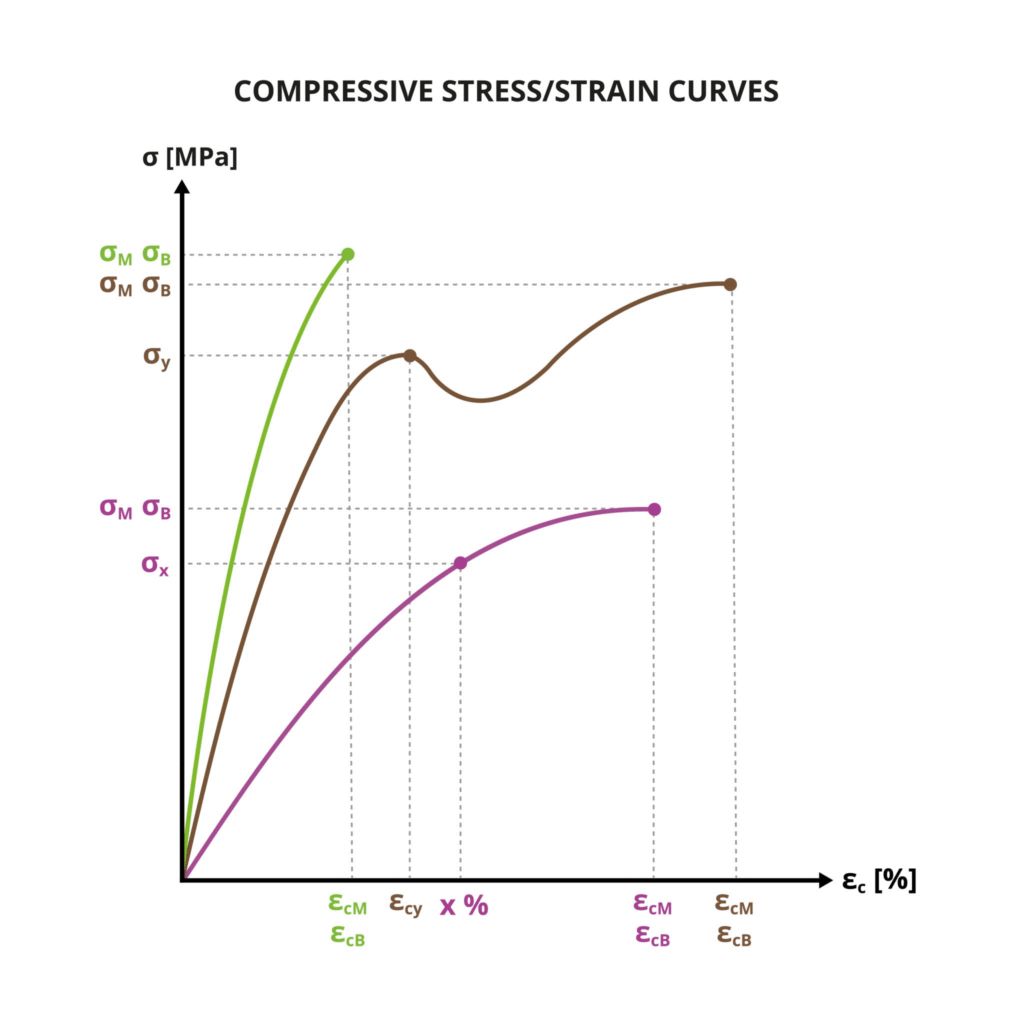
The stress–strain graphs for materials A and B are shown in Fig. 8.10.
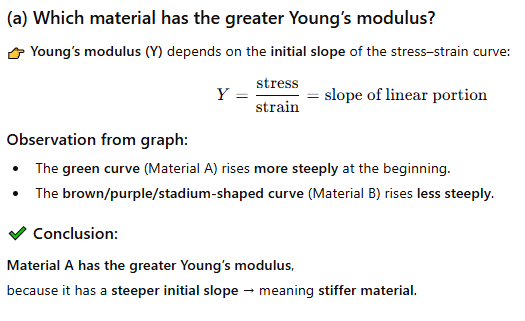
(a) Which material has the greater Young’s modulus?
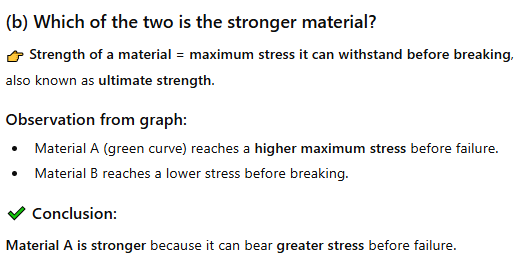
(b) Which material is stronger?
8.4
State whether the statements are true or false, with reasons:
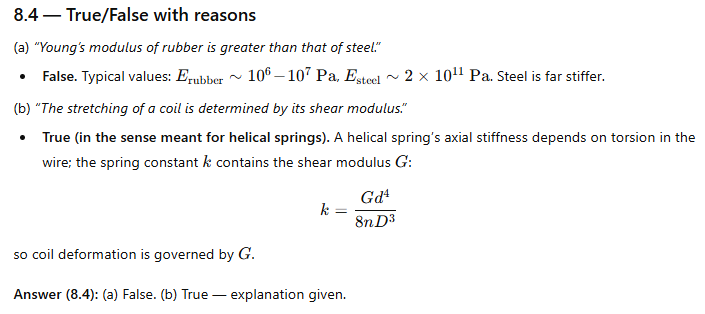
(a) The Young’s modulus of rubber is greater than that of steel.
(b) The stretching of a coil is determined by its shear modulus.
8.5
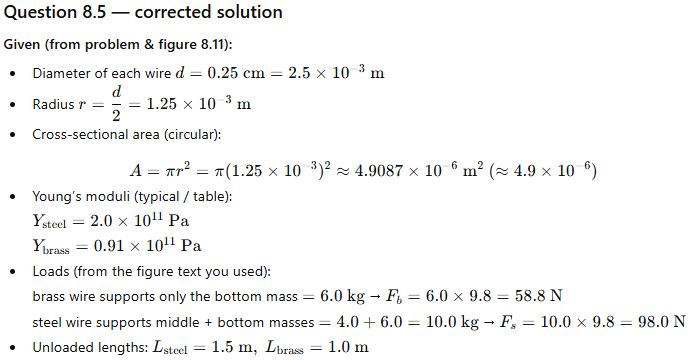
Two wires of diameter 0.25 cm (one steel, one brass) are loaded as in Fig. 8.11.
The unloaded lengths are 1.5 m (steel) and 1.0 m (brass).
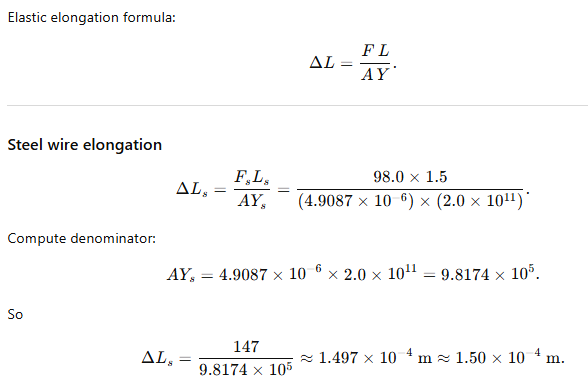
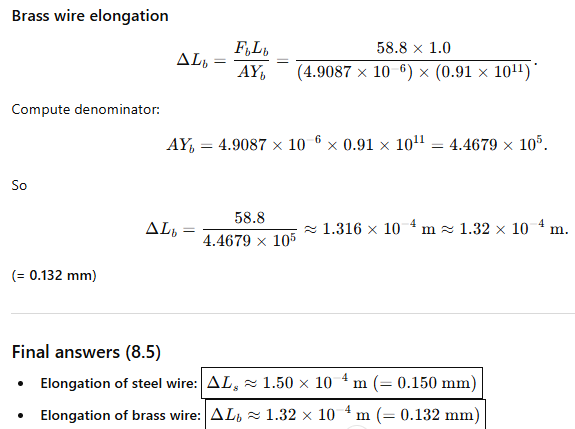
Compute the elongation of each wire.
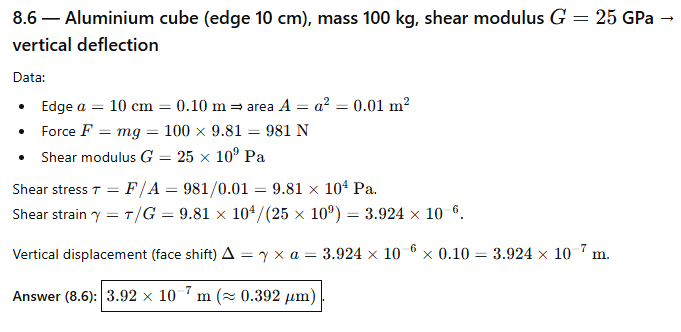
8.6
A 10 cm aluminium cube is fixed on one face. A 100 kg mass is attached to the opposite face.
Given shear modulus = 25 GPa, find the vertical deflection of the cube face.
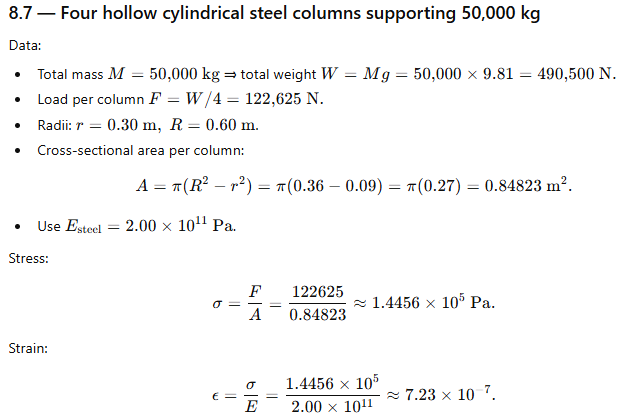
8.7
Four identical hollow steel columns (inner radius 30 cm; outer radius 60 cm) support a 50,000 kg structure.
Find the compressional strain in each column, assuming uniform load.
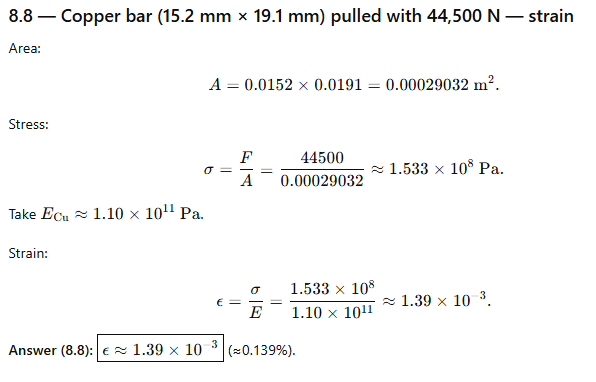
8.8
A copper piece (15.2 mm × 19.1 mm cross-section) is pulled with a 44,500 N force (elastic).
Calculate the resulting strain.
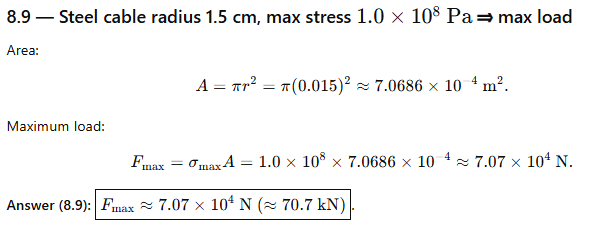
8.9
A steel cable of radius 1.5 cm supports a chairlift.
If maximum stress is 1×10⁸ N/m², find the maximum load the cable can support.
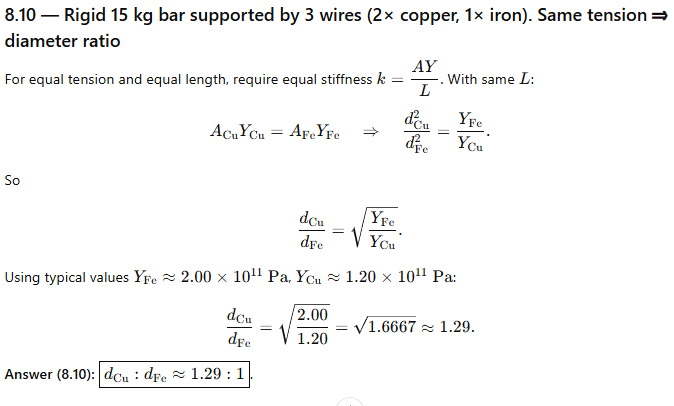
8.10
A 15 kg rigid bar is supported by three 2.0 m wires: copper at each end, iron in the middle.
Determine the ratio of diameters if each wire is to have the same tension.
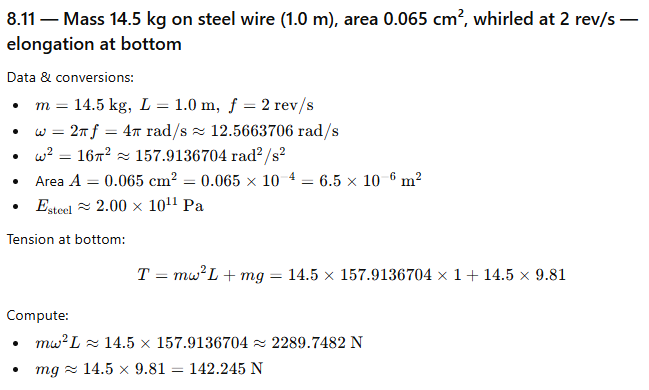
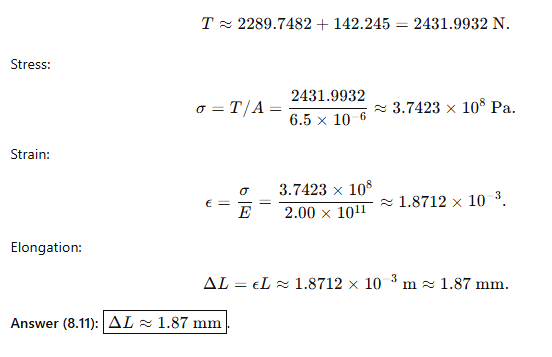
8.11
A 14.5 kg mass attached to a steel wire (1.0 m, 0.065 cm² area) is whirled at 2 rev/s in a vertical circle.
Find the elongation when the mass is at the lowest point.
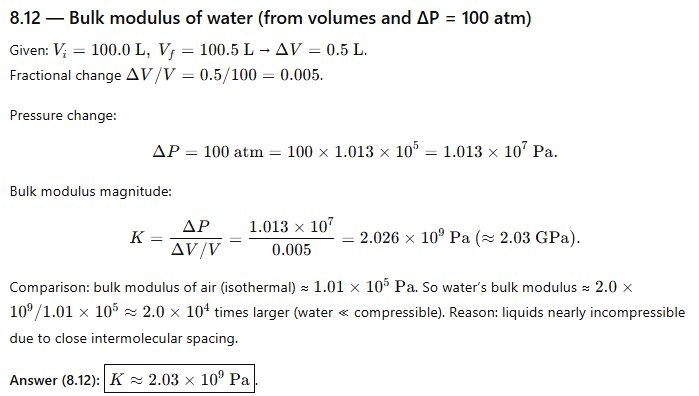
8.12
Compute the bulk modulus of water:
Initial volume = 100 L, Final volume = 100.5 L, Pressure increase = 100 atm.
Compare with air and explain why the ratio is large.
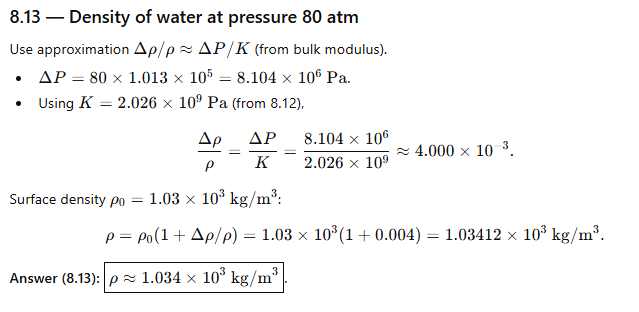
8.13
Find the density of water at a depth where pressure is 80 atm.
Surface density = 1.03 × 10³ kg/m³.
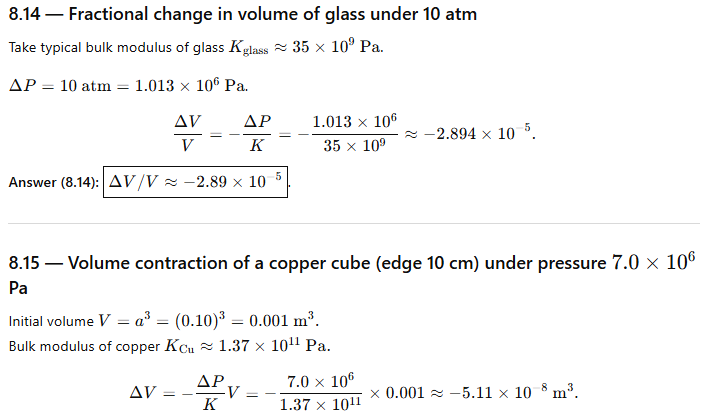
8.14
Compute the fractional change in volume of a glass slab subjected to 10 atm pressure.
8.15
A solid copper cube (10 cm side) is subjected to a pressure of 7×10⁶ Pa.
Find the volume contraction.
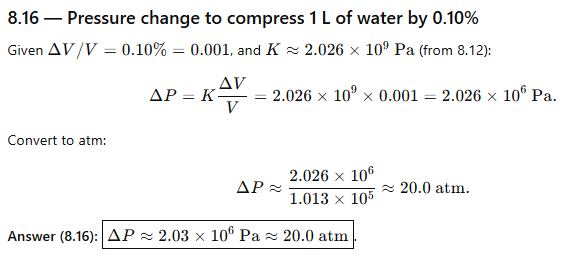
8.16
How much should pressure on 1 L of water be increased to compress it by 0.10%?
8.3 Stress–Strain Comparison Question
The stress–strain curves for two materials, A and B, are shown in Fig. 8.10.
(The graphs are drawn to the same scale.)
(a) Which material has the greater Young’s modulus?
(b) Which of the two materials is the stronger material?
You can access the official NCERT Solutions for Class 11 Mathematics on the NCERT website at the following link:
NCERT Class 11 Mathematics Solutions
Class-wise Solutions
Class 12:
School supplies
Class XII Physics – NCERT Solutions
Class XII Chemistry – NCERT Solutions
Class XI:
- Class XI Physics – NCERT Solutions
- Class XI Chemistry – NCERT Solutions
- Class XI Biology – NCERT Solutions
- Class XI Math – NCERT Solutions
Class 10:
Class 9:
Class 8:
Class 7:
Class 6:
Subject-wise Solutions
Physics:
Chemistry:
Biology:
Math:
- Class 11 Math – NCERT Solutions
- Class 10 Math – NCERT Solutions
- Class 9 Math – NCERT Solutions
- Class 8 Math – NCERT Solutions
Science:
- Class 10 Science – NCERT Solutions
- Class 9 Science – NCERT Solutions
- Class 8 Science – Oxford Solutions
- Class 7 Science – Oxford Solutions
- Class 6 Science – Oxford Solutions

NEET BIOLOGY
- Evolution
- Breathing and Exchange of Gases
- Anatomy of Flowering Plants
- Body Fluids and Circulation
- Human Health and Disease
- Microbes in Human Welfare
- Cell Cycle and Cell Division
- Biotechnology and Its Applications
- Biodiversity and Conservation
- Morphology of Flowering Plants
For the official Mathematics Solutions, you can visit:
- NCERT Textbooks :