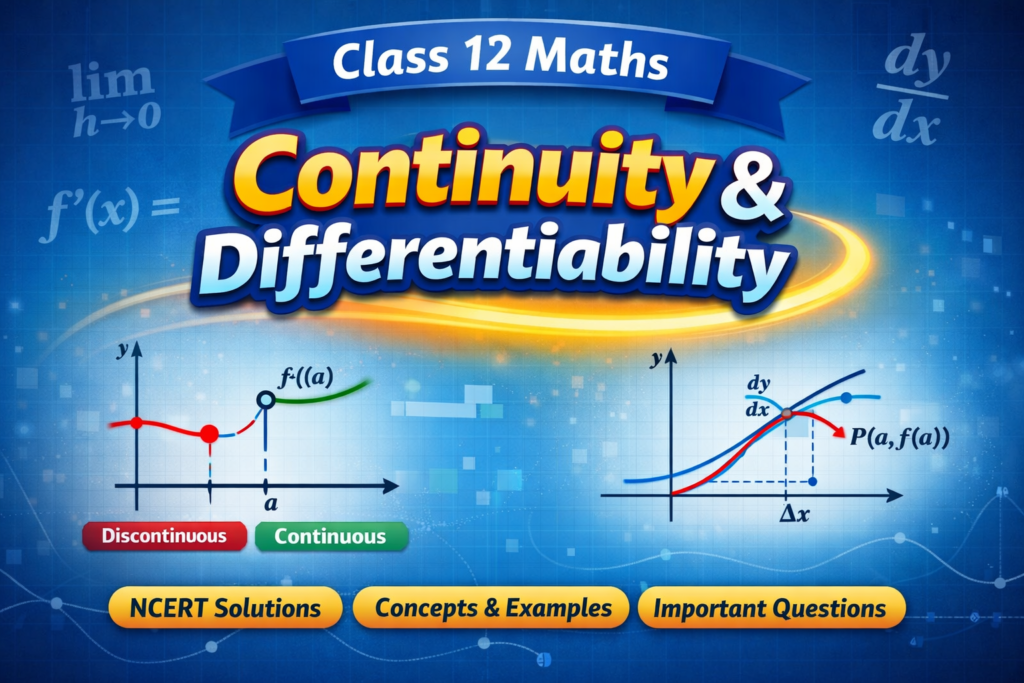
Class 12 Maths Continuity and Differentiability is an important chapter in Class 12 Maths that forms the base of calculus. In this chapter, students learn about continuous functions, differentiability, and their applications. Here, you will find NCERT solutions, solved examples, and important questions explained in a simple and clear way to help you understand concepts and score better in exams.
Class 12 Maths Continuity and Differentiability (Solved Questions)
Q1. Prove that the function f(x)=5x−3 is continuous at x=0,−3 and 5.
Solution:
A function f(x) is continuous at x=a if
L.H.L = R.H.L = f(a)
Given function:
This is a linear polynomial function. We know that all polynomial functions are continuous for all real values of x.
Now checking at given points:
At
L.H.L = R.H.L = -3 ⇒ Continuous
At
L.H.L = R.H.L = -18 ⇒ Continuous
At
L.H.L = R.H.L = 22 ⇒ Continuous
Hence, the function is continuous at x=0,−3 and 5.
Q2. Examine the continuity of the function at x=3
Solution:
Given function:
This is a polynomial function, so it is continuous for all real numbers.
At x=3:
f(3)=2(3)2−1=2(9)−1=18−1=17
L.H.L = R.H.L = 17
Hence, the function is continuous at x=3
Q3. Examine the following functions for continuity
(a) f(x)=x−5
This is a polynomial function.
Polynomial functions are continuous everywhere.
Hence, continuous for all real x.
(b) f(x)=1/x−5, x≠5
This is a rational function.
The denominator becomes zero at , so the function is not defined there.
Hence:
- Continuous for all
- Discontinuous at
(c) f(x)=x2/x+5, x≠−5
This is also a rational function.
Denominator becomes zero at
Hence:
- Continuous for all
- Discontinuous at
(d) f(x)=∣x−5∣
Absolute value functions are continuous for all real values of x.
Even at
L.H.L = R.H.L = 0
Hence, continuous for all real x.
Q4. Prove that the function f(x) = is continuous at x=a, where n is a positive integer.
Solution:
We need to check:
We know that powers of x (like ) are polynomial functions.
All polynomial functions are continuous for all real numbers.
So,
Thus,
L.H.L = R.H.L = f(a)
Hence, f(x) = is continuous at every real number x=a.
Q5.
Is the function fff defined by
continuous at x=0, x=1 and x=2?
Solution:
A function is continuous at if
LHL = RHL = f(a)
At x=0:
Since
f(0) = 0
LHL = RHL = 0 ⇒ Continuous
At x=1
LHL = f(1) = 1
RHL = 5
Since LHL ≠ RHL ⇒ Discontinuous at x=1
At x=2
Since
f(2) = 5
LHL = RHL = 5 ⇒ Continuous
Final Answer:
Continuous at x=0 and x=2
Discontinuous at x=1
Q6.
Find all points of discontinuity of the function
Solution:
Check at
LHL =
RHL =
Since LHL ≠ RHL ⇒ Discontinuous
Final Answer:
Discontinuous at
Q7.
Examine continuity of
Solution:
Check at
LHL =
RHL =
Not equal ⇒ Discontinuous at x=−3
Check at x=3:
LHL =
RHL =
Not equal ⇒ Discontinuous at x=3
Final Answer:
Discontinuous at
Q8.
Examine continuity of
Solution:
For
For
At
LHL = −1
RHL = 1
Not equal ⇒ Discontinuous at x=0
Q9.
Examine continuity of
Solution:
For
For
At
LHL = −1
RHL = 1
Not equal ⇒ Discontinuous at x=0
Q10.
Examine continuity of
Solution:
At
LHL =
RHL =
Equal ⇒ Continuous
Q11.
Examine continuity of
Solution:
At
LHL =
RHL =
Not equal ⇒ Discontinuous at x=2
Q12.
Examine continuity of
Solution:
At
LHL =
RHL = 1
Not equal ⇒ Discontinuous at x=1
Q13.
Is the function defined by
continuous at x=1?
Solution:
At x=1:
LHL =
RHL =
Not equal ⇒ Discontinuous at x=1
Q14.
Discuss the continuity of the function fff, where
Solution:
Check continuity at boundary points and
At x=1:
LHL = 3
RHL = 4
Since LHL ≠ RHL ⇒ Discontinuous at x=1
At x=3:
LHL = 4
RHL = 5
Since LHL ≠ RHL ⇒ Discontinuous at x=3
Final Answer:
Discontinuous at and
Q15.
Discuss the continuity of the function f, where
Solution:
Check at
At x=0
LHL =
RHL = 0
Equal ⇒ Continuous at x=0
At x=1
LHL = 0
RHL =
Not equal ⇒ Discontinuous at x=1
Final Answer:
Continuous at
Discontinuous at
Q16.
Discuss the continuity of the function f, where
Solution:
Check at , x=1
At x=−1:
LHL =
RHL =
Not equal ⇒ Discontinuous at x=−1
At x=1
LHL =
RHL = 2
Not equal ⇒ Discontinuous at x=1
Final Answer:
Discontinuous at
Q17.
Find the relationship between aaa and bbb so that the function fff defined by
is continuous at x=3
Solution:
For continuity at x=3:
LHL = RHL
LHL =
RHL =
Equate:
Divide by 3:
Q18.
For what value of λ is the function
continuous at x=0? Also check continuity at x=1.
Solution:
Continuity at x=0:
LHL =
RHL =
For continuity:
Continuity at x=1:
Since , function becomes , which is a polynomial ⇒ continuous
Final Answer:
Function is continuous at
Q19.
Show that the function g(x)=x−[x]is discontinuous at all integral points.
Solution:
Here [x] is the greatest integer function.
Let x=n, where n is an integer.
LHL =
RHL =
Since LHL ≠ RHL ⇒ Discontinuous at every integer
Final Answer:
Function is discontinuous at all integers
Q20.
Is the function f(x)=x2−sinx+5 continuous at x=π ?
Solution:
All given functions:
- → continuous
- → continuous
Sum/difference of continuous functions is continuous
Hence is continuous everywhere
Final Answer:
Continuous at
Q21.
Discuss the continuity of the following functions:
(a) f(x)=sinx+cosx
Both functions are continuous ⇒ sum is continuous
(b) f(x)=sinx−cosx
Continuous for all real x
Difference of continuous functions
Continuous for all real x
(c) f(x)=sinx⋅cosx
Product of continuous functions
Continuous for all real x
Q22.
Discuss the continuity of cosine, cosecant, secant and cotangent functions.
Solution:
- Cos x → Continuous for all real x
- Cosec x (1/sin x) → Discontinuous where sin x = 0
⇒ - Sec x (1/cos x) → Discontinuous where cos x = 0
⇒ - Cot x (cos x / sin x) → Discontinuous where sin x = 0
⇒
Q23.
Find all points of discontinuity of
Solution:
Check at
LHL =
RHL = undefined (division by zero)
⇒ Discontinuous at x=0
Q24.
Determine whether the function
is continuous.
Solution:
Check at
We know:
So,
Taking limit as x→0:
By sandwich theorem:
Final Answer:
Function is continuous at
Hence continuous everywhere
Q25.
Examine the continuity of the function fff, where
Solution:
Check at f(0)=−1
Since LHL = RHL = f(0),
function is continuous at x=0
Q26.
Find the values of k so that the function f is continuous at the indicated point in Exercises
26 to 29
Solution:
For continuity:
This is not possible.
Final Answer:
No value of makes the function continuous.
Q27.
Find k so that the function is continuous at x=2
Solution:
LHL =
RHL = 3
For continuity:
Q28.
Find k so that the function is continuous at x=π
Solution:
LHL =
RHL =
Q29.
Find k so that the function is continuous at x=5:
Solution:
LHL =
RHL =
Q30.
Find a and b such that the function is continuous:
Solution:
Continuity at
Continuity at
Subtract (1) from (2):
Substitute in (1):
Final Answer:
Class-wise Solutions
Class 12:
Class 12 Physics – NCERT Solutions
Class 11:
- Class 11 Physics – NCERT Solutions
- Class 11 Chemistry – NCERT Solutions
- Class 11 Biology – NCERT Solutions
- Class 11 Math – NCERT Solutions
Class 10:
Class 9:
Class 8:
Class 7:
Class 6:
Subject-wise Solutions
Physics:
Chemistry:
Biology:
Math:
- Class 11 Math – NCERT Solutions
- Class 10 Math – NCERT Solutions
- Class 9 Math – NCERT Solutions
- Class 8 Math – NCERT Solutions
Science:
- Class 10 Science – NCERT Solutions
- Class 9 Science – NCERT Solutions
- Class 8 Science – Oxford Solutions
- Class 7 Science – Oxford Solutions
- Class 6 Science – Oxford Solutions
NEET BIOLOGY
- Evolution
- Breathing and Exchange of Gases
- Anatomy of Flowering Plants
- Body Fluids and Circulation
- Human Health and Disease
- Microbes in Human Welfare
- Cell Cycle and Cell Division
- Biotechnology and Its Applications
- Biodiversity and Conservation
- Morphology of Flowering Plants
For additional reference and to access the official NCERT Class 10 Maths textbook, visit the NCERT website. This will help you understand the concepts covered in Class 12 more effectively.
Visit NCERT Official Website: NCERT Class 12 Maths Book