
Welcome to the ultimate guide on Class 12 Physics Current Electricity. Whether you are preparing for board exams or competitive entrance tests, mastering this core chapter is crucial for scoring well. In this comprehensive breakdown, we will unpack everything from fundamental charge flow to complex network circuits, making the entire syllabus easy to understand and revise.
Class 12 Physics Current Electricity – Complete Summary
1. Electric Current
Electric current is the rate of flow of electric charge through a conductor.
Where:
- = Current (A)
- = Charge (C)
- = Time (s)
SI Unit: Ampere (A)
2. Electromotive Force (EMF)
To maintain a steady current, a closed circuit and an external source are required. The source does work in moving charges from lower to higher potential.
EMF is the work done per unit charge by the source.
Where:
- = EMF
- = Work done
- = Charge
SI Unit: Volt (V)
Note: EMF is not a force. It is the potential difference across the terminals of a source when no current flows.
3. Ohm’s Law
At constant temperature, the current through a conductor is directly proportional to the potential difference across it.
Where:
- = Potential difference
- = Current
- = Resistance
Unit of Resistance:
4. Resistance and Resistivity
The resistance of a conductor depends on its length and cross-sectional area.
Where:
- = Resistance
- = Resistivity
- = Length
- = Area of cross-section
Resistance:
- Increases with length.
- Decreases with area.
Resistivity depends on:
- Nature of material
- Temperature
- Pressure
5. Resistivity of Different Materials
- Metals: to
- Semiconductors: Intermediate resistivity
- Insulators: Extremely high resistivity
Examples:
- Metals: Copper, Silver
- Semiconductors: Silicon, Germanium
- Insulators: Glass, Rubber
6. Charge Carriers
Current may be carried by:
- Electrons in metals.
- Positive and negative ions in electrolytes and ionic crystals.
7. Current Density
Current density is current flowing per unit area normal to the direction of flow.
Where:
- = Current density
- = Number density of charge carriers
- = Charge on each carrier
- = Drift velocity
Current through area :
Unit of Current Density: A m⁻²
8. Drift Velocity
Drift velocity is the average velocity acquired by charge carriers due to an applied electric field.
Where:
- = Electronic charge
- = Electric field
- = Relaxation time
- = Mass of electron
The relation shows that drift velocity is directly proportional to the electric field.
9. Resistivity in Terms of Relaxation Time
Using the drift velocity model:
This shows that resistivity decreases if:
- Number density increases.
- Relaxation time increases.
10. Temperature Coefficient of Resistivity
The temperature coefficient of resistivity (α) is the fractional increase in resistivity per degree rise in temperature.
For metals:
Where:
- = Resistivity at
- = Resistivity at temperature
11. Limitations of Ohm’s Law
Ohm’s law is not a fundamental law of nature.
It fails when:
(a) Current is not proportional to voltage.
(b) The V-I relation depends on the direction of current.
(c) The V-I relation is not unique.
Examples:
- Diodes
- Rectifiers
- GaAs devices
12. Cell with Internal Resistance
A real cell has internal resistance r.
Current supplied by the cell:
Where:
- = EMF of cell
- = External resistance
- = Internal resistance
Terminal voltage:
13. Kirchhoff’s Rules
(a) Junction Rule
At any junction,∑Iin=∑Iout
Basis: Conservation of charge.
(b) Loop Rule
In any closed loop,∑V=0
Basis: Conservation of energy.
14. Wheatstone Bridge
A Wheatstone bridge consists of four resistances.
Balance condition:
R2R1=R4R3
When this condition is satisfied, no current flows through the galvanometer.
Used to determine unknown resistance.
Important Physical Quantities
| Quantity | Symbol | SI Unit |
|---|---|---|
| Electric Current | I | A |
| Charge | Q | C |
| Potential Difference | V | V |
| EMF | ε | V |
| Resistance | R | Ω |
| Resistivity | ρ | Ω m |
| Conductivity | σ | S m⁻¹ |
| Electric Field | E | V m⁻¹ |
| Drift Velocity | vd | m s⁻¹ |
| Relaxation Time | τ | s |
| Current Density | j | A m⁻² |
| Mobility | μ | m² V⁻¹ s⁻¹ |
Points to Ponder
- Current is a scalar quantity, though it has a direction of flow.
- The equation V=IR defines resistance. Ohm’s law states that resistance remains constant and the V-I graph is a straight line.
- All conductors obey Ohm’s law only within a limited range of electric field.
- The motion of electrons consists of:
- Random thermal motion.
- Drift motion due to electric field.
- The relation j=ρv must be applied separately to each type of charge carrier.
- Kirchhoff’s junction rule follows from conservation of charge, while the loop rule follows from conservation of energy.
Class 12 Physics Current Electricity – Exercise Solution
Question 3.1
The storage battery of a car has an emf of 12 V. If the internal resistance of the battery is 0.4 Ω, what is the maximum current that can be drawn from the battery?
Given:
- EMF,
- Internal resistance,
For maximum current, external resistance
Answer: The maximum current that can be drawn from the battery is 30 A.
Question 3.2
A battery of emf 10 V and internal resistance 3 Ω is connected to a resistor. If the current in the circuit is 0.5 A, what is the resistance of the resistor? What is the terminal voltage of the battery when the circuit is closed?
Given:
- EMF,
- Internal resistance,
- Current,
Using:
Resistance of the resistor = 17 Ω
Terminal voltage:
Answer:
- Resistance of resistor = 17 Ω
- Terminal voltage = 8.5 V
Question 3.3
At room temperature (27.0°C) the resistance of a heating element is 100 Ω. What is the temperature of the element if the resistance is found to be 117 Ω, given that the temperature coefficient of the material of the resistor is 1.70×10⁻⁴ ∘C−11.70 \times 10^{-4}\ ^\circ C^{-1}1.70×10⁻⁴ ∘C−1?
Given:
Using:
Answer: The temperature of the heating element is 1027°C.
Question 3.4
A negligibly small current is passed through a wire of length 15 m and uniform cross-section 6.0×10⁻⁷ m26.0 \times 10^{-7}\,m^26.0×10⁻⁷m2, and its resistance is measured to be 5.0 Ω. What is the resistivity of the material at the temperature of the experiment?
Given:
- Length,
- Area,
- Resistance,
Using:
Answer: The resistivity of the material is
Question 3.5
A silver wire has a resistance of 2.1 Ω at 27.5°C, and a resistance of 2.7 Ω at 100°C. Determine the temperature coefficient of resistivity of silver.
Given:
Using:
Answer:
Question 3.6
A heating element using nichrome connected to a 230 V supply draws an initial current of 3.2 A which settles after a few seconds to a steady value of 2.8 A. What is the steady temperature of the heating element if the room temperature is 27.0°C? Temperature coefficient of resistance of nichrome averaged over the temperature range involved is 1.70×10⁻⁴ ∘C−11.70 \times 10^{-4}\ ^\circ C^{-1}1.70×10⁻⁴ ∘C−1.
Given:
- Voltage,
- Initial current,
- Steady current,
- Initial temperature,
Initial resistance:
Final resistance:
Using:
Question 3.7
Determine the current in each branch of the network shown in Fig. 3.20.
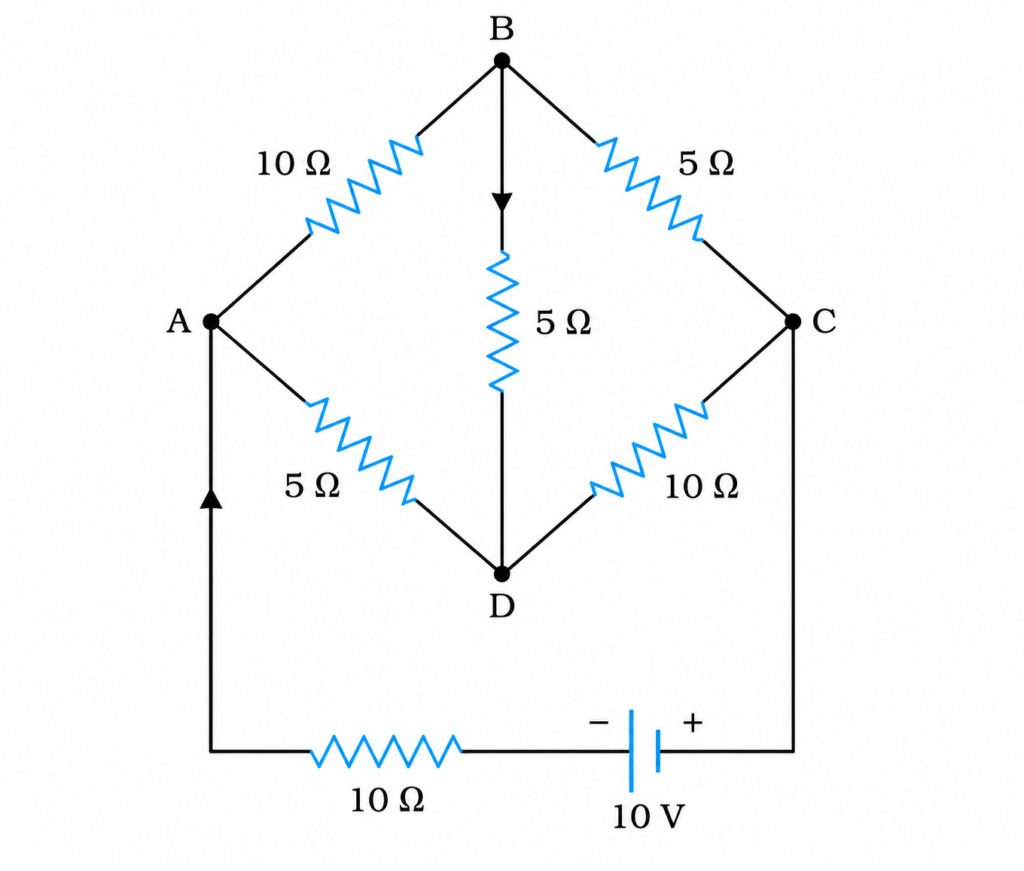
The bridge network between A and C has resistors:
- AB = 10 Ω
- BC = 5 Ω
- AD = 5 Ω
- DC = 10 Ω
- BD = 5 Ω
Using Kirchhoff’s laws, the equivalent resistance of the bridge is:
This is in series with the external 10 Ω resistor.
Total current supplied by the 10 V battery:
Potential difference across the bridge:
Hence,
Current through the middle resistor BD:
Direction: from D to B.
Answer:
- Through 10 Ω (AB): 0.242 A
- Through 5 Ω (AD): 0.353 A
- Through 5 Ω (BC): 0.353 A
- Through 10 Ω (DC): 0.242 A
- Through central 5 Ω (BD): 0.118 A (D → B)
Question 3.8
A storage battery of emf 8.0 V and internal resistance 0.5 Ω is charged by a 12.0 V supply using a series resistance of 15.5 Ω. Find the terminal voltage of the battery during charging. What is the purpose of using a series resistor?
Given:
Charging current:
Terminal voltage during charging:
Answer:
Purpose of series resistor:
To limit the charging current to a safe value and protect the battery from excessive current.
Question 3.9
The number density of free electrons in a copper conductor is 8.5×1028 m−38.5\times10^{28}\,m^{-3}8.5×1028m−3. How long does an electron take to drift from one end of a wire 3.0 m long to its other end? The wire has cross-sectional area 2.0×10⁻⁶ m22.0\times10^{-6}\,m^22.0×10⁻⁶m2 and carries a current of 3.0 A.
Given:
Using
Time taken:
Answer:
For the official site, you can visit:
- NCERT Textbooks :