Boost your Board Exam preparation with the latest Class 12 Sample Question Paper 2024-25 With Answer. We provide official sample papers accompanied by detailed answers and marking schemes to help you master the new exam pattern, improve your time management, and score higher with confidence
SAMPLE QUESTION PAPER
PHYSICS
Subject Code: 042
Class: XII
Academic Session: 2024–25
Time Allowed: 3 Hours
Maximum Marks: 70
GENERAL INSTRUCTIONS
- There are 33 questions in all. All questions are compulsory.
- This question paper consists of five sections A, B, C, D and E.
- All sections are compulsory.
- Section A contains 16 questions of 1 mark each.
- Section B contains 5 questions of 2 marks each.
- Section C contains 7 questions of 3 marks each.
- Section D contains 2 case study based questions of 4 marks each.
- Section E contains 3 long answer questions of 5 marks each.
- Internal choices are provided in some questions. Attempt only one option.
- Use of calculators is not permitted.
SECTION A
(16 x 1 = 16 marks)
Question:
A uniform electric field exists in the positive X-direction. Point A is at the origin, point B lies on the X-axis at cm and point C lies on the Y-axis at cm. Which of the following relations between the electric potentials at A, B and C is correct?
(A)
(B)
(C)
(D)
Answer:
In a uniform electric field directed along the positive X-axis, the electric potential decreases in the direction of the electric field.
Coordinates of the points:
Point A = (0, 0)
Point B = (1 cm, 0)
Point C = (0, 1 cm)
Potential in a uniform electric field depends only on the x-coordinate. Since point B lies in the positive X-direction from A, the potential at B is less than at A. Points A and C have the same x-coordinate, so their potentials are equal.
Therefore,
and
Hence, the correct option is (B)
Q2. Two charged conducting spheres of radii r1 and r2 are connected by a conducting wire. The distance between the spheres is very large compared to their radii. After electrostatic equilibrium is reached, find the ratio of the magnitudes of the electric fields at the surfaces of the two spheres.
The ratio of the magnitudes of the electric fields at the surfaces of the spheres of radii r1 and r2 is

Answer:
When two conducting spheres are connected by a wire, their electric potentials become equal at electrostatic equilibrium.
Potential of a charged sphere:
Let the charges on the spheres be and
Since potentials are equal:
Electric field at the surface of a sphere:
So,
Now take the ratio:Substitute
Final Result:
Q3. A long straight wire of circular cross-section having radius a carries a steady current uniformly distributed over its cross-section. Find the ratio of the magnitudes of the magnetic field at a point located at a distance a/2 above the surface of the wire to that at a point located at a distance a/2 below the surface of the wire.
(A) 4:1 (B) 1:1 (C) 4: 3 (D) 3 :4
Answer:
Radius of the wire =a
Distance of the point above the surface:
Distance of the point below the surface (inside the wire):
Magnetic field outside the wire
For r>a:
Magnetic field inside the wire
For
Ratio
Q4. Diffraction effect can be observed in which of the following types of waves?
(A) sound waves only
(C) ultrasonic waves only
(B) light waves only
(D) sound waves as well as light waves
Answer:
Diffraction is the bending of waves around obstacles or through narrow openings. This phenomenon occurs for all types of waves, including sound waves and light waves.
Sound waves easily show diffraction because their wavelength is large. Light waves also show diffraction when they pass through very small openings or around edges.
Therefore, diffraction can be observed in both sound waves and light waves.
Correct Option: (D) Sound waves as well as light waves.
Q5. A capacitor consists of two parallel plates each having an area of 0.001 square metre separated by a distance of 0.0001 metre. If the potential difference across the plates changes at the rate of 10 to the power 8 volt per second, calculate the displacement current through the capacitor.
- (A) 8.85 ×10⁻³𝐴
- (B) 8.85×10⁻⁴𝐴
- (C) 7.85×10⁻³𝐴
(D) 9.85 × 10⁻³𝐴
Answer:
Displacement current is given by
Since
Therefore,
Given:
Substitute the values:
Final Answer:
Q6. In a series LCR circuit, the voltages across the resistance, capacitance and inductance are each equal to 10 V. If the capacitor is short-circuited, what will be the voltage across the inductance?
- (A) 10 V
- (B) 10√2V
- (C) 10/√2V
- (D) 20 V
Answer:
Given in the series LCR circuit:
Voltage across resistance
Voltage across inductance
Voltage across capacitance
In a series LCR circuit, the supply voltage is
Substitute the values:
So the supply voltage = 10 V.
If the capacitor is short-circuited, the circuit becomes an RL series circuit.
The current in the circuit remains the same because the total impedance remains unchanged.
Thus the voltage across the inductor remains the same as before.
Final Answer:
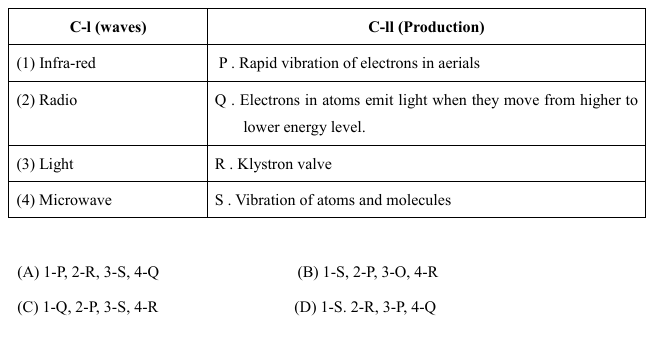
Q7. Match the waves listed in Column I with their methods of production listed in Column II.
Q8. An alpha particle moves towards a nucleus with speed V and has a distance of closest approach equal to d. Another alpha particle is projected with higher energy such that its distance of closest approach becomes d/2. Find the speed of projection of the second alpha particle.
- (A) V /2
- (B) √2V
(C) 2 V
(D) 4 V
Answer:
For an alpha particle approaching a nucleus, the initial kinetic energy is converted into electrostatic potential energy at the distance of closest approach.
Thus,
So,
For the first particle:
For the second particle:
Now,
Correct Option: (B)
Q9. A point object is placed at the centre of a glass sphere of radius 6 cm and refractive index 1.5. Find the distance of the virtual image formed from the surface of the sphere.
(A) 2 cm
(B) 4 cm
(C) 6 cm
(D) 12 cm
Answer:
Radius of the sphere
Refractive index of glass
The object is placed at the centre of the sphere, so the object distance from the surface is
For refraction at a spherical surface:
Where
(glass)
(air)
Substitute the values:
The negative sign indicates a virtual image formed inside the sphere at the centre.
Distance of the image from the surface = 6 cm
Correct Option: (C) 6 cm.
Q10. Colours observed on a CD (Compact Disk) is due to
(A) Reflection (B) Diffraction
(C) Dispersion
(D) 12 cm
Answer:
A CD has very closely spaced spiral tracks on its surface which act like a diffraction grating. When white light falls on the surface of the CD, it undergoes diffraction and interference, separating the light into different colours.
Therefore, the colours seen on a CD are due to diffraction.
Correct Option: (B) Diffraction.
Q11. The number of electrons made available for conduction by dopant atoms in a semiconductor depends strongly on which factors?(A) doping level
(B) increase in ambient temperature
(C) energy gap
(D) options (A) and (B) both
Answer:
The number of electrons available for conduction in a doped semiconductor mainly depends on:
- Doping level – More dopant atoms introduce more free charge carriers.
- Temperature – As temperature increases, more dopant atoms get ionized and release electrons for conduction.
The energy gap mainly affects intrinsic semiconductors rather than the number of electrons provided by dopant atoms.
Therefore, the correct answer is both doping level and temperature.
Correct Option: (D) Options (A) and (B) both.
Q12. A copper wire is stretched so that its radius decreases by 0.1 percent. Find the approximate percentage change in its resistance.
(A) –0.4%
(B) +0.8%
(C) +0.4%
(D) +0.2%
Answer:
Resistance of a wire is
where
If the wire is stretched, volume remains approximately constant:
So,
Since
Given:
Thus,
Now for resistance:
So resistance increases by 0.4%.
Correct Option: (C) +0.4%.
For Questions 13 to 16, Assertion and Reason are given. Choose the correct option.
A. Both Assertion and Reason are true and Reason is the correct explanation.
B. Both Assertion and Reason are true but Reason is not the correct explanation.
C. Assertion is true but Reason is false.
D. Both Assertion and Reason are false.
Q13. Assertion: Increasing the number of turns of a galvanometer coil may not necessarily increase its voltage sensitivity.
Reason: Increasing the number of turns increases the resistance of the galvanometer coil.
Answer:
Voltage sensitivity of a galvanometer is
where
= number of turns,
= magnetic field,
= area of the coil,
= torsional constant,
= resistance of the coil.
If the number of turns n increases, the resistance R of the coil also increases. Since voltage sensitivity is inversely proportional to resistance, the increase in resistance may offset the increase due to n.
Thus, increasing the number of turns may not necessarily increase voltage sensitivity.
- Assertion is true.
- Reason is true and correctly explains the assertion.
Correct Answer:
Both Assertion and Reason are true, and Reason is the correct explanation of the Assertion.
Q14. Assertion: The emission spectrum of hydrogen atom contains many spectral lines.
Reason: In a sample of hydrogen, electrons in different atoms may undergo different transitions between energy levels.
Answer:
The hydrogen atom has many discrete energy levels. When electrons move from higher energy levels to lower energy levels, they emit photons of specific wavelengths, producing spectral lines.
In a hydrogen sample, different electrons in different atoms can make different transitions (for example , , , etc.). Each transition produces a different wavelength, resulting in many spectral lines in the emission spectrum.
Therefore:
- Assertion is true.
- Reason is true and correctly explains the assertion.
Correct Answer:
Both Assertion and Reason are true, and the Reason is the correct explanation of the Assertion.
Q15. Assertion: Nuclei having mass number around 60 are least stable.
Reason: When two or more light nuclei combine to form a heavier nucleus, the binding energy per nucleon decreases.
Answer:
The binding energy per nucleon curve shows that nuclei with mass number around 56–60 (like iron and nickel) have the maximum binding energy per nucleon, which means they are most stable, not least stable.
Also, when light nuclei combine (nuclear fusion), the binding energy per nucleon increases, releasing energy.
Therefore:
- Assertion is false.
- Reason is also false.
Correct Answer: Both Assertion and Reason are false.
Q16. Assertion: The de Broglie wavelength of a freely falling body decreases with time.
Reason: The momentum of the freely falling body increases with time.
Answer:
The de Broglie wavelength is given by
where is Planck’s constant and is the momentum.
For a freely falling body, its velocity increases with time due to gravity, so its momentum p=mvp = mvp=mv also increases with time.
Since wavelength is inversely proportional to momentum, as momentum increases, the de Broglie wavelength decreases.
Therefore:
- Assertion is true.
- Reason is true and correctly explains the assertion.
Correct Answer: Both Assertion and Reason are true, and the Reason is the correct explanation of the Assertion.
SECTION B
(5 x 2 = 10 marks)
Q17. A platinum surface having work function 5.63 eV is illuminated by a monochromatic source of 1.6
x 10 15 Hz. What will be the minimum wavelength associated with the ejected electron.
Answer:
Using Einstein’s photoelectric equation:
where
h=6.63×10⁻³⁴Js
ν=1.6×10¹⁵Hz
ϕ=5.63eV=5.63×1.6×10−19J=9.008×10⁻¹⁹J
First calculate photon energy:
Maximum kinetic energy:
Now using
Electron mass
De Broglie wavelength:
Final Answer:
Q18. (I) A beam of light consisting of two wavelengths, 4000 Å and 6000 Å, is used to obtain
interference fringes in a Young’s double-slit experiment. What is the least distance from the
central maximum where the dark fringe is obtained?
OR
(II) In Young’s double-slit experiment using monochromatic light of wavelength λ, the intensities
of two sources are I. What is the intensity of light at a point where path difference between
wavefronts is λ/4?
Answer:
For a dark fringe in YDSE:
For both wavelengths to give a dark fringe at the same point:
Substitute λ1=4000 Å and λ2=6000 Å:
Left side is even while the right side is odd, which is impossible.
Therefore, no common dark fringe occurs.
Final Answer:
There is no position where a common dark fringe is formed.
OR
Q18 (II) Question:
In Young’s double-slit experiment using monochromatic light of wavelength , the intensities of the two sources are I each. What is the intensity of light at a point where the path difference between wavefronts is ?
Answer:
Resultant intensity formula:
Phase difference:
Since
Final Answer:
Q19. P and Q are two identical charged particles each of mass 4 × 10–26 kg and charge 4.8 × 10⁻¹⁹ C,
each moving with the same speed of 2.4 × 10⁵ m/s as shown in the figure. The two particles are
equidistant (0.5 m) from the vertical Y -axis. At some instant, a magnetic field B is switched on so
that the two particles undergo head-on collision.
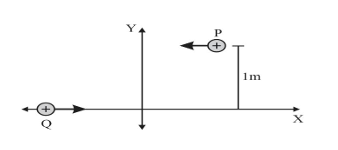
Find –
(I) the direction of the magnetic field and
(II) the magnitude of the magnetic field applied in the region.
Answer
(i) Direction of Magnetic Field
Magnetic force is given by
Both particles are positively charged.
- Particle Q moves along +X direction.
- To make it bend upward toward the centre, the magnetic force must be upward.
Using the right-hand rule:
This happens when the magnetic field is directed into the plane of the paper.
Thus both particles curve toward each other and collide.
Direction of magnetic field: Into the plane of the paper.
(ii) Magnitude of Magnetic Field
In a magnetic field, a charged particle moves in a circular path:
From the geometry of the figure:
- Each particle is 0.5 m from the Y-axis
- They collide at the centre line
- Therefore radius of circular path
Now,
Substitute values:
(for VI candidates)
A proton is moving with speed of 2 x 10⁵ m s–1 enters a uniform magnetic field B = 1.5 T. At the
entry velocity vector makes an angle of 30° to the direction of the magnetic field. Calculate
(a) the pitch of helical path described by the charge
(b) Kinetic energy after completing half of the circle.
Answer
Given:
Charge of proton
Mass of proton
(a) Pitch of the Helical Path
Velocity components:
Parallel to magnetic field:
Perpendicular component:
Time period of circular motion:
Pitch:
(b) Kinetic Energy after Half Circle
Magnetic force does no work, so kinetic energy remains constant.
Initial kinetic energy:
Final Answers
(a) Pitch of helical path
(b) Kinetic energy after half circle
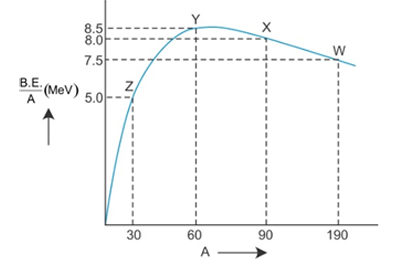
Q.20. Binding energy per nucleon vs mass number curve for nuclei is shown in the figure. W, X, Y and Z
are four nuclei indicated on the curve. Identify which of the following nuclei is most likely to undergo
(i) Nuclear Fission
(ii) Nuclear Fusion.
Justify your answer.
(for V.I. Candidates)
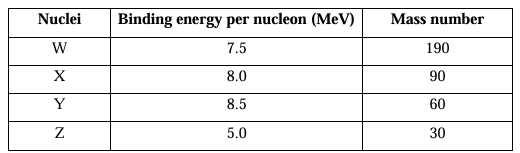
Binding energy per nucleon and mass number of the following nuclei are given in the below table
Q21. A cylindrical conductor of length l and cross-section area A is connected to a DC source. Under the
influence of electric field set up due to source, the free electrons begin to drift in the opposite direction
of the electric field.
(I) Draw the curve showing the dependency of drift velocity on relaxation time.
(II) If the DC source is replaced by a source whose current changes its magnitude with time such
that I = Io sin 2πνt , where ν is the frequency of variation of current, then determine the average drift
velocity of the free electrons over one complete cycle.
SECTION C
(7 x 3 = 21 marks)
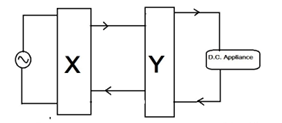
Q22. (I) Identify the circuit elements X and Y as shown in the given block diagram and draw the output
waveforms of X and Y.
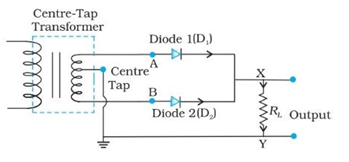
(II) If the centre tapping is shifted towards Diode D1 as shown in the diagram, draw the output
waveform of the given circuit.
(for V.I. candidates)
Which device is used to convert AC into DC. State it’s underlying principle and explain its working. If
the frequency of input AC to this device is 60 Hz, then what will be frequency of the output of this
device.
Q23. Find the expression for the capacitance of a parallel plate capacitor of plate area A and plate separation
d when (I) a dielectric slab of thickness t and (II) a metallic slab of thickness t, where (t < d) are
introduced one by one between the plates of the capacitor. In which case would the capacitance be
more and why?
Answer
(i) Dielectric slab inserted
Let the dielectric constant of the slab be .
When a dielectric slab of thickness t is inserted between the plates, the capacitor behaves like two capacitors in series:
- One region filled with dielectric (thickness )
- Remaining region with air (thickness
Effective separation becomes
Thus capacitance is
(ii) Metallic slab inserted
Inside a metal the electric field is zero, so the potential drop occurs only in the air gaps.
If the metallic slab thickness is t, the effective separation becomes
Therefore capacitance is
Comparison
For dielectric slab:
For metallic slab:
Since
the denominator is smaller for metallic slab, therefore capacitance is larger.
Q24. (I) Draw a ray diagram for the formation of image by a Cassegrain telescope.
(II)Why these types of telescopes are preferred over refracting type telescopes. (Write 2 points)
(for V.I. Candidates)
A Cassegrain telescope is built with an arrangement of two mirrors placing them 20 mm apart. If the radius
of curvature of the large mirror is 200mm and the small mirror is 150mm, where will the final image of an
object at infinity be?
Answer
Step 1: Focal length of the mirrors
For a spherical mirror:
Large mirror (concave):
So the primary mirror would form an image of an object at infinity 100 mm in front of it.
Step 2: Position of secondary mirror
The secondary mirror is 20 mm in front of the primary mirror.
Therefore the image formed by the primary mirror would be
in front of the secondary mirror.
Thus for the secondary mirror
Step 3: Focal length of secondary mirror
For a convex mirror
Step 4: Mirror formula
Q25. (I) Draw the energy band diagram for P-type semiconductor at (i) T=0K and (ii) room temperature.
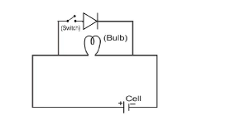
(II)In the given diagram considering an ideal diode, in which condition will the bulb glow
(a) when the switch is open
(b) when the switch is closed
Justify your answer.
(for V.I. Candidates)
Explain briefly how
(i) barrier potential is formed in p-n junction diode.
(ii) Width of depletion region of the diode is affected when it is (a) forward biased, (b) reverse
biased.
Answer
(i) Formation of Barrier Potential
When a p-type semiconductor is joined with an n-type semiconductor, a p–n junction is formed.
- In the p-region, the majority charge carriers are holes.
- In the n-region, the majority charge carriers are electrons.
Due to the concentration difference, electrons diffuse from the n-side to the p-side, and holes diffuse from the p-side to the n-side.
When electrons and holes diffuse across the junction, they recombine with each other near the junction. This leaves behind:
- Positive ions on the n-side
- Negative ions on the p-side
These immobile ions form a charge region called the depletion region. The electric field created by these ions produces a potential difference across the junction, called the barrier potential, which opposes further diffusion of charge carriers.
(ii) Effect on Depletion Region Width(a) Forward Bias
In forward bias:
- p-side is connected to the positive terminal of the battery
- n-side is connected to the negative terminal
Effects:
- External voltage reduces the barrier potential
- Charge carriers move easily across the junction
- Width of the depletion region decreases
(b) Reverse Bias
In reverse bias:
- p-side is connected to the negative terminal
- n-side is connected to the positive terminal
Effects:
- External voltage increases the barrier potential
- Majority carriers are pulled away from the junction
- Width of the depletion region increases
Conclusion
- Barrier potential forms due to diffusion and recombination of electrons and holes at the junction.
- Forward bias → depletion region decreases.
- Reverse bias → depletion region increases.
Q26. A boy is holding a smooth, hollow and non-conducting pipe vertically with charged spherical ball of
mass 10 g carrying a charge of +10 mC inside it which is free to move along the axis of the pipe.
The boy is moving the pipe from East to West direction in the presence of magnetic field of 2T. With
what minimum velocity, should the boy move the pipe such that the ball does not move along the
axis. Also determine the direction of the magnetic field.
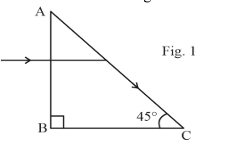
Q27. A light ray entering a right-angled prism undergoes refraction at the face AC as shown in Fig. 1.
(I) What is the refractive index of the material of the prism in
Fig. 1?
(II) (a) If the side AC of the above prism is now surrounded by a liquid of refractive index

shown in Fig. 2,
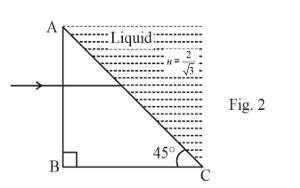
determine if the light ray continues to graze along the interface AC or undergoes
total internal reflection or undergoes refraction into the liquid.
(b) Draw the ray diagram to represent the path followed by the incident ray with the corresponding
angle values.

(for V.I. candidates)
A ray of light is incident on an equilateral prism at an angle 3/4 th of the angle of the prism. If the ray
passes symmetrically through the prism, find the (a) angle of minimum deviation, and (b) refractive index
of the material of the prism.
Q28. (I)State Gauss᾿s theorem in electrostatics. Using this theorem, derive an expression for the electric
field due to an infinitely long straight wire of linear charge density .
OR
(a) Define electric flux and write its SI unit.
(b) Use Gauss᾿s law to obtain the expression for the electric field due to a uniformly charged
infinite plane sheet of charge.
Q28. (I)State Gauss᾿s theorem in electrostatics. Using this theorem, derive an expression for the electric
field due to an infinitely long straight wire of linear charge density .
OR
(II)(a) Define electric flux and write its SI unit.
(b) Use Gauss᾿s law to obtain the expression for the electric field due to a uniformly charged
infinite plane sheet of charge.
SECTION D
(2 x 4 = 8 marks)
Case Study Based Question:
Motion of Charge in Magnetic Field
(02×4=08 marks)
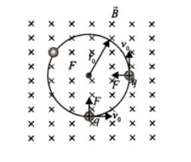
An electron with speed vo << c moves in a circle of radius ro in a uniform magnetic field. This
electron is able to traverse a circular path as the magnetic force acting on the electron is
perpendicular to both vo and B ,as shown in the figure. This force continuously deflects the
particle sideways without changing its speed and the particle will move along a circle
perpendicular to the field. The time required for one revolution of the electron is To
(i) If the speed of the electron is now doubled to 2vo. The radius of the circle will change to
(A) 4ro
(B) 2 ro
(C) ro
(D) ro/2
(ii) If v = 2vo, then the time required for one revolution of the electron (To ) will change to
(A) 4 To
(B) 2 To
(C) To
(D) To/2
(iii) A charged particle is projected in a magnetic field B = (2 i + 4 j) X 102 T . The acceleration of the
particle is found to be a = ( x i + 2 j ) m/s2 . Find the value of x.
(A) 4 ms-2
(B) -4 ms-2
(C) -2 ms-2
(D) 2 ms-2
(iv) If the given electron has a velocity not perpendicular to B, then trajectory of the electron is
(A) straight line
(B) circular
(C) helical
OR
(D) zig-zag
If this electron of charge (e) is moving parallel to uniform magnetic field with constant velocity v, the
force acting on the electron is
(A) Bev
(B) Be/v
(C) B/ev
Q30. Case Study Based Question: Photoelectric effect
It is the phenomenon of emission of electrons from a metallic surface when light of a suitable frequency
is incident on it. The emitted electrons are called photoelectrons.
Nearly all metals exhibit this effect with ultraviolet light but alkali metals like lithium, sodium,
potassium, cesium etc. show this effect even with visible light. It is an instantaneous process i.e.
photoelectrons are emitted as soon as the light is incident on the metal surface. The number of
photoelectrons emitted per second is directly proportional to the intensity of the incident radiation. The
maximum kinetic energy of the photoelectrons emitted from a given metal surface is independent of
the intensity of the incident light and depends only on the frequency of the incident light. For a given
metal surface there is a certain minimum value of the frequency of the incident light below which
emission of photoelectrons does not occur.
(I) In a photoelectric experiment plate current is plotted against anode potential.
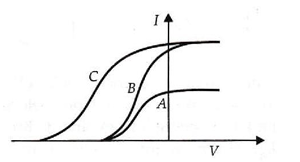
(A) A and B will have same intensities while B and C will have different frequencies
(B) B and C will have different intensities while A and B will have different frequencies
(C) A and B will have different intensities while B and C will have equal frequencies
(D) B and C will have equal intensities while A and B will have same frequencies.
(II) Photoelectrons are emitted when a zinc plate is
(A) Heated
(C) Irradiated by ultraviolet light
(B) hammered
(D) subjected to a high pressure
(III) The threshold frequency for photoelectric effect on sodium corresponds to a wavelength of 500 nm.
Its work function is about
(A) 4×10⁻¹⁹ J
(B) 1 J
(C)2×10⁻¹⁹ J
(D) 3×10⁻¹⁹ J
(IV) The maximum kinetic energy of photoelectrons emitted from a surface when photons of energy 6 eV
fall on it is 4 eV. The stopping potential is
(A) 2 V
(B) 4 V
(C) 6 V
(D) 10 V
OR
The minimum energy required to remove an electron from a substance is called its
(A) work function
(B) kinetic energy (C) stopping potential (D) potential energy
[SECTION E]
Q31. (I) a) Write two limitations of ohm’s law. Plot their I-V characteristics.(03X5=15)
b) A heating element connected across a battery of 100 V having an internal resistance of 1 Ω
draws an initial current of 10 A at room temperature 20.0 °C which settles after a few seconds to a
steady value. What is the power consumed by battery itself after the steady temperature of 320.0 °C
is attained? Temperature coefficient of resistance averaged over the temperature range involved is
3.70 × 10⁻⁴ °C–1.
OR
(II) a) Using Kirchhoff’᾿s laws obtain the equation of the balanced state in Wheatstone bridge.
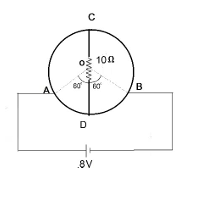
b) A wire of uniform cross-section and resistance of 12 ohm is bent in the shape of circle as
shown in the figure. A resistance of 10 ohms is connected to diametrically opposite ends C
and D. A battery of emf 8V is connected between A and B. Determine the current flowing
through arm AD.
(for V.I. Candidates)
(II) a) Using Kirchhoff’᾿s laws obtain the equation of the balanced state in Wheatstone bridge.
b) What do you understand by ‘sensitivity of Wheatstone bridge’ ? How the sensitivity of wheatstone
bridge can be increased?
Q32. (I) Explain briefly, with the help of a labelled diagram, the basic principle of the working of an a.c.
generator. In an a.c. generator, coil of N turns and area A is rotated at an angular velocity ω in a
uniform magnetic field B. Derive an expression for the instantaneous value of the emf induced
in coil. What is the source of energy generation in this device?
OR
(II) a) With the help of a diagram, explain the principle of a device which changes a low ac voltage
into a high voltage . Deduce the expression for the ratio of secondary voltage to the primary
voltage in terms of the ratio of the number of turns of primary and secondary winding. For an
ideal transformer, obtain the ratio of primary and secondary currents in terms of the ratio of
the voltages in the secondary and primary coils.
b) Write any two sources of the energy losses which occur in actual transformers.
c) A step-up transformer converts a low input voltage into a high output voltage. Does it violate
law of conservation of energy? Explain.
Q33. (I) a) A giant refracting telescope at an observatory has an objective lens of focal length 15 m. If an
eyepiece of focal length 1.0 cm is used, what is angular magnification of the telescope in
normal adjustment?
b) If this telescope is used to view the moon, what is the diameter of the image of the moon formed
by the objective lens? The diameter of the moon is 3.48 × 10⁶ m, and the radius of lunar orbit
is 3.8 × 10⁸ m.
OR
(II) A compound microscope consists of an objective lens of focal length 2.0 cm and an eyepiece of
focal length 6.25 cm separated by a distance of 15 cm. How far from the objective should an object
be placed in order to obtain the final image at
a) the least distance of distinct vision (25 cm) and
b) infinity? What is the magnifying power of the microscope in each case?

Math & Science Solutions by Class
Class 10
Class 9
Class 8
Class 7
Class 6
- Class 6 Math Solutions
- Class 6 Science SolutionsClass 12
- Class 12 Math Solutions
- Class 12 Physics Solutions
Class 11
- Class 11 Math Solutions
- Class 11 Physics Solutions
- Class 11 Chemistry Solutions
- Class 11 Biology Solutions
Learn more about circle formulas from NCERT.
Class-wise Solutions
Class 12:
Class 12 Physics – NCERT Solutions
Class 12 Chemistry – NCERT Solutions
Class 11:
- Class 11 Physics – NCERT Solutions
- Class 11 Chemistry – NCERT Solutions
- Class 11 Biology – NCERT Solutions
- Class 11 Math – NCERT Solutions
Class 10:
Class 9:
Class 8:
Class 7:
Class 6:
Subject-wise Solutions
Physics:
Chemistry:
Biology:
Math:
- Class 11 Math – NCERT Solutions
- Class 10 Math – NCERT Solutions
- Class 9 Math – NCERT Solutions
- Class 8 Math – NCERT Solutions
Science:
- Class 10 Science – NCERT Solutions
- Class 9 Science – NCERT Solutions
- Class 8 Science – Oxford Solutions
- Class 7 Science – Oxford Solutions
- Class 6 Science – Oxford Solutions