
Forests are called the lifeline of our planet because they provide us with oxygen, food, medicines, and raw materials while maintaining ecological balance. In Class 7 Science Chapter Forest: Our Lifeline (Oxford Solution),
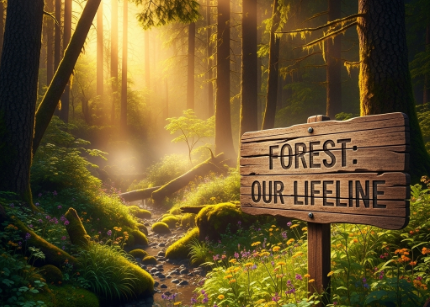
we explore the importance of forests, their role in supporting wildlife, and the need for their conservation. This chapter also explains how forests influence rainfall, soil fertility, and the survival of living beings. Studying this topic helps us understand why protecting forests is essential for our future.
Class 7 Science Chapter Forest Our Lifeline Oxford Textbook Solve
I. Objective Type Questions
A. Fill in the blanks with the correct words.
- Roots of trees help to bind soil together and prevent its erosion.
- Animals are called consumers because they depend on plants and other animals for their food.
- Trees help to regulate the climate of a place.
- Food web is a complex representation of energy flow in nature.
- Forests play a vital role in releasing large amounts of oxygen in the air.
B. Choose the correct option.
- Which of these affects the type of trees and animals found in a forest?
- d. All of these (Climate, topography, and soil type all influence the types of organisms that can thrive in an area.)
- Which of these are timber-based industries?
- a. Paper, pulp and cardboard
- Which of these is a producer in a food chain?
- c. Green plants (Green plants are producers because they make their own food through photosynthesis.)
- Which of these gives us Ayurvedic medicines?
- a. Eucalyptus, amla and cinchona
- Which of these does deforestation lead to?
- d. All of these (Deforestation causes flooding, soil erosion, and global warming.)
- Which forest layer is a shaded layer where the available light is low?
- b. Understory
- Which of these do trees help in?
- d. All of these (Trees help control soil erosion, regulate climate, and provide essential products.)
- Which of these fibers do we not get from plants?
- d. None of these (Cotton, jute, flax, ramie, and hemp are all plant fibers.)
- In a food chain, what are bacteria and fungi referred to as?
- c. Decomposers
- Which of these can help in conserving forests?
- d. All of these (Afforestation, planned cultivation, and preventing illegal logging all contribute to forest conservation.)
II. Very Short Answer Type Questions
Give two examples for the following.
- Trees that give us timber:
- Teak
- Sal
- Things made from resins:
- Varnish
- Lac
- Animals that depend on forests for shelter:
- Monkeys
- Tigers
- Common pollinators:
- Bees
- Butterflies
- Natural disasters commonly caused by deforestation:
- Landslides
- Floods
III. Short Answer Type Questions
Q. How do trees help in regulating the climate of a place?
Answer:
Trees play an important role in regulating the climate of a place in the following ways:
- They release water vapour through transpiration, which cools the surrounding air.
- They absorb carbon dioxide during photosynthesis, which reduces the greenhouse effect and helps in controlling global warming.
- They provide shade, which lowers the ground temperature and keeps the surroundings cool.
Q. What is a biotic community?
Answer:
A biotic community is a group of interdependent living organisms such as plants, animals, and microorganisms that live together and interact with each other in the same environment.
Q. What role do coconut and palm trees play in providing protection in coastal areas?
Answer:
Coconut and palm trees have strong, fibrous root systems that hold the soil firmly together. This prevents soil erosion and protects coastal areas from the destructive effects of waves, storms, and tsunamis. Thus, they act as natural barriers in coastal regions
IV. Long Answer Type Questions
Q. What would happen if forests disappeared?
Answer:
If forests disappeared, it would have several catastrophic effects:
- Climate Change – Removal of trees would increase carbon dioxide in the atmosphere, leading to global warming.
- Loss of Biodiversity – Many species of plants, animals, and insects would lose their habitats, causing mass extinctions.
- Soil Erosion and Flooding – Without tree roots to hold the soil, it would be washed away by rain, leading to landslides and floods.
- Water Cycle Disruption – Forests play a major role in rainfall. Their disappearance would reduce rainfall and cause droughts.
- Economic and Social Impact – Industries depending on forest products would collapse, and communities relying on forests for livelihood would suffer.
Q. Explain some measures that can help us conserve our forests.
Answer:
Some important measures to conserve forests are:
- Afforestation and Reforestation – Planting trees in new areas (afforestation) and replanting trees in deforested areas (reforestation).
- Controlled Logging – Practising selective logging where only mature or damaged trees are cut, to maintain forest health.
- Preventing Illegal Logging and Poaching – Enforcing strict laws to stop illegal cutting of trees and hunting of animals.
- Creating Protected Areas – Establishing national parks, biosphere reserves, and wildlife sanctuaries to preserve biodiversity.
- Promoting Public Awareness – Educating people about the importance of forests and encouraging responsible use of forest resources.
Q. What is a food chain and a food web? Illustrate the difference with examples.
Answer:
- Food Chain:
A food chain is a simple, straight sequence that shows how energy is transferred from one organism to another through food. It follows a single pathway. Example: Grass → Deer → Tiger
(Grass, the producer, is eaten by deer, the primary consumer, which is eaten by tiger, the secondary consumer.) - Food Web:
A food web is a complex network of interconnected food chains that shows multiple feeding relationships within an ecosystem. It provides a more realistic picture of energy flow. Example: In a forest food web, a tiger may eat deer or wild boar. The deer may eat grass, shrubs, or tree leaves. Many such chains overlap to form a food web.
Difference: A food chain shows only one pathway of energy flow, while a food web shows many interconnected pathways.
Class-wise Solutions
Class 12:
Class 12 Physics – NCERT Solutions
Class 12 Chemistry – NCERT Solutions
Class 11:
- Class 11 Physics – NCERT Solutions
- Class 11 Chemistry – NCERT Solutions
- Class 11 Biology – NCERT Solutions
- Class 11 Math – NCERT Solutions
Class 10:
Class 9:
Class 8:
Class 7:
Class 6:
Subject-wise Solutions
Physics:
Chemistry:
Biology:
Math:
- Class 11 Math – NCERT Solutions
- Class 10 Math – NCERT Solutions
- Class 9 Math – NCERT Solutions
- Class 8 Math – NCERT Solutions
Science:
- Class 10 Science – NCERT Solutions
- Class 9 Science – NCERT Solutions
- Class 8 Science – Oxford Solutions
- Class 7 Science – Oxford Solutions
- Class 6 Science – Oxford Solutions
NEET BIOLOGY
- Evolution
- Breathing and Exchange of Gases
- Anatomy of Flowering Plants
- Body Fluids and Circulation
- Human Health and Disease
- Microbes in Human Welfare
- Cell Cycle and Cell Division
- Biotechnology and Its Applications
- Biodiversity and Conservation
- Morphology of Flowering Plants
You can access the official NCERT Solutions for Class 10 Mathematics on the NCERT website at the following link:
NCERT Class 10 Mathematics Solutions
Forests are very important for maintaining the balance of nature as they provide oxygen, food, shelter, and raw materials. Studying Class 7 Science Chapter Forest Our Lifeline Oxford Book Answers helps us understand the role of forests in our life. By going through Class 7 Science Chapter Forest Our Lifeline Oxford Book Answers, students learn how forests support biodiversity and conserve soil and water.
Reading Class 7 Science Chapter Forest Our Lifeline Oxford Book Answers also makes us aware of the need to conserve forests for future generations. Overall, Class 7 Science Chapter Forest Our Lifeline Oxford Book Answers teaches us that forests are truly the lifeline of Earth. The exercises from Class 7 Science Chapter Forest Our Lifeline Oxford Book Answers further strengthen our knowledge of this topic. Thus, by carefully studying Class 7 Science Chapter Forest Our Lifeline Oxford Book Answers, students can build awareness about protecting the environment.