
Welcome to the complete solutions guide for Class 7 Science Chapter Time and Motion Oxford Solutions aligned with CBSE standards. This chapter introduces students to fundamental concepts of time, speed, motion, and their interrelationships.
Our step-by-step solutions are designed to simplify complex ideas, clarify doubts, and strengthen understanding—helping students prepare effectively for exams. Whether you’re a student, parent, or teacher, these solutions will serve as a reliable companion in mastering this important science topic.
Class 7 Science Chapter Time and Motion Oxford Textbook Answers
I. Objective type questions
A. Fill in the blanks with the correct words.
- A water clock and a sand clock are two examples of ancient (modern/ancient) clocks.
- A sundial works only in the day (day/night).
- In a pendulum, the greater the length of the string, the greater (greater/lesser) is the time period.
II. Multiple Choice Questions
B. Choose the correct option.
- Which of these does not measure time?
- a. Timer
- b. Stopwatch
- c. Measuring tape
- d. Wrist watch
Answer: c. Measuring tape
Reason: A timer, stopwatch, and wrist watch all measure time. A measuring tape is used to measure length or distance.
2. What does one hour equals to?
- a. 60 seconds
- b. 60 weeks
- c. 3600 minutes
- d. 3600 seconds
Answer: d. 3600 seconds
Reason: One hour is equal to 60 minutes, and each minute has 60 seconds.
Therefore, 60minutes×60seconds/minute=3600seconds.
3. Which of these is not related to a pendulum?
- a. Bob
- b. String
- c. Time period
- d. Sundial
Answer: d. Sundial
Reason: A pendulum is a device with a bob (mass) suspended by a string, which swings with a specific time period. A sundial is a time-telling device that uses the sun’s shadow.
4. In which unit is the time period of a pendulum measured?
- a. Days
- b. Metres per second
- c. Seconds
- d. Years
Answer: c. Seconds
Reason: The time period of a pendulum is the time it takes to complete one oscillation, and time is measured in units of seconds.
5. Which of these is correct for a body in uniform motion?
- a. It covers equal distances in unequal intervals of time
- b. It covers unequal distances in equal intervals of time
- c. It covers equal distances in equal intervals of time
- d. Both a and c
Answer: c. It covers equal distances in equal intervals of time
Reason: By definition, uniform motion is when an object travels equal distances in equal intervals of time.
6. What is a sundial used for?
- a. Steering a car
- b. Dialling a telephone number
- c. Measuring time
- d. Measuring speed
Answer: c. Measuring time
Reason: A sundial is an ancient instrument used to measure time based on the position of the sun.
7. What does an hour glass use to measure time?
- a. The angle of the sun
- b. The to and fro motion of a pendulum
- c. The amount of sand streaming down
- d. The angle of the moon
Answer: c. The amount of sand streaming down
Reason: An hourglass measures time by the flow of a fixed amount of sand from one bulb to the other.
8. Under the influence of which of the following does the bob of a pendulum swing?
- a. Time
- b. Gravity
- c. Daylight
- d. Periodic motion
Answer: b. Gravity
Reason: Gravity is the force that pulls the bob of a pendulum back towards its equilibrium position, causing the swinging motion.
9. How much are ten decades equal to?
- a. One millennium
- b. One century
- c. Ten centuries
- d. Ten years
Answer: b. One century
Reason: A decade is 10 years, so ten decades are equal to 10×10=100 years, which is one century.
10. What does the time period of a simple pendulum depend on?
- a. The time of the day
- b. The length of the string
- c. The mass of the bob
- d. The size of the bob
Answer: b. The length of the string
Reason: The time period of a simple pendulum is primarily dependent on the length of its string and the acceleration due to gravity. It does not depend on the mass or size of the bob.
III. Very short answer type questions
Give two examples for the following.
- Units of time smaller than an hour
- Second
- Minute
- Time-measuring instruments in earlier times
- Sundial
- Water clock
- Modern time-measuring instruments
- Digital watch
- Quartz clock
- Factors on which the time period of a pendulum depends
- Length of the string
- Acceleration due to gravity
- Factors on which the time period of a pendulum does not depend
- Mass of the bob
- Amplitude of the oscillation
IV. Short answer type questions
1.What is periodic motion?
Ans: Periodic motion is a motion that repeats itself after equal intervals of time. An example is the motion of a pendulum or the Earth’s revolution around the sun.
2. Name the following.
a) Instrument for measuring speed in an automobile:
Ans: Speedometer.
b) Instrument for measuring distance travelled in an automobile:
Ans: Odometer.
3. What is the time period of a pendulum?
Ans: The time period of a pendulum is the time it takes for one complete back-and-forth swing, or oscillation.
4. What is one oscillation of a pendulum?
Ans: One oscillation is a complete to-and-fro motion of the pendulum bob from one extreme position to the other and back to the starting point.
5. What is average speed?
Ans: Average speed is the total distance an object travels divided by the total time it takes to travel that distance.
V. Long answer type questions
1. Why is the measurement of time important to us?
Ans: The measurement of time is very important to us for several everyday and scientific reasons:
Scientific Experiments: Measuring time is necessary to record how long an event takes. For example, finding out how much time a simple pendulum takes to complete one oscillation.
Following a Daily Routine: We need to measure time to organize our daily activities. It tells us when to wake up, when to go to school, when to eat, and when to sleep.
Agriculture and Seasons: By measuring time in days, months, and years, we can track the changing of seasons. This is essential for farmers to know exactly when to sow seeds and harvest crops.
Measuring Speed and Motion: In physics, we need time to find out how fast or slow an object is moving. For example, to calculate the speed of a car, we need to know the distance it traveled and the time it took to cover that distance.
2. How did people in earlier days measure time using the following?
Ans: Sundial: A sundial uses the shadow cast by a vertical rod (gnomon) on a calibrated dial to indicate the time of day. The position and length of the shadow change as the sun moves across the sky.
Hourglass: An hourglass consists of two glass bulbs connected by a narrow neck, containing a specific amount of sand. Time is measured by the amount of time it takes for all the sand to flow from the upper bulb to the lower one.
3. Describe an activity to demonstrate the constancy of the time period of a pendulum.
Ans: Activity: Constancy of a Pendulum’s Time Period
Materials: A metal ball (bob), a 1-meter string, a stand, and a stopwatch.
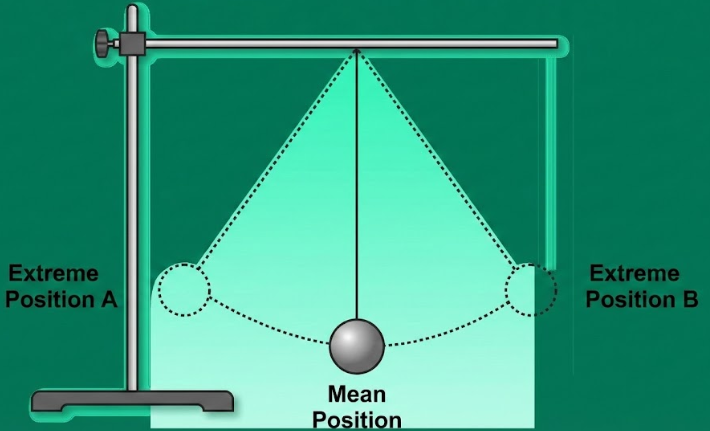
Steps:
- Hang the bob from the stand using the string so it can swing freely.
- Pull the bob slightly to one side and let it go.
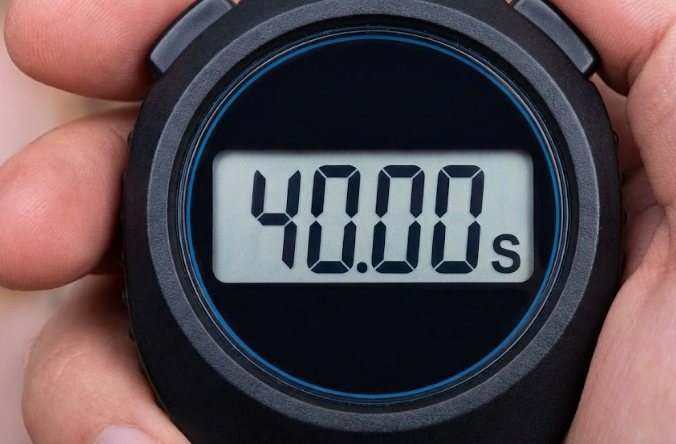
- Use the stopwatch to measure the total time it takes to complete exactly 20 full swings (oscillations).
- Divide this total time by 20 to find the time for just one swing (this is the Time Period).
- Repeat the experiment a few more times. Pull the bob back a slightly different amount each time, but do not change the length of the string.
Observation: You will see that the time taken to complete 20 swings is exactly the same in every trial.
Conclusion: This proves that the time period of a simple pendulum remains constant as long as the length of the string stays the same.
4. What is a distance-time graph? How can we find the speed of an object from its distance-time graph?
Ans: A distance-time graph is a visual representation of how the distance traveled by an object changes over time.
- The horizontal axis (x-axis) represents Time.
- The vertical axis (y-axis) represents Distance.
If the graph is a straight line, it means the object is moving at a constant speed.
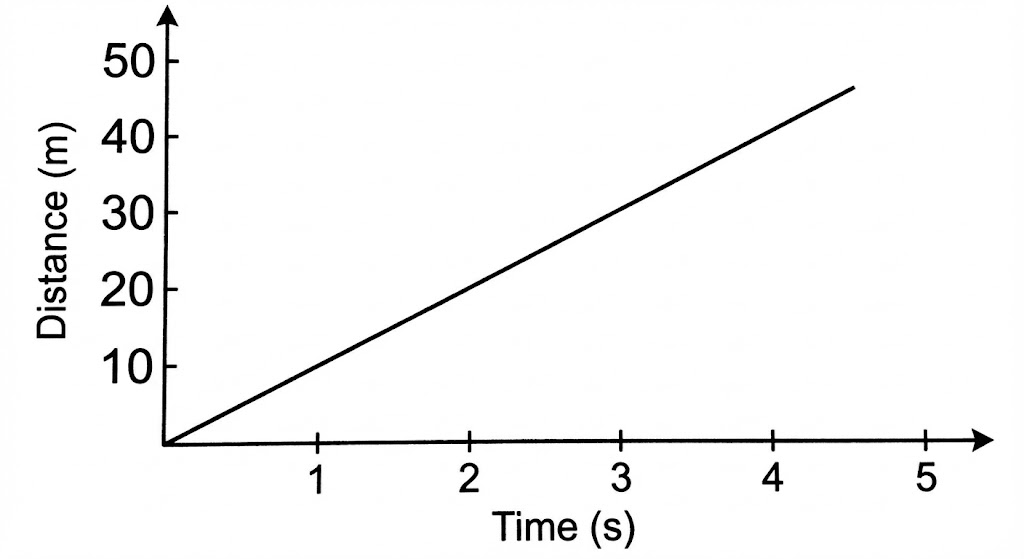
Finding Speed from a Graph
The speed is simply the slope of the line.
- Step 1: Find the change in distance (vertical axis).
- Step 2: Find the change in time (horizontal axis).
- Step 3: Divide them!
Speed = Distance ÷ Time
5. Distinguish between uniform and non-uniform motion. Also, give examples of each.
Ans: Uniform Motion
Uniform motion is the motion in which an object covers equal distances in equal intervals of time, no matter how small the time interval is.
- Speed remains constant
- Acceleration is zero
- Distance–time graph is a straight line
Example:
- A car moving with constant speed of 60 km/h on a straight road.
- The motion of the hands of a clock.
Non-Uniform Motion
Non-uniform motion is the motion in which an object covers unequal distances in equal intervals of time.
- Speed keeps changing
- Acceleration is not zero
- Distance–time graph is a curved line
Example:
A freely falling object under gravity.
A bus moving in city traffic.
VI. Numerical questions
1. Convert the following:
a) 2400 seconds to minutes:
Ans: Since 1 minute = 60 seconds,
So, 2400 seconds = 40 minutes.
b) 8 hours to minutes:
Ans: Since 1 hour = 60 minutes,
So, 8 hours = 480 minutes.
c) How many hours are there in 3 days?
Ans: 1 day = 24 hours
3 days = 3 × 24 hours
= 72 hours
d) How many days are there in one decade? (Take 365¼ days in each year.
Ans: 1 decade = 10 years
Given:
1 year = 365¼ days = 365.25 days
So,
10 years = 10 × 365.25
= 3652.5 days
e) Calculate the number of minutes in a day.
Ans: 1 day = 24 hours
1 hour = 60 minutes
So,
Number of minutes in 1 day
= 24 × 60
= 1440 minutes
f) An object moves 360 km in 2 hours. Calculate its speed in km/h and m/s.
Ans: Speed in km/h
Formula:
Speed in m/s
We know:
So,
g) A car covers 240 km in 3 hours and a motorcycle covers 360 km in 4 hours. Which vehicle is travelling faster?
Ans:
Car
Distance = 240 km
Time = 3 hours
Motorcycle
Distance = 360 km
Time = 4 hours
Since 90 km/h > 80 km/h,
h) Plane ‘A’ travels at 900 km/h and plane ‘B’ travels at 250 m/s. Which plane travels faster?
Ans:
Plane A
Speed = 900 km/h
Convert km/h to m/s:
Plane A speed = 250 m/s
Plane B
Speed = 250 m/s
j) In a cricket match, on an average, it takes 5 minutes to bowl one over and 1 minute to cross over after each over. How many overs (including the time taken for cross-over) can be finished in 1 hour?
Ans: Given:
Time to bowl 1 over = 5 minutes
Time for cross-over = 1 minute
So, total time per over (including cross-over):
Total time available = 1 hour = 60 minutes
k) Sonu goes for basketball coaching three times a week, and swimming classes two times a week. Each basketball class is for 1 hour and 45 minutes, and each swimming class is for an hour. How much time does she spend in a week in these two classes?
Ans:
Basketball Classes
Each class = 1 hour 45 minutes
Convert to minutes:
She goes 3 times a week:
Swimming Classes
Each class = 1 hour = 60 minutes
She goes 2 times a week:
Total Time in a Week
Convert back to hours:
l) If you travel by road, it takes 46 hours to travel from New Delhi to Kanyakumari. How many days and hours would this be?
Ans: We know:
Divide 46 by 24:
Because:
m) Kushal loves to visit his grandparents every year to spend his summer holidays with them. They live in a remote village. He takes a train, then a bus and then, walks the rest of the journey. The train travels at 60 km/h for 5 hours, the bus travels at 40 km/h for 3 hours and he walks at a speed of 5 km/h for 1 hour. What is the total distance he travels from the railway station to his grandparents’ house
Solution :
Train
Speed = 60 km/h
Time = 5 hours
Bus
Speed = 40 km/h
Time = 3 hours
Walking
Speed = 5 km/h
Time = 1 hour
Total Distance
Math & Science Solutions by Class
Class 10
Class 9
Class 8
Class 7
Class 6
Class 12
Class 11
- Class 11 Math Solutions
- Class 11 Physics Solutions
- Class 11 Chemistry Solutions
- Class 11 Biology Solutions
For the official Class 10 Mathematics Solutions, you can visit: