
🌟 Introduction
Class 8 Science Ch 15 Some Natural Phenomena Notes help students understand important natural events like lightning and earthquakes in a simple and clear way. In this chapter, you will learn how electric charges build up in clouds to produce lightning, and how movements inside the Earth cause earthquakes. These concepts are not only important for exams but also help us understand real-life situations and safety measures. This page provides complete notes, NCERT solutions, MCQs, and extra practice questions to help you revise the chapter effectively and score better in exams.
⚡ Some Natural Phenomena Notes
🔹 Lightning
Lightning is a natural phenomenon caused by the accumulation of electric charges in clouds. When these charges build up, a sudden discharge of electricity occurs between clouds or between cloud and Earth, producing a bright flash called lightning.
🔹 How does lightning occur?
- Clouds collect electric charges due to friction between water droplets.
- Positive and negative charges get separated.
- When the difference becomes large, electricity flows suddenly → lightning.
🔹 Safety Measures During Lightning
- Stay indoors during thunderstorms
- Avoid open fields and tall trees
- Do not use electrical appliances
- Stay away from metal objects
🌍 Earthquakes
An earthquake is the sudden shaking of the Earth’s surface caused by movement of tectonic plates.
🔹 Focus and Epicentre
- Focus: Point inside the Earth where earthquake starts
- Epicentre: Point on the Earth’s surface directly above the focus
🔹 Measuring Earthquakes
Earthquakes are measured using:
- Seismograph
- Richter Scale
🔹 Safety Measures During Earthquake
- Drop, cover and hold
- Stay away from windows and buildings
- Do not use lifts
- Move to open area
📘 NCERT Book Questions and Answers
Select the correct option in Questions 1 and 2.
Question 1.
Which of the following cannot be changed easily by friction?
(a) A plastic scale
(b) A copper rod
(c) An inflated balloon
(d) A woollen cloth
Answer:
(b) A copper rod
Question 2.
When a glass rod is rubbed with a piece of silk cloth the rod
(a) and the cloth both acquire a positive charge.
(b) becomes positively charged while the cloth has a negative charge.
(c) and the cloth both acquire a negative charge.
(d) becomes negatively charged while the cloth has a positive charge
Answer:
(b) becomes positively charged while the cloth has a negative charge.
Question 3.
Write T against true and F against false in the following statements.
(a) Like charges attract each other.
(b) A charged glass rod attracts a charged plastic straw.
(c) Lightning conductor cannot protect a building from lightning.
(d) Earthquakes can be predicted in advance.
Answer:
(a) False
(b) True
(c) False
(d) False
Question 4.
Sometimes, a crackling sound is heard while taking off a sweater during winters. Explain.
Answer:
The electric discharge takes place between the body and the sweater due to friction. At the time of electric discharge some energy is released. In this case energy is released in the form of crackling sound.
Question 5.
Explain why a charged body loses its charge if we touch it with our hand.
Human body is a conductor of electricity. When a charged body is touched with hand, our body conducts its charges to the earth. Hence, by this way charged body loses its charge.
Question 6.
Name the scale on which the destructive energy of an earthquake is measured. An earthquake measures 3 on this scale. Would it be recorded by a seismograph? Is it likely to cause much damage?
Solution:
The destructive energy of an earthquake is measured on a scale called the Richter Scale.
Yes, it would be recorded by seismograph because this scale has the readings from 1 to 10. No it is not likely to cause much damage as earthquakes of magnitude higher than 5 is considered destructive in nature.
Question 7.
Suggest three measures to protect ourselves from lightning.
(i) Do not use TV or cable phone during lightning.
(ii) Stay indoor or under covered area.
(iii) Don’t take bath during lightning.
Question 8.
Explain why a charged balloon is repelled by another charged balloon whereas an uncharged balloon is attracted by another charged balloon?
Answer:
A charged balloon is repelled by another charged balloon because both carry same type of charges. On the other hand, an uncharged balloon is attracted by another charged balloon as they have opposite charges. We know that same charges repel and opposite charges attract each other.
Question 9.
Describe with the help of a diagram an instrument which can be used to detect a charged body.
Answer:
Electroscope is a device which is used to detect the charge on a body. It works on the principle that like charges repel each other while unlike charges attract each other. It consists of a metal rod with thin metal strip or leaf attached to it at the bottom.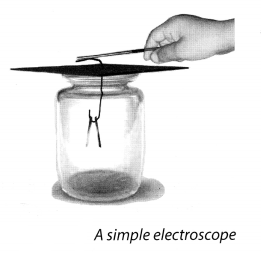
At the top, the metal rod enters in a metallic cup or disc. The bottom of the rod and the metal leaf are enclosed in a glass box for protection. When the disc of the electroscope is touched with a charged ebonite or glass rod, the metal leaves open out or diverge.
The extent of divergence depends upon the amount of charge on the electroscope. When the metal strips repel each other proves that the body is charged because repulsion is the sure test to detect that body is charged or not through an electroscope.
Question 10.
List three states in India where earthquakes are more likely to strike.
Answer:
Kashmir, Rajasthan and Gujarat.
Question 11.
Suppose you are outside your home and an earthquake strikes. What precaution would you take to protect yourself?
Answer:
We will take the following precautions to protect ourselves:
(i) Move to open space. Find a clean spot away from buildings, trees and overhead power lines. Drop to the ground.
(ii) If we are in a car or a bus, will not come out. Drive slowly to a clear spot and remain in it till the earthquake stops.
Question 12.
The weather department has predicted that a thunderstorm is likely to occur on a certain day. Suppose you have to go out on that day. Would you carry an umbrella? Explain.
Answer:
No, it is not advisable to carry an umbrella at all. Its metallic objects are more prone to lightning stroke. So an umbrella increases the risk.
NCERT Solutions for Class 8 Science Chapter 15 – Short questions Answer
Question 1.
Explain why a charged body loses its charge if we touch it with our hand.
Answer:
When we touch a charged body with our hand, the body is earthed. This causes the charges flow to the earth and the body looses the charge.
Question 2.
List three states in India where earthquakes are more likely to strike.
Answer:
Three states in India where earthquakes can occur are Gujarat, Rajasthan and Jammu & Kashmir.
Question 3.
The weather department has predicted that a thunderstorm is likely to occur on a certain day. Suppose you have to go out on that day. Would you carry an umbrella ? Explain. [NCERT]
Answer:
No, I would not carry an umbrella. The charges produced during a thunderstrom can flow through the umbrella and harm us.
Question 4.
When a charged plastic straw is brought near a charged plastic straw, there is repulsion between them. What type of charge exists between them ?
Answer:
The charge on both the plastic straw are same, since like charges repel each other.
Question 5.
When a charged balloon is brought near a charged refill, there is attraction between the two. What type of charge exists between the two ?
Answer:
The charge on the balloon and a refill are different, because unlike charges attract each other.
Question 6.
Why is the charging by rubbing known as static electricity ?
Answer:
Charging by rubbing is known as static electricity because the charges do not move.
Question 7.
Give the difference between static electricity and electric current ?
Answer:
In static electricity, the charges do not move. In electric current, there is flow of charges.
Question 8.
When is lightning seen ?
Answer:
When the negative charges from the clouds and the positive charges on the ground meet huge amount of energy is produced as bright light and sound. This is seen as lightning.
Question 9.
Is the car safe during thunderstorm ?
Answer:
Yes, the car is safe during thunderstorm with windows and doors of the vehicle shut.
Question 10.
Can we use telephone during a thunderstorm ?
Answer:
No, it is not safe to use a telephone during thunderstorm, as lightning can strike through telephone cords.
Question 11.
Do the car tyres protect us from lightning ?
Answer:
No, the car tyres do not protect us from lightning, but the metal case of the car protects us.
Question 12.
Choose the correct option :
A charged plastic comb (B) is brought near another similar charged and suspended plastic comb (A). Then comb A
- remains unaffected
- moves towards comb B
- moves away from comb B
- starts oscillating
Answer:
moves away from comb B.
Question 13.
During lightning we have an electric discharge
- only between two opposite charged clouds
- only between a charged cloud and the ground
- either between two oppositely charged clouds or a charged cloud and ground.
- neither between two oppositely charged clouds nor between a charged cloud and ground.
Answer:
either between two oppositely charged clouds or a charged cloud and ground.
Question 14.
What is the effect of
- a charged object
- an uncharged object on small bits of paper ?
Answer:
- a charged object will attract bits of paper.
- an uncharged object will have no effect on bits of paper.
NCERT Solutions for Class 8 Science Chapter 15 – Important Questions
Question 1.
Name the scale on which the destructive energy of an earthquake is measured. An earthquake measures 3 on this scale. Would it be recorded by a seismograph ? Is it likely to cause much damage ?
Answer:
The destructive energy of the earthquake can be measured on the Richter scale. Yes, an earthquake measuring 3 would be recorded by the seismograph. This earthquake would not cause much damage.
Question 2.
Suggest three measures to protect ourselves from lightning.
Answer:
We can protect ourselves from lightning by
- switching off and disconnecting all heavy electrical appliances.
- Not bathing under running tap water.
- Not standing near metallic poles.
Question 3.
Explain why a charged balloon is repelled by another charged balloon whereas an uncharged balloon is attracted by another charged balloon ?
Answer:
A charged balloon has the same charge as another charged balloon, so there is repulsion between them because like charges repel each other. On the other hand, an uncharged body always attracts a charged body. Therefore, an uncharged balloon is attracted by a charged balloon.
Question 4.
Apart from disturbance inside the earth, what are the other reasons of earthquake ?
Answer:
Earthquakes can also occur due to underground nuclear explosion, or when a volcano erupts, or when a meteor hits the earth.
Question 5.
What are weak zones ?
Answer:
Since earthquakes are caused by the movements of plates, the boundaries of the plates are weak zones where earthquakes are most likely to occur.
Question 6.
What useful changes are caused by earthquakes ?
Answer:
Earthquakes can also cause new islands, coral breaches and fresh water springs to emerge due to upheaval.
Question 7.
Name the weak zones in India ?
Answer:
The weak zones in India are Kashmir, Western and Central Himalayas, the whole of North¬East, Rann ofKutch, Rajasthan and the Indo-Gangetic Plane. Some areas of South India also fall in the danger zone.
Question 8.
Explain the working of seismograph.
Answer:
The seismograph consists of a vibrating rod which starts vibrating when tremors occur. A pen is attached to the vibrating rod that records the seismic waves on a paper which moves under it.
Question 9.
In highly seismic areas, which material should be used for construction of houses ?
Answer:
In highly seismic areas, the use of mud or timber is better than any heavy construction material. The roofs should be made as light as possible so that if the house falls, it does not cause much damage.
Question 10.
To make the house quake safe, what precautions should be taken ?
Answer:
To make the house quake safe, it is better if the cupboards and shelves are fixed to the walls, so that they donot fall easily. Clocks, photo-frames, water heaters should be hung carefully.
Question 11.
How are positive and negative charges produced during a thunderstorm ?
Answer:
Clouds are very small droplets of water in the form of vapour. A patch of cloud develops an electric charge on it by friction. The upper layers of cloud get positively charged and the lower layers of cloud get negatively charged.
Question 12.
How is electric discharge fatal for human beings ?
Answer:
The process of electric discharge can occur between two clouds, between clouds and the earth, even between the clouds and the human body. Such lightning strokes can be fatal.
Question 13.
A glass rod is rubbed against a silk cloth and an ebonite rod is rubbed against a piece of flannel. List the pairs which have
- similar
- dissimilar charges on them.
Answer:
- Glass rod and flannel (similar charge i.e., positive); Silk and ebonite (both negative)
- Glass rod and ebonite rod.
Question 14.
A charged drinking plastic straw is brought near another similar suspended straw that is
- also similarly charged ‘
- uncharged.
Explain what would happen in each case and why?
Answer:
- The suspended straw is repelled from it because of similar charge.
- The uncharged plastic straw is attracted towards it because the charged object applies a force on it.
Question 15.
Is it important to have a good contact between the lower end of lightning conductor and the earth ? If so, why ?
Answer:
It is important to have a good contact between the lower end of lightning conductor and earth so that the lightning charged flow deep down into the earth and not through the structure.
Question 16.
When and where major earthquakes have taken place in India ?
Answer:
On 26th January 2001 in Bhuj and on 8th October 2005 in Uri and Tangdhar major earthquakes had taken place.
Question 17.
A charged object is found to lose its charges when touched by hand. Explain why ?
Answer:
A charged object loses its charges when touched by hand because the charges flow to the earth through the human body. This is known as earthing.
Question 18.
Is lightning useful ? How ?
Answer:
Lightning is useful in many ways :
- Lightning is effective in the formation of ozone in nature.
- Lightning played an important role in the origin and evoluation of life on earth.
- Due to high discharge of electric charge through air nitrogen contributes with oxygen to form nitrate oxide and nitrogen dioxide gases.
Question 19.
What is Tsunami ? Explain.
Answer:
Tsunami is a Japanese name for tidal waves. They are large waves that are generated when the sea floor is deformed by seismic activity. A Tsunami can be 10 to 20 metres high when it hits the shore and a series of waves come at short intervals.
Question 20.
How will you make an electroscope if the gold leaf electroscope is not at hand ?
Answer:
Take a metallic bar on a stand. Take a strip of cellophane paper and fold it half. Hang it from the metallic bar. This will work like a gold leaf electroscope.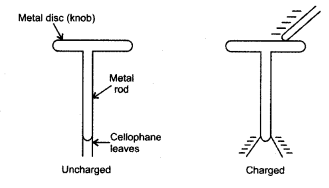
Question 21.
Why the gold leaves in an electroscope :
- diverge when touched charge glass rod.
- fold back when touched with hands.
- fold back when touched with a charged ebonite rod ?
Answer:
- Gold leaves diverge when touched with a charged glass rod because they both acquire similar charge.
- Gold leaves fold back when touched with hands because the charged is ‘earthed’.
- When touched with charged ebonite rod, the charges are neutralized, so the leaves fold back.
Question 22.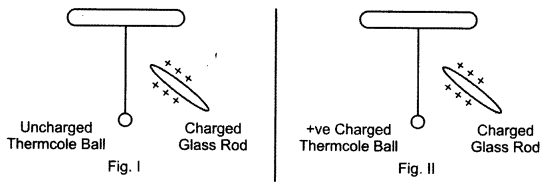
- What will you observe in Figure-I ?
- What will you observe in Figure-II ?
- What conclusion will you draw ?
Answer:
- In the figure-I the thermocole ball will be attracted to the glass rod.
- In the figure-II the thermocole ball will be repelled due to similar charge.
- The conclusion we draw is that attraction between two bodies is not a sure test of the presence of charge on a body. Repulsion is a sure that of charge on a body.
Question 23.
Is it true that a charged object always attracts an uncharged object but it may or may not attract another charged object ?
Answer:
Yes, an uncharged object is always attracted by a charged object. It will only attract another charged object, if the charge on it is opposite. If the charge on the other body is same, there will be repulsion.
NCERT Solutions for Class 8 Science Chapter 15 – Long Questions and Answers
Question 1.
Suppose you are outside your home and an earthquake strikes. What precaution would you take to protect yourself ?
Answer:
If you are outdoors and an earthquake strikes, we should some precautions take to protect ourself:
- Leave your building and more to open areas.
- Keep away from high rise buildings.
- Keep away from trees,, signboards, electric poles.
- If you are in a vehicle, remain inside it.
Question 2.
Describe with the help of a diagram an instrument which can be used to detect a charged body. [NCERT]
Answer: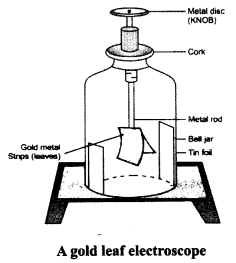
An electroscope is an apparatus to test an electric charge.
Conclusion: An electroscope has a brass rod passing through a tight fitting cork in a glass bottle. A pair of thin gold leaves are attached to the lower end of the brass rod. To protect the gold leaves from external electric charge the lower half of the bottle is lined with tin foil which is ‘earthed’ by connecting it to the table. This kind of electroscope is called a gold leaf electroscope.
Working: When a charged rod is touched to the metal disc, the charge is transferred to the gold leaves and they diverge.
Question 3.
What steps should be taken to protect yourself in case of an earthquake, if you are at home ?
Answer:
If you are at home :
- Do not stand near windows.
- Lie in bed.
- Do not stand near heavy objects that may fall on you.
- Stay under a table till the earthquake stops.
Question 4.
During a thunderstorm which places are safe ?
Answer:
During a thunderstorm, a house or building is the safest place. If you are travelling by car or by bus, you are safe inside with windows and doors of the vehicle shut.
Question 5.
During a thunderstorm, which places are unsafe if you are outside ?
Answer:
If you are outside :
- Open vehicles, like motor bike, tractor are not safe.
- Carrying umbrella is not a good idea.
- Stay away from poles or other metal objects.
- Do not lie on the ground.
Question 8.
Explain why a charged balloon is repelled by another charged balloon whereas an uncharged balloon is attracted by another charged balloon?
Answer:
A charged balloon is repelled by another charged balloon because both carry same type of charges. On the other hand, an uncharged balloon is attracted by another charged balloon as they have opposite charges. We know that same charges repel and opposite charges attract each other.
Question 9.
Describe with the help of a diagram an instrument which can be used to detect a charged body.
Answer:
Electroscope is a device which is used to detect the charge on a body. It works on the principle that like charges repel each other while unlike charges attract each other. It consists of a metal rod with thin metal strip or leaf attached to it at the bottom.
At the top, the metal rod enters in a metallic cup or disc. The bottom of the rod and the metal leaf are enclosed in a glass box for protection. When the disc of the electroscope is touched with a charged ebonite or glass rod, the metal leaves open out or diverge.
The extent of divergence depends upon the amount of charge on the electroscope. When the metal strips repel each other proves that the body is charged because repulsion is the sure test to detect that body is charged or not through an electroscope.
Class 8 Science NCERT Solution| 3 Mark Questions and Answers
Question 1.
Name the scale on which the destructive energy of an earthquake is measured. An earthquake measures 3 on this scale. Would it be recorded by a seismograph ? Is it likely to cause much damage ?
Answer:
The destructive energy of the earthquake can be measured on the Richter scale. Yes, an earthquake measuring 3 would be recorded by the seismograph. This earthquake would not cause much damage.
Question 2.
Suggest three measures to protect ourselves from lightning.
Answer:
We can protect ourselves from lightning by
- switching off and disconnecting all heavy electrical appliances.
- Not bathing under running tap water.
- Not standing near metallic poles.
Question 3.
Explain why a charged balloon is repelled by another charged balloon whereas an uncharged balloon is attracted by another charged balloon ?
Answer:
A charged balloon has the same charge as another charged balloon, so there is repulsion between them because like charges repel each other. On the other hand, an uncharged body always attracts a charged body. Therefore, an uncharged balloon is attracted by a charged balloon.
Question 4.
Apart from disturbance inside the earth, what are the other reasons of earthquake ?
Answer:
Earthquakes can also occur due to underground nuclear explosion, or when a volcano erupts, or when a meteor hits the earth.
NCERT Solutions for Class 8 Science Chapter 15 – 5 Mark Questions and Answers
Question 1.
Suppose you are outside your home and an earthquake strikes. What precaution would you take to protect yourself ?
Answer:
If you are outdoors and an earthquake strikes, we should some precautions take to protect ourself:
- Leave your building and more to open areas.
- Keep away from high rise buildings.
- Keep away from trees,, signboards, electric poles.
- If you are in a vehicle, remain inside it.
Question 2.
Describe with the help of a diagram an instrument which can be used to detect a charged body]
Answer:
An electroscope is an apparatus to test an electric charge.
Conclusion: An electroscope has a brass rod passing through a tight fitting cork in a glass bottle. A pair of thin gold leaves are attached to the lower end of the brass rod. To protect the gold leaves from external electric charge the lower half of the bottle is lined with tin foil which is ‘earthed’ by connecting it to the table. This kind of electroscope is called a gold leaf electroscope.
Working: When a charged rod is touched to the metal disc, the charge is transferred to the gold leaves and they diverge.
Question 3.
What steps should be taken to protect yourself in case of an earthquake, if you are at home ?
Answer:
If you are at home :
- Do not stand near windows.
- Lie in bed.
- Do not stand near heavy objects that may fall on you.
- Stay under a table till the earthquake stops.
Question 5.
During a thunderstorm, which places are unsafe if you are outside ?
Answer:
If you are outside :
- Open vehicles, like motor bike, tractor are not safe.
- Carrying umbrella is not a good idea.
- Stay away from poles or other metal objects.
- Do not lie on the ground.
Question 6.
If your friend is struck by lightning, how will you help him ?
Answer:
A lightning victim carries no electrical charge and cannot electrocute us. You can give first aid by performing mouth to mouth breathing.
Question 7.
Name the device used to secure tall buildings from lightning. Explain its construction and working.
Answer:
Lightning rod is a device used to secure tall buildings from the effect of lightning.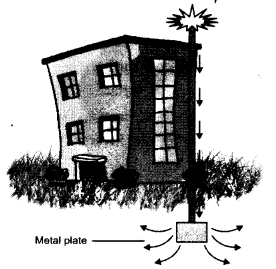
A metallic rod taller than the height of the building to be protected is installed in the walls of the building during its construction. One end of the rod is kept out in the air and the other is fixed in the ground. This provides easy route for transfer of electric discharge to the ground.
Question 8.
- Why do dry hair stand on when combed with a plastic comb ?
- What kind of charge is acquired by ebonite when rubbed with fur ?
- What kind of charge is acquired by fur when it is rubbed over ebonite ?
- What type of charge is borne on clouds facing the earth ?
- Is dry air a conductor or an insulator ?
Answer:
- Dry hair stand when combed with a plastic comb because they get charged.
- When rubbed with fur ebonite gets a negative charge.
- When fur is rubbe^ with ebonite, fur acquires positive charge.
- Normally, the layers of cloud facing the earth get negatively charged.
- Dry air is a bad conductor (or insulator) of electricity.
Question 9.
- Name the agency responsible for making quake proof houses ?
- What are seismic zones ?
- Give some suggestions how the houses should be made in seismic zones.
Answer:
(i) The houses in seismic zones should be symmetrical.
(ii) The foundation of the building should be deep.
(iii) Roofs should be of light material and the fixtures should be light.
The technique to develop quake proof houses has been developed by Central Building Research Institute, Roorkee.
The seismic zones are those areas which are prone to earthquakes. They are the areas lying on the boundaries of the plates.
📚 Extra Questions (Based on Oxford Book)
I. Objective type questions
A. Choose the correct option.
1. When a glass rod is rubbed with a piece of silk, the piece of silk gets.
- a. positive charge
- b. charge depending on the way it was rubbed
- c. no charge
- d. negative charge
Ans: d. negative charge
(Silk gains negative charge when rubbed with a glass rod.)
2. An electroscope is used for
- a. creating lightning
- b. charging an object
- c. detecting an electric charge
- d. protection against lightning
Ans: c. detecting an electric charge
(An electroscope is used to detect the presence of electric charge.)
3. Lightning is accompanied with
- a. large amounts of electric current and very high temperature
- b. earthquakes
- c. volcanic eruptions
- d. All of these
Ans: a. large amounts of electric current and very high temperature
(Lightning produces intense heat and electric current.)
4. The lithosphere consists of.
- a. Earth’s mantle and core
- b. Earth’s crust and inner mantle
- c. Earth’s core and crust
- d. Earth’s crust and upper mantle
Ans: d. Earth’s crust and upper mantle
(The lithosphere includes the crust and upper part of the mantle.)
5. Plate tectonics is a theory about
- a. charges
- b. lightning
- c. structure of the surface of the Earth
- d. structure of the inner core of the Earth
Ans: c. structure of the surface of the Earth
(Plate tectonics explains the movement of Earth’s surface plates.)
6. A sudden movement or a fracture in the Earth’s crust is called
a. earthquake b. lightning
c. thunder d. cyclonic storm
Ans: a. earthquake
(A sudden movement in Earth’s crust is called an earthquake.)
7. Seismology is the branch of science concerned with
- a. floods
- b. earthquakes
- c. lightning storms
- d. tides
Ans: b. earthquakes
(Seismology is the study of earthquakes.)
8. A lightning conductor provides an easy path for the charges (from the lightning strike) to
- a. the building
- b. the electrical fittings of the building
- c. the water pipes of the building
- d. deep underground
Ans: d. deep underground
(A lightning conductor directs the charge safely into the ground.)
9. The epicentre of an earthquake is
- a. point vertically above the focus on the surface of the Earth
- b. point at the Earth’s core
- c. point below the focus in the mantle of the Earth
- d. the graph of the earthquake
Ans: a. point vertically above the focus on the surface of the Earth
(The epicentre is the surface point above the earthquake’s origin.)
10. Lightning happens because of
- a. earthquakes
- b. transfer of massive electric charges
- c. electric poles
- d. volcanoes
Ans: b. transfer of massive electric charges
(Lightning is caused by the movement of electric charges in clouds.)
Class 8 Science Some Natural Phenomena-Oxford Book-1 Mark
B. Match the following.
Column A Column B
1. Natural phenomenon a. Electric discharge
2. Lightning b. Richter scale
3. Focus c. Lightning
4. Earthquake d. Sunrise
5. Thunder e. Earthquake
Ans:
| Column A | Column B |
|---|
| 1. Natural phenomenon | d. Sunrise |
| 2. Lightning | a. Electric discharge |
| 3. Focus | e. Earthquake |
| 4. Earthquake | b. Richter scale |
| 5. Thunder | c. Lightning |
Class 8 Science Some Natural Phenomena-Oxford Book-1Mark
II. Very short answer type questions
1.What is charging by friction?
Ans: Charging by friction is the process of transferring electric charge between two objects by rubbing them together.
2.What is earthing?
Ans: Earthing is the process of transferring electric charge from a charged object to the ground to make it neutral.
3. What is the outer covering of Earth called?
Ans: The outer covering of Earth is called the crust.
4. Why is it unsafe to hold an umbrella during a thunderstorm?
Ans: It is unsafe because the metal parts of the umbrella can attract lightning, which may cause electric shock.
5. What is seismology?
Ans: Seismology is the branch of science that studies earthquakes and the movements of Earth’s crust.:
Class 8 Science Some Natural Phenomena-Oxford Book-3 marks
1. Explain with examples how an object can be charged by friction.
Ans: When we rub two objects together, they can become electrically charged. This happens because tiny particles called electrons move from one object to the other. The object that loses electrons becomes positively charged, and the one that gains electrons becomes negatively charged. This process is called charging by friction.
Examples:
- If you rub a glass rod with a silk cloth, the glass rod loses electrons and becomes positively charged. The silk gains electrons and becomes negatively charged.
- When you comb your dry hair with a plastic comb, the comb gets charged and can attract small paper bits.
So, charging by friction happens because of rubbing and transfer of charges between objects.
2. What is an electroscope? Draw a neat labelled diagram and explain how it works.
Ans: An electroscope is a device used to detect electric charge on an object.
It has a metal rod with a metal disc or knob at the top and two thin metal leaves (usually gold or aluminium) at the bottom, kept inside a glass container.
How it works:
- When a charged object touches the metal knob, the electric charge travels down to the metal leaves.
- Since both leaves get the same charge, they repel each other and move apart.
- If there is no charge, the leaves remain together.

3. With the help of a simple diagram, explain how a lightning conductor can protect a building from a lightning strike.
Ans: A lightning conductor is a metal rod placed at the highest point of a building. It is connected to a thick wire that runs down the building and goes deep into the ground.
How it works:
- When lightning strikes, the conductor gives the electric charge a safe path to travel from the top of the building into the ground.
- This prevents the lightning from damaging the building or causing a fire.
It’s like giving lightning a shortcut to the Earth so that it doesn’t harm anything.
4. List three steps that we can take to protect ourselves from being struck by lightning during a thunderstorm.
Ans: Here are three easy and important safety steps:
- Stay indoors – Don’t go outside when you hear thunder or see lightning.
- Stay away from metal – Don’t touch anything made of metal, like bicycles or wires.
- Avoid water and electrical devices – Don’t take a bath or use mobile phones or TVs during a storm, because lightning can travel through wires and water.
These simple steps can keep you safe during a thunderstorm.
For Visualization:
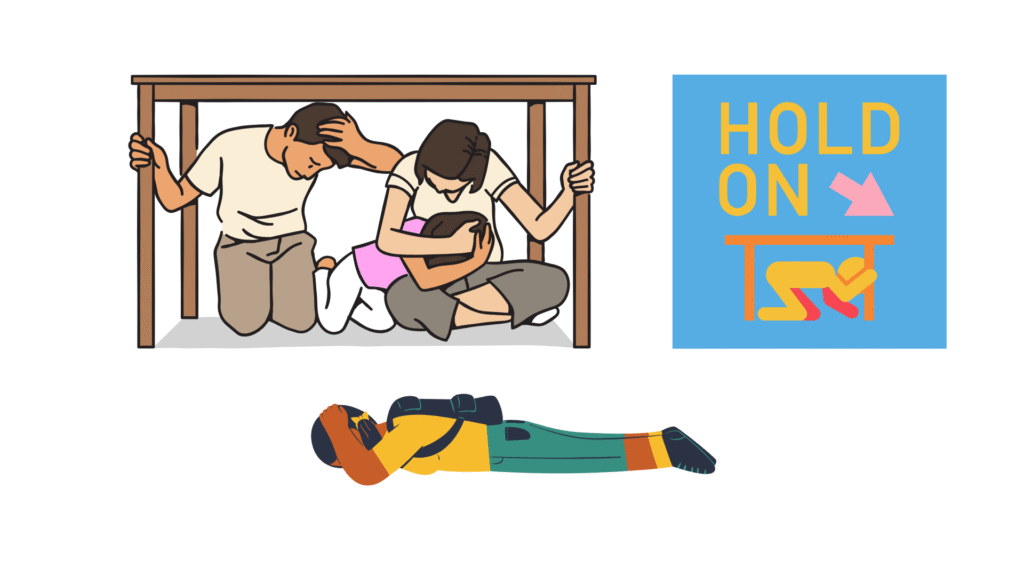
5. Draw a diagram and explain the internal structure of the Earth.
Ans: The Earth is made of three main layers:

- Crust – The thin outer layer where we live. It is made of solid rocks.
- Mantle – The thick layer below the crust. It is made of hot, flowing rock.
- Core – The deepest part of the Earth. It has two parts:
- Outer core – Made of liquid metal.
- Inner core – Made of solid metal, mostly iron and nickel.
6. Give a simple diagrammatic representation of how an earthquake occurs.
Ans: An earthquake happens when there is a sudden movement in the Earth’s crust. This usually happens at fault lines where two plates of the Earth move against each other.
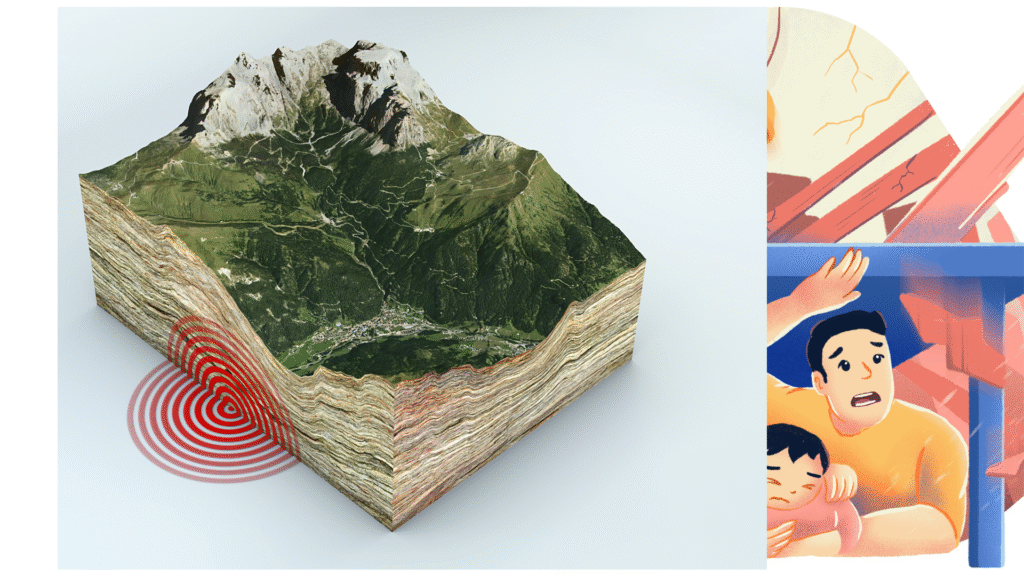
- The place inside the Earth where it starts is called the focus.
- The point directly above the focus on the Earth’s surface is called the epicentre.
- The shock waves that come out from the focus are called seismic waves.
These waves shake the ground and cause the earthquake.
7. In what way can we design buildings to minimize the loss of life and property in the event of an earthquake? Give two examples. Also, mention the importance of the location of the building in reference to earthquake safety.
Ans: To make buildings safer during earthquakes, we should:
- Use earthquake-resistant designs like strong foundations and flexible structures that can absorb shaking.
- Install shock absorbers and use light materials that reduce damage if something falls.
Examples:
- Buildings in Japan often have base isolators that help the building move without breaking.
- In some places, wooden homes are used because wood bends and doesn’t easily crack during shaking.
Location is also important:
- Buildings should be made on strong ground, not on loose soil or near steep slopes.
- Avoid constructing buildings close to fault lines, where earthquakes are more likely to happen.
Choosing the right design and location helps save lives and reduces damage during an earthquake.
📘 Math & Science Solutions by Class
🔹 Class 10
🔹 Class 9
🔹 Class 8
🔹 Class 7
🔹 Class 6
🔹 Class 12
🔹 Class 11
- Class 11 Math Solutions
- Class 11 Physics Solutions
- Class 11 Chemistry Solutions
- Class 11 Biology Solutions
For the official Class 10 Mathematics Solutions, you can visit:
- NCERT Textbooks (for Class 10):
https://ncert.nic.in/textbook.php?class=10