
Every living organism, from the tiniest bacterium to the largest tree, is made up of small structural and functional units known as cells. The cell is the basic building block of life, just like bricks form a building. Whether it’s a single-celled organism like Amoeba or a multicellular organism like humans, the cell performs all the essential functions that sustain life.
Class 9 Science Ch 5 Fundamental unit of life-Cell (Textbook Answers)
Page 59
Question 1. Who discovered cells, and how?
Answer: Robert Hooke discovered cells in 1665 while examining a thin slice of cork through a self-designed microscope. He saw that the cork resembled the structure of a honey comb consisting of many little compartments. These small boxes are called cells.
Question 2. Why the cell is called the structural and Junctional unit of life?
Answer: A cell is capable of independently carrying out all necessary activities of life. So, they are called basic or functional unit of life.
Class 9 Science NCERT Textbook – Page 61
Question 1. How do substances like C02 and water move in and out of the cell? Discuss.
Answer: Substances like CO₂ and water move in and out of the cell through a process called diffusion.
1.Diffusion: This is the movement of molecules from an area of higher concentration to an area of lower concentration.
CO₂: During cellular respiration, CO₂ is produced inside the cell and needs to move out. Since there is a higher concentration of CO₂ inside the cell and a lower concentration outside, it moves out of the cell through the cell membrane by diffusion.
Water: Water moves in and out of the cell through osmosis, which is a type of diffusion specific to water. Water moves from an area of lower solute concentration (outside the cell) to an area of higher solute concentration (inside the cell), balancing the concentration on both sides.
Question 2. Why is the plasma membrane called a selectively permeable membrane?
Answer: It is called selectively permeable membrane because it allows the entry and exit of some substances, not all.
Class 9 Science NCERT Textbook – Page 63
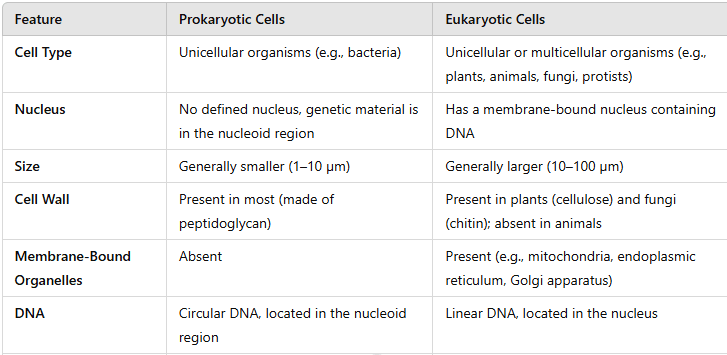
Question 1. Fill in the gaps in the following table illustrating differences between prokaryotic and eukaryotic cells.
Answer:
NCERT Textbook for Class 9 Science – Page 65
Question 1. Can you name the two organelles we have studied that contain their own genetic material?
Answer: The two organelles which have their own genetic material are:
1. Mitochondria 2. Plastids
Question 2. If the organisation of a cell is destroyed due to some physical or chemical influence, what will happen?
Answer: If the organization of a cell is destroyed due to physical or chemical damage, the cell will not function properly. This can lead to the breakdown of its structures and processes. For example, the cell membrane might lose its ability to control what enters or leaves the cell, or the nucleus may not be able to manage cell activities like growth and division. In severe cases, the cell could die because it can no longer maintain its normal functions. The damage can also spread to nearby cells, affecting the overall health of the tissue or organ.
Question 3. Why are lysosomes known as suicide hags?
Answer: Lysosomes are called “suicide bags” because they contain strong enzymes that can break down the cell’s own parts. If the cell gets damaged or is no longer needed, the lysosomes release these enzymes, which destroy the cell. This helps remove unhealthy or old cells from the body. So, they are called “suicide bags” because they can cause the cell to destroy itself when necessary.
Question 4. Where are proteins synthesised inside the cell?
Answer: The proteins are synthesised in the ribosomes that are also known as protein factories.
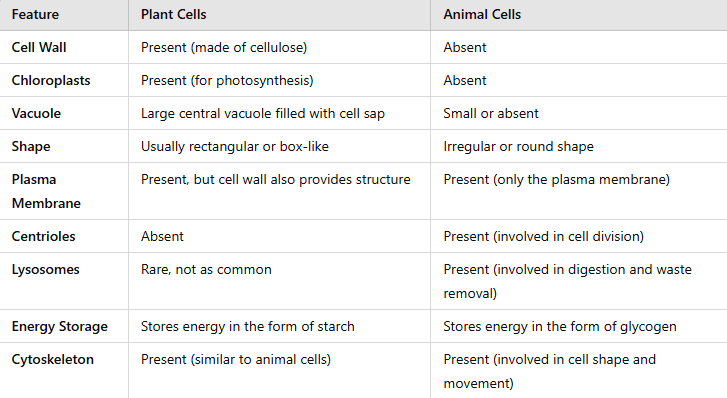
Question 1. Make a comparison and write down ways in which plant cells are also different from animal cells.
Answer:
Question 2. How is prokaryotic cell different from a eukaryotic cell?
Answer:
| Feature | Prokaryotic Cell | Eukaryotic Cell |
|---|---|---|
| Nucleus | No true nucleus, DNA is free in the cytoplasm | Has a defined nucleus with a nuclear membrane |
| Size | Generally smaller (0.1–5 micrometers) | Larger (10–100 micrometers) |
| Organelles | No membrane-bound organelles | Contains membrane-bound organelles like mitochondria, Golgi apparatus, etc. |
| DNA | Single circular DNA strand | Multiple linear DNA strands (chromosomes) |
| Ribosomes | Smaller (70S) | Larger (80S) |
| Cell Division | Binary fission (simple division) | Mitosis and meiosis (complex division) |
| Examples | Bacteria, Archaea | Plants, Animals, Fungi, Protists |
| Cell Wall | Present in most (made of peptidoglycan) | Present in plants (made of cellulose) or absent |
| Flagella | Simple, made of flagellin | Complex, made of tubulin |
Question 3. What would happen if the plasma membrane ruptures or breaks down?
Answer: If plasma membrane ruptures or breaks down then molecules of some substances will freely move in and out.
Question 4. What would happen to the life of a cell if there was no Golgi apparatus?
Answer: Golgi apparatus has the function of storage, modification and packaging of the products in vesicles. If there were no Golgi bodies, packaging and dispatching of materials synthesised by the cell will be stocked.
Question 5. Which organelle is known as the powerhouse of the cell? Why?
Answer: Mitochondria is known as powerhouse of the cell because it releases the energy required for different activities of life.
Question 6. Where do the lipids and proteins constituting the cell membrane get synthesised?
Answer: Lipids and proteins are synthesised in ER [Endoplasmic Reticulum].
Question 7. How does Amoeba obtain it’s food?
Answer: Amoeba obtains food through phagocytosis. It extends its pseudopodia to surround and engulf food, forming a food vacuole. Inside the vacuole, digestive enzymes break down the food into nutrients, which are absorbed by the cell. Any waste is then expelled from the cell.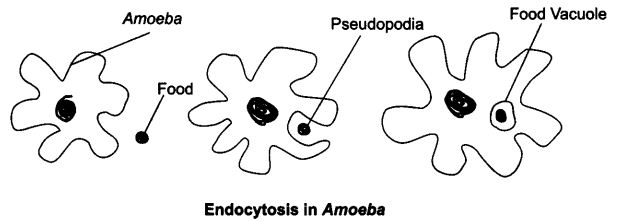
Question 8. What is osmosis?
Answer: Osmosis is the process of movement of water molecule from a region of higher water concentration through a semi-permeable membrane to a region of lower water concentration.
Question 9. Carry out the following osmosis experiment:
Take four peeled potato halves and scoop each one out to make potato cups, one of these potato cups should be made from a boiled potato. Put each potato cup in a trough containing water.
Now,
(a) Keep cup A empty
(b) Put one teaspoon sugar in cup B
(c) Put one teaspoon salt in cup C ‘
(d) Put one teaspoon sugar in the boiled potato cup D
Keep these for two hours. Then observe the four potato cups and answer the following:
(i) Explain why water gathers in the hollowed portion of B and C.
(ii) Why is potato A necessary for this experiment?
(iii) Explain why water does not gather in the hollowed out portions of A and D.
Answer: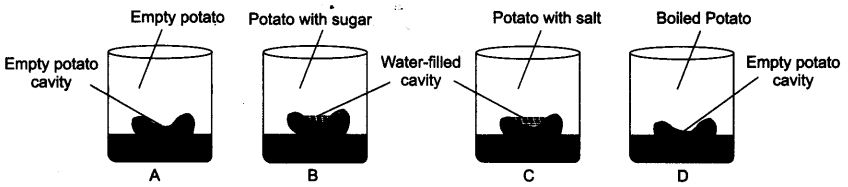
(i) Water gathers in B and C because in both the situations there is difference in the concentration of water in the trough and water in the cup of Potato. Hence, osmosis takes place as the potato cells act as a semi-permeable membrane.
(ii) Potato A is necessary for this experiment for comparison, it acts as a control.
(iii) Water does not gather in the hollowed out portions of A and D. As cup of A does not have change in the concentration for water to flow. For osmosis to occur one of the concentration should be higher than the other.
In cup D, the cells are dead and hence the semi-permeable membrane does not exists for the flow of water and no osmosis takes place.
You can access the official NCERT Solutions for Class 10 Mathematics on the NCERT website at the following link:
NCERT Class 10 Mathematics Solutions
This page will guide you to the textbook and solutions, as provided by the National Council of Educational Research and Training (NCERT).