
Welcome to mathscience.in, where you’ll find comprehensive and accurate Class 9 Science Ch1 Matter in our surrounding NCERT. This chapter introduces you to the fascinating world of matter, its properties, and its various states. Whether you’re preparing for exams or looking to better understand the concepts, we have detailed solutions and explanations for every question to help you succeed.
Class 9 Science Ch1 Matter in our surrounding NCERT-Short Concept
Matter forms the basis of everything around us. It is anything that occupies space and has mass. Matter exists in three primary states: solid, liquid, and gas. Each state has distinct characteristics, and understanding these differences is crucial for mastering this chapter. Our Class 9 Science Ch1 Matter in our surrounding NCERT provide step-by-step explanations of these states, including real-life examples to help you visualize how matter behaves in various forms.
Mastering the concepts in Class 9 Science Ch1 Matter in our surrounding NCERT is essential for building a strong foundation in science. Our solutions are designed to make learning easy and effective, ensuring you understand the fundamental properties of matter and the changes it undergoes. Whether you’re revising for your exams or just curious about how matter works, our solutions provide the clarity you need to succeed.
Visit MathScience.in for the complete Class 9 Science Ch1 Matter in our surrounding NCERT and more resources to help you excel in your studies.
INTEXT QUESTIONS – PAGE 3 (NEW CBSE BOOK)
Question 1. Which of the following are matter?
Chair, air, love, smell, hate, almonds, thought, cold, cold-drink, smell of perfume.
Answer: Chair, air, almonds, and cold-drink.
Question 2. Give reasons for the following observation:
The smell of hot sizzling food reaches you several meters away, but to get the smell from cold food you have to go close.
Answer: The smell of hot sizzling food reaches severed meters away, as the particles of hot food have more kinetic energy and hence the rate of diffusion is more than the particles of cold food.
Question 3. A diver is able to cut through water in a swimming pool. Which property of matter does this observation show?
Answer: A diver is able to cut through water in a swimming pool. This shows that the particles of water have intermolecular space and has less force of attraction.
Question 4. What are the characteristics of the particles of matter?
Answer. The characteristics of the particles of matter are:
(1) Particles have intermolecular space.
(2) Particles have intermolecular force.
(3) Particles of matter are moving continuously.
Class 9 Science NCERT Textbook – Page 6
Question 1. The mass per unit volume of a substance is called density.(density = mass/volume).
Arrange the following in order of increasing density: air, exhaust from chimneys, honey, water, chalk, cotton and iron.
Answer: Increasing density:
air < exhaust from chimneys < cotton < water < honey < chalk < iron.
Question 2. (a) Tabulate the differences in the characteristics of states of matter.
(b) Comment upon the following: rigidity, compressibility, fluidity, filling a gas container, shape, kinetic energy and density.
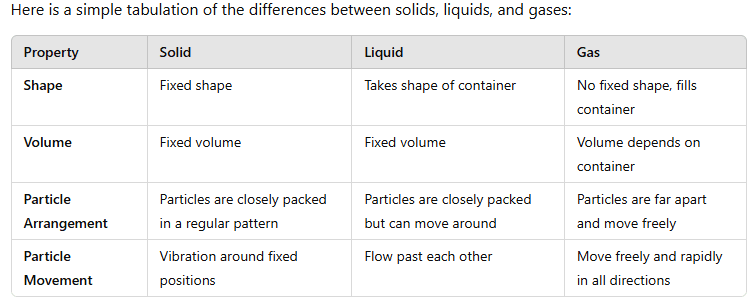
Class 9 Science Ch1 Matter in our surrounding NCERT-2 marks
Question 3. Give reasons
(a) A gas fills completely the vessel in which it is kept.
(b) A gas exerts pressure on the walls of the container.
(c) A wooden table should be called a solid.
(d) We can easily move our hand in air but to do the same through a solid block of wood we need a karate expert.
Answer: (a) The molecules of gas have high kinetic energy due to which they keep moving in all directions and hence fill the vessel completely in which they are kept.
(b) A gas exerts pressure on the walls of the container because the molecules of the gas are in constant random motion due to high kinetic energy. These molecules constantly vibrate, move and hit the walls of the container thereby exerting pressure on it.
(c) The molecules/particles of wooden table are tightly packed with each
other, there is no intermolecular space, it cannot be compressed, it cannot flow, all these characteristics are of solid. So wooden table should be called a solid. ‘
(d) We can easily move our hand in air but to do the same through a solid block of wood we need a karate expert. It is because the molecules of air has less force of attraction between them and a very small external force can separate them and pass through it. But in case of solids, the molecules have maximum force of attraction, the particles are tightly bound due to this force. Hence large amount of external force is required to pass through solid.
Question 4. Liquids generally have lower density as compared to solids. But you must have observed that ice floats on water. Find out why.
Answer: Ice is a solid but its density is lower than water due to its structure. The molecules in ice make a cage like structure with lot of vacant spaces, this makes ice float on water.
INTEXT QUESTIONS – PAGE 9
Question 1. Convert the following temperature to Celsius scale:
(a) 300 K (b) 573 K
Answer. (a) 300 – 273 = 27°C (b) 573 – 273 = 300°C
Question.2. What is the physical state of water at:
(a) 250°C (b) 100°C
Answer: (a) 250°C = gas (b) 100°C liquid as well as gas
Question 4. Suggest a method to liquefy atmospheric gases?
Answer: The atmospheric gases are taken in a cylinder with piston fitted on it. By cooling and applying pressure on them, the gases can be liquefied.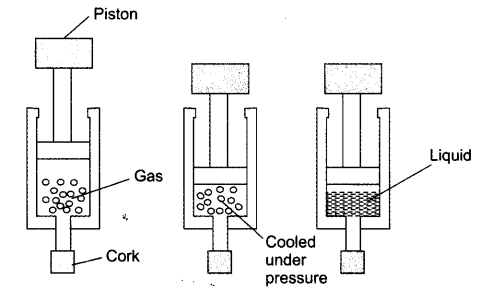
INTEXT QUESTIONS – PAGE 10
Question 1. Why does a desert cooler cool better on a hot dry day?
Answer: The outer walls of the cooler get sprinkled by water constantly. This water evaporates due to hot dry weather. Evaporation causes cooling of inside air of cooler. This cool air is sent in the room by the fan.
Question 2. How does the water kept in an earthen pot (matka) become cool during summer?
Answer: The earthen pot is porous with lot of pores on it, the water oozes out through these pores and the water gets evaporated at the surface of the pot thereby causing cooling effect. This makes the pot cold and the water inside the pot cools by this process.
Question 3. Why does our palm feel cold when we put some acetone or petrol or perfume on it?
Answer: Acetone, petrol or perfume evaporate when they come into contact with air. The evaporation causes cooling sensation in our hands.
Question 4. Why are we able to sip hot tea or milk faster from a saucer rather than a cup?
Answer: Tea in a saucer has larger surface area than in a cup. The rate of evaporation is faster with increased surface area. The cooling of tea in saucer takes place sooner than in a cup. Hence we are able to sip hot tea or milk faster from a saucer rather than a cup.
Question 5. What type of clothes should we wear in summer?
Answe: We should wear light coloured cotton clothes in summer. Light colour because it reflects heat. Cotton clothes because it has pores in it, which absorbs sweat and allows the sweat to evaporate faster thereby giving cooling effect.
Questions From NCERT Textbook for Class 9 Science
Question 1. Convert the following temperatures to the Celsius scale.
(a) 293 K (b) 470 K.
Answer: (a) 293 K into °C
293 – 273 = 20°C
(b) 470 K into °C 470 – 273 = 197°C
Question 2. Convert the following temperatures to the Kelvin scale.
(a) 25°C (b) 373°C.
Answer: (a) 25°C into K
25 + 273 = 298 K
(b) 373°C into K 4 373 + 273 = 646 K
Question 3. Give reason for the following observations.
(a) Naphthalene balls disappear with time without leaving any solid.
(b) We can get the smell of perfume sitting several metres away.
Answer: (a) Naphthalene balls disappear with time without leaving any solid, because naphthalene balls sublime and directly changes into vapour state without leaving any solid.
(b) We can get the smell of perfume sitting several meters away because perfume contain volatile solvent and diffuse faster and can reach people sitting several meters away.
Question 4. Arrange the following substances in increasing order of forces of attraction between the particles—water, sugar, oxygen.
Answer: Oxygen —> water —> sugar.
Question 5. What is the physical state of water at—
(a) 25°C (b) 0°C (c) 100°C
Answer: (a) 25°C is liquid (b) 0°C is solid or liquid
(c) 100°C is liquid and gas
Question 6. Give two reasons to justify
(a) water at room temperature is a liquid.
(b) an iron almirah is a solid at room temperature.
Answer: (a) Water at room temperature is a liquid because its freezing point is 0°C and boiling point is 100°C.
(b) An iron almirah is a solid at room temperature because melting point of iron is higher than room temperature.
Question 7. Why is ice at 273 K more effective in cooling than water at the same temperature?
Answer: Ice at 273 K will absorb heat energy or latent heat from the medium to overcome the fusion to become water. Hence the cooling effect of ice is more than the water at same temperature because water does not absorb this extra heat from the medium.
Question 8. What produces more severe bums, boiling water or steam?
Answer: Steam at 100°C will produce more severe bums as extra heat is hidden in it called latent heat whereas the boiling water does not have this hidden heat.
Question 9. Name A, B, C, D, E and F in the following diagram showing change in its state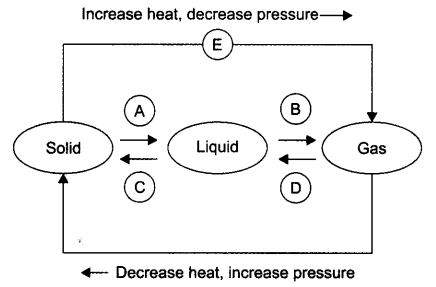
Answer: A —> Liquefication/melting/fusion B —> Vapourisation/evaporation C—>Condensation D—> Solidification E —> Sublimation F —> Sublimation
For the official Class 10 Mathematics Solutions, you can visit:
- NCERT Textbooks (for Class 10):
NEW BOOK UPDATED 2026: Chapter 5 – EXPLORING MIXTURES
## Chapter End Exercises & Solutions
### Question 1: Which of the following mixtures are correctly classified as homogeneous (Hm) and heterogeneous (Ht)? Choose the correct option.
(i) Air — Hm, Milk — Ht, Sugar solution — Hm, Smoke — Hm
(ii) Brass — Ht, Fog — Ht, Vinegar — Ht, Muddy water — Hm
(iii) Copper sulfate solution — Hm, Salt solution — Hm, Milk — Hm, Bronze — Hm
(iv) Muddy water — Ht, Milk — Ht, Blood — Ht, Brass — Hm
#### Answer:
The correct option is (iv).
Explanation:
- Muddy water: It is a suspension where soil particles remain suspended and visible, making it heterogeneous (Ht).
- Milk and Blood: These are colloids. Even though they look uniform, under a microscope they contain distinct particles (fats/proteins in milk and blood cells in plasma) that do not completely dissolve, making them heterogeneous (Ht).
- Brass: It is an alloy (a solid solution of copper and zinc) with a uniform composition throughout, making it homogeneous (Hm).
### Question 2: Choose the correct options, and explain the reason for the correct and incorrect options. Which among the following mixtures show the Tyndall Effect? A mixture of:
(a) air and dust particles
(b) copper sulfate and water
(c) starch and water
(d) acetone and water
(i) a and b
(ii) b and d
(iii) a and c
(iv) c and d
#### Answer:
The correct option is (iii) a and c.
Reason for Correct Options (Show Tyndall Effect):
The Tyndall effect is the scattering of light by particles large enough to intercept a light beam. It is shown by colloids and suspensions.
- (a) Air and dust particles: This forms a colloid (an aerosol where solid dust is scattered in gas). The dust particles scatter light, making a beam of sunlight visible in a dark room.
- (c) Starch and water: This forms a colloid. Starch molecules cluster into intermediate-sized particles that do not completely dissolve on a molecular level, allowing them to scatter light.
Reason for Incorrect Options (Do NOT Show Tyndall Effect):
- (b) Copper sulfate and water: This forms a true solution. The solute particles break down into individual ions smaller than $1\text{ nm}$, which are too small to scatter light.
- (d) Acetone and water: These are two completely miscible liquids forming a uniform, homogeneous true solution. Because the particles are extremely small, light passes straight through without scattering.
### Question 3: A mixture can be categorised as a solution, a suspension, or a colloid, each possessing distinct properties. Utilise the words or phrases provided in the box to fill in the Table 5.2.
(Note: Table 5.2 represents the complete comparative properties required by the NCERT syllabus).
#### Answer:
Table 5.2: Comparative Properties of Solutions, Colloids, and Suspensions
| Property | True Solution | Colloid | Suspension |
| Type of Mixture | Homogeneous | Heterogeneous (appears homogeneous) | Heterogeneous |
| Particle Size | Smallest ($< 1\text{ nm}$) | Intermediate ($1\text{ nm}$ to $1000\text{ nm}$) | Largest ($> 1000\text{ nm}$) |
| Filterability | Passes through filter paper | Passes through filter paper | Retained on filter paper |
| Stability | Highly Stable (particles do not settle) | Stable (particles do not settle) | Unstable (particles settle at the bottom) |
| Tyndall Effect | Does not show | Shows distinctly | Shows (until particles settle) |
| Visibility | Particles invisible even under microscope | Invisible to naked eye, visible under microscope | Particles visible to the naked eye |
| Examples | Salt solution, Vinegar | Milk, Blood, Fog | Muddy water, Chalk powder in water |
### Question 4: Solve the following problems:
(i) A cake recipe uses dry ingredients, namely 75 g of sugar for 420 g of all-purpose flour and 5 g of sodium hydrogencarbonate. Express the concentration of each component in the mixture using an appropriate method.
(ii) A brass alloy contains 70% copper by mass. Calculate the quantities of copper and zinc present in 120 g of brass.
#### Answer:
(i) Total mass of the dry ingredients mixture
= Mass of flour + Mass of sugar + Mass of sodium hydrogencarbonate
= 420 g + 75 g + 5 g
= 500 g
Concentration of each component by mass percentage:
- Flour
- Sugar
- Sodium hydrogencarbonate
Therefore, the mixture contains:
- Flour = 84%
- Sugar = 15%
- Sodium hydrogencarbonate = 1%
(ii) Brass contains 70% copper by mass.
Mass of brass = 120 g
Copper in brass:
Percentage of zinc:
Zinc in brass:
Therefore:
- Copper = 84 g
- Zinc = 36 g
### Question 5: The label on a cooking oil pack says one litre (910 g). If this oil is mixed with water, will it form a separate layer? If so, which substance will be on top? How will you separate the two layers? Also, draw the diagram of the apparatus used.
#### Answer: Yes, cooking oil and water will form separate layers because they are immiscible liquids (they do not mix with each other).
The density of cooking oil is less than water:
- 1 litre oil = 910 g
- 1 litre water = 1000 g
Since oil is lighter, the oil layer will float on top of the water.
The two liquids can be separated using a separating funnel.
Steps:
- Pour the oil-water mixture into a separating funnel.
- Allow it to stand undisturbed for some time.
- Water forms the lower layer and oil forms the upper layer.
- Open the stopcock to drain the lower water layer into a beaker.
- Close the tap when the oil layer reaches the stopcock.
Diagram of Separating Funnel:
### Question 6: Assertion (A): Solutions do not exhibit the Tyndall effect.
Reason (R): The particles in solutions are larger than 100 nm, so they cannot scatter light.
Choose the correct option:
(i) Both A and R are true, and R is the correct explanation of A.
(ii) Both A and R are true, but R is not the correct explanation of A.
(iii) A is true, but R is false.
(iv) A is false, but R is true.
#### Answer:
The correct option is (iii) A is true, but R is false.
Explanation: The Assertion (A) is completely true because true solutions pass light cleanly without any scattering. However, the Reason (R) is completely false because the particles in a true solution are actually smaller than 1nm.
### Question 7: How would you separate the mixtures given in Table 5.3? Mention the reason for choosing your method. If a mixture cannot be separated, explain why.
#### Answer:
Table 5.3: Separation Methods and Reasons
| Mixture | Method of Separation | Reason for Selection |
| Mud from muddy water | Filtration | Mud particles are large, insoluble suspended solids that cannot pass through the pores of a filter paper. |
| Plasma from other components in blood sample | Centrifugation | Spinning blood at ultra-high speeds forces the denser blood cells to settle at the bottom, isolating the liquid plasma on top. |
| Naphthalene and sand | Sublimation | Naphthalene is a sublime substance that transforms directly from solid to gas when heated, leaving the stable sand behind. |
| Chalk powder and common salt | Dissolution in water, Filtration, followed by Evaporation | Salt is soluble in water while chalk is not. Dissolving the mixture allows you to filter the chalk out and then evaporate the water to reclaim the salt. |
| Common salt and water | Evaporation (or Distillation) | Water has a low boiling point and vaporizes into gas, leaving the non-volatile solid salt crystals behind in the dish. |
| Oil from water | Separating Funnel | They are completely immiscible liquids that separate naturally into distinct layers due to differences in their densities. |
| Pigments of the flower | Paper Chromatography | Different colored natural pigments travel up specialized chromatography paper at different speeds based on their varying solubility. |
### Question 8: Two miscible liquids, A and B, are present in a mixture. The boiling point of A is 60 °C and the boiling point of B is 90 °C. Suggest a method to separate them. Also, draw a labelled diagram of the method suggested.
#### Answer:
Suggested Method: Simple Distillation
Reason:
The two liquids are miscible and have different boiling points:
- Boiling point of A = 60 °C
- Boiling point of B = 90 °C
They can be separated by simple distillation because the difference in boiling points is large enough.
Principle:
The liquid with the lower boiling point vaporises first. Therefore, liquid A boils first at 60 °C, changes into vapour, and then condenses back into liquid in the condenser. Liquid B remains in the distillation flask.
Steps:
- Take the mixture in a distillation flask.
- Heat the mixture gently.
- Liquid A vaporises first at 60 °C.
- The vapours pass through the condenser where they cool and condense.
- Pure liquid A is collected in the receiving flask.
- Liquid B remains behind in the flask.
Labelled Diagram of Simple Distillation:
### Question 9: Compare evaporation, crystallization and distillation. In which situation, would you prefer each of these over the others?
#### Answer:
Comparison Matrix:
- Evaporation: Separates a soluble solid from a liquid by boiling away the liquid. The liquid solvent is completely lost to the atmosphere.
- Crystallization: Separates a pure solid from an impure sample by forming pure crystals from a saturated solution. It yields higher purity than evaporation.
- Distillation: Separates liquids from liquids (or solvents from solids) based on boiling point differences. Both the solid solute and liquid solvent are recovered completely.
When to prefer each method:
- Prefer Evaporation: When you only need to recover the solid solute, the liquid solvent has no value, and the solid is stable enough not to decompose under direct heating (e.g., getting salt from seawater).
- Prefer Crystallization: When the solid substance tends to decompose, char, or break down upon direct heating to dryness (like sugar or copper sulfate), or when you require a highly pure crystalline sample free from soluble impurities.
- Prefer Distillation: When you need to recover both the liquid solvent and the solute, or when you are separating a mixture of two or more completely miscible liquids.
### Question 10: Blood is an example of a colloidal mixture.
(i) What would happen if blood behaved like a true suspension inside the body?
(ii) In a blood sample, identify the dispersed phase and the dispersion medium.
#### Answer:
(i) If blood behaved like a suspension:
If blood acted like a true suspension, it would become highly unstable when at rest. Whenever a person sits or sleeps still, the heavy cellular components (RBCs, WBCs, and platelets) would settle down to the bottom of the blood vessels due to gravity. This sedimentation would instantly clog blood vessels, completely stop blood circulation, and prevent oxygen from reaching vital organs, making life impossible.
(ii) Blood Components:
- Dispersed Phase (Solute-like components): Blood cells (Red Blood Cells, White Blood Cells, and Platelets).
- Dispersion Medium (Solvent-like component): Liquid Plasma (which consists mostly of water, proteins, and dissolved nutrients).
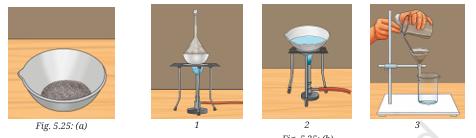
### Question 11: You are given a mixture of sand, common salt and naphthalene (Fig. 5.25a). Identify and write down the correct sequence of separation techniques depicted in Fig. 5.25b.
#### Answer:
The correct sequence of separation techniques is 1 → 3 → 2.
The Step-by-Step Process:
- Step 1 (Sublimation): Heat the mixture in a china dish covered with an inverted funnel. Naphthalene is a sublime substance; it will change directly into vapor and solidify on the inner walls of the funnel. This separates Naphthalene from the sand and salt.
- Step 3 (Filtration): Dissolve the remaining residue (sand and salt) in water. Salt is soluble, but sand is not. Pour the mixture through a filter paper. The sand remains as a residue on the paper, while the salt solution passes through as the filtrate.
- Step 2 (Evaporation): Heat the salt solution in a china dish. The water will evaporate into the air, leaving behind the pure common salt crystals.
### Question 12: Why is distillation an effective method for separating a mixture of water and acetone?
#### Answer:
Distillation is effective for separating water and acetone because they are miscible liquids with a significant difference in their boiling points.
- The boiling point of Acetone is approximately 56°C.
- The boiling point of Water is 100°C.
Because the boiling point difference is more than 25°C, when the mixture is heated, acetone vaporizes first. These vapors are then condensed back into liquid form in a condenser and collected separately, leaving the water behind in the distillation flask.
### Question 13: Answer the following questions with the help of the data given in Table 5.4 (Solubility of various salts).
Table 5.4: Solubility of Various Salts at Different Temperatures
(Solubility expressed in grams of salt per 100 grams of water)
| Name of Salt | 10 °C | 20 °C | 30 °C | 40 °C | 60 °C | 80 °C |
| Potassium nitrate | 21 | 32 | 45 | 62 | 106 | 167 |
| Sodium chloride | 36 | 36 | 36.3 | 36.5 | 37 | 37 |
| Potassium chloride | 35 | 35 | 37.4 | 40 | 46 | 54 |
| Ammonium chloride | 24 | 37 | 41 |
(i) What mass of potassium nitrate would be needed to prepare its saturated solution in 50 g of water at 40 °C?
- From Table 5.4: Solubility of Potassium nitrate at 40 °C is 62 g per 100 g of water.
- Calculation: If 100 g of water needs 62 g, then 50 g of water (which is half) will need half the mass.
Result: 62/2=31 g
Therefore, of potassium nitrate is required.
(ii) A student makes a saturated solution of potassium chloride in water at 80 °C and leaves the solution to cool at room temperature (25 °C). What would she observe as the solution cools? Explain.
- Observation: The student will observe crystals of potassium chloride forming at the bottom of the container.
- Explanation: According to the table, the solubility of potassium chloride decreases as temperature drops (from 54 g at 80 °C to approx 35-36 g at 25 °C). Since the water can no longer hold the excess salt at a lower temperature, the “extra” salt precipitates out as solid crystals.
(iii) What is the effect of a change in temperature on the solubility of salts? Also, compare the changes in the solubility of the four given salts with increasing temperature from 10 °C to 80 °C.
- General Effect: For most salts, solubility increases as the temperature increases.
- Comparison:
- Potassium nitrate: Shows the highest increase in solubility (from 21 g to 167 g).
- Ammonium chloride: Shows a significant increase (from 24 g to 66 g).
- Potassium chloride: Shows a moderate increase (from 35 g to 54 g).
- Sodium chloride: Shows the least change; its solubility remains almost constant (from 36 g to 37 g) despite the temperature rise.
### Question 14: Three students, A, B and C, are preparing sugar solutions for an experiment:
- Student A dissolves 20 g of sugar in 80 g of water.
- Student B dissolves 20 g of sugar in 100 g of water.
- Student C dissolves 30 g of sugar in 80 g of water.
(i) Calculate the mass percentage (% m/m) concentration of sugar in each student’s solution.
(ii) Whose solution is the most concentrated? Explain why.
#### Answer:
(i) Mass Percentage Calculations:The formula for mass percentage is:
For Student A:
For Student B:
For Student C:
(ii) Most Concentrated Solution:
Student C’s solution is the most concentrated.
Reason: Concentration depends on the ratio of solute to the total solution. Student C has the highest mass percentage (27.27%) because they dissolved the greatest amount of sugar (30 g) in the same amount of water used by Student A (80 g). Student C also used less water than Student B. Therefore, Student C’s solution is the most concentrated.
Question 15: Examine Fig. 5.26.
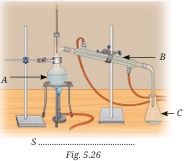
(i) Identify the separation technique marked as ‘S’.
(ii) Label the apparatus A, B and C.
(iii) Which of the following mixtures can be separated by the technique identified above? Use the data given in Table 5.5.

#### Answer:
(i) Identification:
The technique marked as ‘S’ is Simple Distillation.
(ii) Labels:
- A: Distillation Flask
- B: Water Condenser (Liebig Condenser)
- C: Receiving Flask (or Beaker)
(iii) Selecting the correct mixtures:
Simple distillation is effective for separating miscible liquids if the difference in their boiling points is more than 25 °C. Using Table 5.5, let’s calculate the differences:
(a) Water (100°C) — Acetone (56°C)
Difference in boiling points = 100∘C−56∘C=44∘C
Since the difference is large, they can be separated by simple distillation.
(b) Water (100°C) — Salt
Salt is a non-volatile solid and does not evaporate with water.
Therefore, they can be separated by evaporation or simple distillation.
(c) Acetone (56°C) — Alcohol (78°C)
Difference in boiling points = 78∘C−56∘C=22∘C
Since the boiling points are close, they require fractional distillation for separation.
(d) Sand — Salt
Both are solids and cannot be separated by distillation.
They can be separated using filtration after dissolving salt in water, followed by evaporation.
(e) Alcohol (78°C) — Chloroform (61°C)
Difference in boiling points = 78∘C−61∘C=17∘C
Since the difference is small, fractional distillation is required.
(f) Alcohol (78°C) — Benzene (80°C)
Difference in boiling points = 80∘C−78∘C=2∘C
Since the boiling points are very close, fractional distillation is required for separation.
Correct Mixtures for Simple Distillation: (a) and (b).