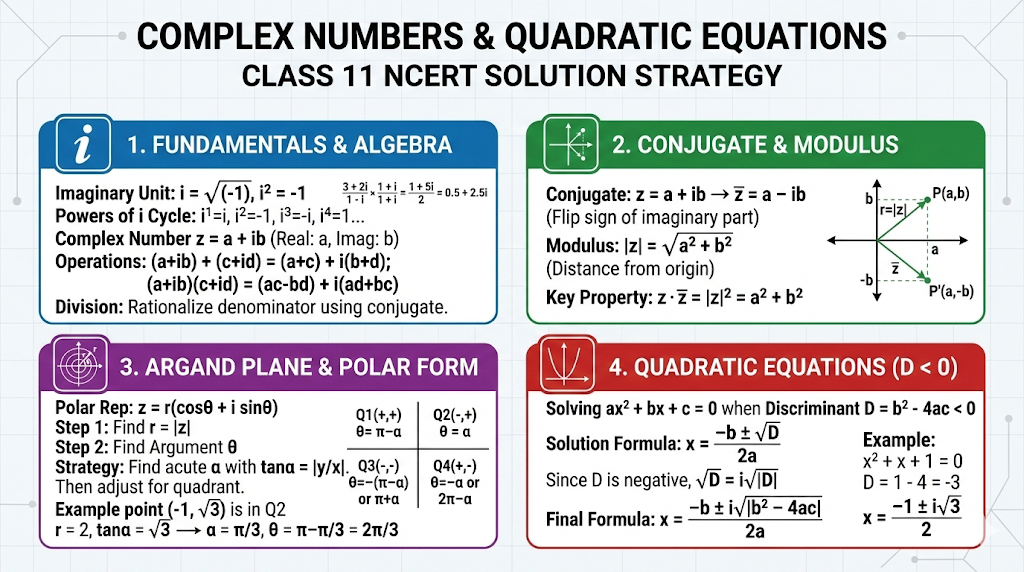
Complex Numbers and Quadratic Equations Class 11 Solution provides detailed and easy-to-understand answers to all the questions of Chapter 5. This chapter covers important concepts such as complex numbers, algebra of complex numbers, Argand plane, quadratic equations, and the relationship between roots and coefficients. On this page, you will find exercise-wise solutions explained step by step to help you build strong
Complex Numbers and Quadratic Equations Class 11 EXERCISE 5.1 Express each complex number in the form a + i b a + ib
1. ( 5 i ) ( − 3 5 i ) (5i)\left(-\frac{3}{5}i\right) = 5 i ⋅ ( − 3 5 i ) = − 3 i 2 = − 3 ( − 1 ) = 3 = 5i \cdot \left(-\frac{3}{5}i\right) = -3 i^2 = -3(-1) = 3 3 \boxed{3}
2. i 9 + i 19 i^9 + i^{19} Using powers of i i i 4 = 1 i^4 = 1 i 9 = i 8 + 1 = i i^9 = i^{8+1} = i i 19 = i 16 + 3 = i 3 = − i i^{19} = i^{16+3} = i^3 = -i i − i = 0 i – i = 0 0 \boxed{0}
3. i − 39 i^{-39} i − 39 = 1 i 39 i^{-39} = \frac{1}{i^{39}} i 39 = i 36 + 3 = i 3 = − i i^{39} = i^{36+3} = i^3 = -i 1 − i = i \frac{1}{-i} = i i \boxed{i}
4. 3 ( 7 + i ) + i ( 7 + i ) 3(7+i) + i(7+i) = 21 + 3 i + 7 i + i 2 = 21 + 3i + 7i + i^2 = 21 + 10 i − 1 = 21 + 10i -1 = 20 + 10 i = 20 + 10i 20 + 10 i \boxed{20 + 10i}
5. ( 1 − i ) − ( − 1 + i 6 ) (1-i) – (-1 + i^6) i 6 = i 4 i 2 = − 1 i^6 = i^4 i^2 = -1 = ( 1 − i ) − ( − 1 − 1 ) = (1-i) – (-1 -1) = ( 1 − i ) + 2 = (1-i) + 2 = 3 − i = 3 – i 3 − i \boxed{3 – i}
6. ( 1 5 + 2 5 i ) − ( 4 + 5 2 i ) \left(\frac{1}{5} + \frac{2}{5}i\right) – \left(4 + \frac{5}{2}i\right) Real part:1 5 − 4 = − 19 5 \frac{1}{5} – 4 = -\frac{19}{5}
Imaginary part:2 5 − 5 2 = 4 − 25 10 = − 21 10 \frac{2}{5} – \frac{5}{2} = \frac{4 – 25}{10} = -\frac{21}{10} − 19 5 − 21 10 i \boxed{-\frac{19}{5} – \frac{21}{10}i}
7. [ ( 1 3 + 7 3 i ) + ( 4 + i ) ] ( − 4 3 + i ) \left[\left(\frac{1}{3} + \frac{7}{3}i\right) + \left(4 + i\right)\right] \left(-\frac{4}{3} + i\right)
First bracket:= 13 3 + 10 3 i = \frac{13}{3} + \frac{10}{3}i
Multiply:= ( 13 3 + 10 3 i ) ( − 4 3 + i ) = \left(\frac{13}{3} + \frac{10}{3}i\right) \left(-\frac{4}{3} + i\right)
After simplification:= − 82 9 + i = -\frac{82}{9} + i − 82 9 + i \boxed{-\frac{82}{9} + i}
8. ( 1 − i ) 4 (1 – i)^4 ( 1 − i ) 2 = 1 − 2 i + i 2 = − 2 i (1-i)^2 = 1 – 2i + i^2 = -2i ( 1 − i ) 4 = ( − 2 i ) 2 = 4 i 2 = − 4 (1-i)^4 = (-2i)^2 = 4i^2 = -4 − 4 \boxed{-4}
9. ( 1 3 + 3 i ) 3 \left(\frac{1}{3} + 3i\right)^3 Using expansion:= − 242 27 − 26 3 i = -\frac{242}{27} – \frac{26}{3}i − 242 27 − 26 3 i \boxed{-\frac{242}{27} – \frac{26}{3}i}
10. ( − 2 − 1 3 i ) 3 \left(-2 – \frac{1}{3}i\right)^3 After expansion:= − 214 9 − 107 27 i = -\frac{214}{9} – \frac{107}{27}i − 214 9 − 107 27 i \boxed{-\frac{214}{9} – \frac{107}{27}i}
EXERCISE 5.2 1. Find the modulus and argument For a complex numberz = x + i y z = x + iy ∣ z ∣ = x 2 + y 2 |z| = \sqrt{x^2 + y^2} arg ( z ) = tan − 1 ( y x ) \arg(z) = \tan^{-1}\left(\frac{y}{x}\right)
1. z = − 1 − i 3 z = -1 – i\sqrt{3} Modulus:∣ z ∣ = ( − 1 ) 2 + ( − 3 ) 2 = 1 + 3 = 2 |z| = \sqrt{(-1)^2 + (-\sqrt{3})^2} = \sqrt{1 + 3} = 2
Argument:tan θ = − 3 − 1 = 3 \tan \theta = \frac{-\sqrt{3}}{-1} = \sqrt{3}
Reference angle:θ = π 3 \theta = \frac{\pi}{3}
Since point lies in III quadrant :θ = − 2 π 3 (principal argument) \theta = -\frac{2\pi}{3} \quad \text{(principal argument)} ∣ z ∣ = 2 , arg ( z ) = − 2 π 3 \boxed{|z| = 2,\quad \arg(z) = -\frac{2\pi}{3}}
2. z = − 3 + i z = -\sqrt{3} + i Modulus:∣ z ∣ = 3 + 1 = 2 |z| = \sqrt{3 + 1} = 2
Argument:tan θ = 1 − 3 = − 1 3 \tan \theta = \frac{1}{-\sqrt{3}} = -\frac{1}{\sqrt{3}}
Reference angle:π 6 \frac{\pi}{6}
Point lies in II quadrant :θ = π − π 6 = 5 π 6 \theta = \pi – \frac{\pi}{6} = \frac{5\pi}{6} ∣ z ∣ = 2 , arg ( z ) = 5 π 6 \boxed{|z| = 2,\quad \arg(z) = \frac{5\pi}{6}}
2. Convert into Polar Form Polar form:z = r ( cos θ + i sin θ ) z = r(\cos\theta + i\sin\theta)
3. z = 1 − i z = 1 – i ∣ z ∣ = 1 + 1 = 2 |z| = \sqrt{1+1} = \sqrt{2} θ = − π 4 \theta = -\frac{\pi}{4} 2 ( cos ( − π 4 ) + i sin ( − π 4 ) ) \boxed{\sqrt{2}\left(\cos\left(-\frac{\pi}{4}\right) + i\sin\left(-\frac{\pi}{4}\right)\right)}
4. z = − 1 + i z = -1 + i ∣ z ∣ = 2 |z| = \sqrt{2} θ = 3 π 4 \theta = \frac{3\pi}{4} 2 ( cos 3 π 4 + i sin 3 π 4 ) \boxed{\sqrt{2}\left(\cos\frac{3\pi}{4} + i\sin\frac{3\pi}{4}\right)}
5. z = − 1 − i z = -1 – i ∣ z ∣ = 2 |z| = \sqrt{2} θ = − 3 π 4 \theta = -\frac{3\pi}{4} 2 ( cos ( − 3 π 4 ) + i sin ( − 3 π 4 ) ) \boxed{\sqrt{2}\left(\cos\left(-\frac{3\pi}{4}\right) + i\sin\left(-\frac{3\pi}{4}\right)\right)}
6. z = − 3 z = -3 ∣ z ∣ = 3 |z| = 3 θ = π \theta = \pi 3 ( cos π + i sin π ) \boxed{3(\cos\pi + i\sin\pi)}
7. z = 3 + i z = \sqrt{3} + i ∣ z ∣ = 2 |z| = 2 θ = π 6 \theta = \frac{\pi}{6} 2 ( cos π 6 + i sin π 6 ) \boxed{2\left(\cos\frac{\pi}{6} + i\sin\frac{\pi}{6}\right)}
8. z = i z = i ∣ z ∣ = 1 |z| = 1 θ = π 2 \theta = \frac{\pi}{2} cos π 2 + i sin π 2 \boxed{\cos\frac{\pi}{2} + i\sin\frac{\pi}{2}}
EXERCISE 5.3 Solve each of the following equations:
1. x 2 + 3 = 0 x^2 + 3 = 0 x 2 = − 3 x^2 = -3 x = ± − 3 = ± i 3 x = \pm \sqrt{-3} = \pm i\sqrt{3} x = ± i 3 \boxed{x = \pm i\sqrt{3}}
2. 2 x 2 + x + 1 = 0 2x^2 + x + 1 = 0 Using quadratic formula:x = − b ± b 2 − 4 a c 2 a x = \frac{-b \pm \sqrt{b^2 – 4ac}}{2a}
Here a = 2 , b = 1 , c = 1 a=2,\; b=1,\; c=1 Δ = 1 − 8 = − 7 \Delta = 1 – 8 = -7 x = − 1 ± i 7 4 x = \frac{-1 \pm i\sqrt{7}}{4} x = − 1 ± i 7 4 \boxed{x = \frac{-1 \pm i\sqrt{7}}{4}}
3. x 2 + 3 x + 9 = 0 x^2 + 3x + 9 = 0 Δ = 9 − 36 = − 27 \Delta = 9 – 36 = -27 x = − 3 ± 3 i 3 2 x = \frac{-3 \pm 3i\sqrt{3}}{2} x = − 3 ± 3 i 3 2 \boxed{x = \frac{-3 \pm 3i\sqrt{3}}{2}}
4. − x 2 + x − 2 = 0 -x^2 + x – 2 = 0 Multiply by -1:x 2 − x + 2 = 0 x^2 – x + 2 = 0 Δ = 1 − 8 = − 7 \Delta = 1 – 8 = -7 x = 1 ± i 7 2 x = \frac{1 \pm i\sqrt{7}}{2} x = 1 ± i 7 2 \boxed{x = \frac{1 \pm i\sqrt{7}}{2}}
5. x 2 + 3 x + 5 = 0 x^2 + 3x + 5 = 0 Δ = 9 − 20 = − 11 \Delta = 9 – 20 = -11 x = − 3 ± i 11 2 x = \frac{-3 \pm i\sqrt{11}}{2} x = − 3 ± i 11 2 \boxed{x = \frac{-3 \pm i\sqrt{11}}{2}}
6. x 2 − x + 2 = 0 x^2 – x + 2 = 0 Δ = 1 − 8 = − 7 \Delta = 1 – 8 = -7 x = 1 ± i 7 2 x = \frac{1 \pm i\sqrt{7}}{2} x = 1 ± i 7 2 \boxed{x = \frac{1 \pm i\sqrt{7}}{2}}
7. 3 x 2 − 2 x + 3 3 = 0 \sqrt{3}x^2 – \sqrt{2}x + 3\sqrt{3} = 0 a = 3 , b = − 2 , c = 3 3 a=\sqrt{3},\; b=-\sqrt{2},\; c=3\sqrt{3} Δ = 2 − 36 = − 34 \Delta = 2 – 36 = -34 x = 2 ± i 34 2 3 x = \frac{\sqrt{2} \pm i\sqrt{34}}{2\sqrt{3}} x = 2 ± i 34 2 3 \boxed{x = \frac{\sqrt{2} \pm i\sqrt{34}}{2\sqrt{3}}}
8. 2 x 2 + x − 2 = 0 \sqrt{2}x^2 + x – \sqrt{2} = 0 Δ = 1 + 8 = 9 \Delta = 1 + 8 = 9 x = − 1 ± 3 2 2 x = \frac{-1 \pm 3}{2\sqrt{2}} x = 2 2 2 = 1 2 or x = − 4 2 2 = − 2 x = \frac{2}{2\sqrt{2}} = \frac{1}{\sqrt{2}} \quad \text{or} \quad x = \frac{-4}{2\sqrt{2}} = -\sqrt{2} x = 1 2 , − 2 \boxed{x = \frac{1}{\sqrt{2}},\; -\sqrt{2}}
9. x 2 + x + 1 2 = 0 x^2 + x + \frac{1}{\sqrt{2}} = 0 Δ = 1 − 4 2 \Delta = 1 – \frac{4}{\sqrt{2}} Δ = 1 − 2 2 \Delta = 1 – 2\sqrt{2}
Since Δ < 0 \Delta < 0 x = − 1 ± i 2 2 − 1 2 x = \frac{-1 \pm i\sqrt{2\sqrt{2}-1}}{2} x = − 1 ± i 2 2 − 1 2 \boxed{x = \frac{-1 \pm i\sqrt{2\sqrt{2}-1}}{2}}
10. x 2 + x 2 + 1 = 0 x^2 + \frac{x}{\sqrt{2}} + 1 = 0 Δ = 1 2 − 4 = − 7 2 \Delta = \frac{1}{2} – 4 = -\frac{7}{2} x = − 1 2 ± i 7 2 2 x = \frac{-\frac{1}{\sqrt{2}} \pm i\sqrt{\frac{7}{2}}}{2} x = − 1 ± i 7 2 2 x = \frac{-1 \pm i\sqrt{7}}{2\sqrt{2}} x = − 1 ± i 7 2 2 \boxed{x = \frac{-1 \pm i\sqrt{7}}{2\sqrt{2}}} Miscellaneous Exercise – Chapter 5
1. Evaluate [ i 8 + ( 1 i ) 2 ] 3 \left[i^8 + \left(\frac{1}{i}\right)^2\right]^3 i 8 = ( i 4 ) 2 = 1 i^8 = (i^4)^2 = 1 ( 1 i ) 2 = 1 i 2 = 1 − 1 = − 1 \left(\frac{1}{i}\right)^2 = \frac{1}{i^2} = \frac{1}{-1} = -1 ⇒ ( 1 − 1 ) 3 = 0 \Rightarrow (1 – 1)^3 = 0 0 \boxed{0}
2. Prove that Re ( z 1 z 2 ) = Re z 1 Re z 2 − Im z 1 Im z 2 \text{Re}(z_1 z_2) = \text{Re}z_1 \text{Re}z_2 – \text{Im}z_1 \text{Im}z_2
Let:z 1 = a + i b , z 2 = c + i d z_1 = a + ib, \quad z_2 = c + id z 1 z 2 = ( a + i b ) ( c + i d ) = a c + i a d + i b c + i 2 b d z_1 z_2 = (a+ib)(c+id) = ac + iad + ibc + i^2 bd = ( a c − b d ) + i ( a d + b c ) = (ac – bd) + i(ad + bc) Re ( z 1 z 2 ) = a c − b d \text{Re}(z_1 z_2) = ac – bd = Re z 1 Re z 2 − Im z 1 Im z 2 = \text{Re}z_1 \text{Re}z_2 – \text{Im}z_1 \text{Im}z_2 Proved \boxed{\text{Proved}}
3. Reduce ( 1 − i 1 − 4 i + 2 5 + i ) \left(\frac{1-i}{1-4i} + \frac{2}{5+i}\right)
First term:1 − i 1 − 4 i × 1 + 4 i 1 + 4 i = 5 + 3 i 17 \frac{1-i}{1-4i} \times \frac{1+4i}{1+4i} = \frac{5+3i}{17}
Second term:2 5 + i × 5 − i 5 − i = 10 − 2 i 26 = 5 − i 13 \frac{2}{5+i} \times \frac{5-i}{5-i} = \frac{10-2i}{26} = \frac{5-i}{13}
Add:= 5 + 3 i 17 + 5 − i 13 = \frac{5+3i}{17} + \frac{5-i}{13}
Taking LCM and simplifying:= 150 + 22 i 221 = \frac{150+22i}{221} 150 221 + 22 221 i \boxed{\frac{150}{221} + \frac{22}{221}i}
4. If x − i y = a − i b c − i d x – iy = \sqrt{\frac{a-ib}{c-id}}
Prove:( x 2 + y 2 ) 2 = a 2 + b 2 c 2 + d 2 (x^2 + y^2)^2 = \frac{a^2 + b^2}{c^2 + d^2}
Take modulus both sides:∣ x − i y ∣ 2 = ∣ a − i b c − i d ∣ 2 |x-iy|^2 = \left|\sqrt{\frac{a-ib}{c-id}}\right|^2 x 2 + y 2 = a 2 + b 2 c 2 + d 2 x^2 + y^2 = \sqrt{\frac{a^2+b^2}{c^2+d^2}}
Squaring:( x 2 + y 2 ) 2 = a 2 + b 2 c 2 + d 2 (x^2+y^2)^2 = \frac{a^2+b^2}{c^2+d^2} Proved \boxed{\text{Proved}}
5. Convert to Polar Form (i) 1 + 7 i ( 2 − i ) 2 \frac{1+7i}{(2-i)^2} ( 2 − i ) 2 = 3 − 4 i (2-i)^2 = 3-4i z = 1 + 7 i 3 − 4 i = − 25 + 25 i 25 = − 1 + i z = \frac{1+7i}{3-4i} = \frac{-25+25i}{25} = -1 + i
Modulus:∣ z ∣ = 2 |z| = \sqrt{2}
Argument:θ = 3 π 4 \theta = \frac{3\pi}{4} 2 ( cos 3 π 4 + i sin 3 π 4 ) \boxed{\sqrt{2}\left(\cos\frac{3\pi}{4} + i\sin\frac{3\pi}{4}\right)}
(ii) 1 + 3 i 1 − 2 i \frac{1+3i}{1-2i}
Multiply conjugate:= − 1 + i = -1 + i
Polar form same as above:2 ( cos 3 π 4 + i sin 3 π 4 ) \boxed{\sqrt{2}\left(\cos\frac{3\pi}{4} + i\sin\frac{3\pi}{4}\right)}
Solve each equation 6. 3 x 2 − 4 x + 20 3 = 0 3x^2 – 4x + \frac{20}{3} = 0 9 x 2 − 12 x + 20 = 0 9x^2 -12x +20=0 Δ = 144 − 720 = − 576 \Delta = 144 -720 = -576 x = 12 ± 24 i 18 = 2 ± 4 i 3 x = \frac{12 \pm 24i}{18} = \frac{2 \pm 4i}{3} x = 2 ± 4 i 3 \boxed{x = \frac{2 \pm 4i}{3}}
7. x 2 − 2 x + 3 2 = 0 x^2 -2x + \frac{3}{2} = 0 2 x 2 − 4 x + 3 = 0 2x^2 -4x +3=0 Δ = 16 − 24 = − 8 \Delta = 16 -24 = -8 x = 1 ± i 2 2 x = 1 \pm \frac{i\sqrt{2}}{2} x = 1 ± i 2 2 \boxed{x = 1 \pm \frac{i\sqrt{2}}{2}}
8. 27 x 2 − 10 x + 1 = 0 27x^2 -10x +1 = 0 Δ = 100 − 108 = − 8 \Delta = 100 -108 = -8 x = 10 ± 2 i 2 54 = 5 ± i 2 27 x = \frac{10 \pm 2i\sqrt{2}}{54} = \frac{5 \pm i\sqrt{2}}{27} x = 5 ± i 2 27 \boxed{x = \frac{5 \pm i\sqrt{2}}{27}}
For the official Class 11 Physics Solutions , you can visit:
NCERT Textbooks ncert resources
Class-wise Solutions Class 12:
Class 12 Physics – NCERT Solutions
Class 12 Chemistry – NCERT Solutions
Class 11:
Class 10:
Class 10 Science – CBSE SQP 2024
Class 10 Science – NCERT Solutions
Class 10 Math – NCERT Solutions