
In this section, we provide clear and step-by-step NCERT Solutions For Class 10 Maths Chapter 2 Polynomials Ex 2.4. These solutions are designed to help students understand the concepts of polynomials, algebraic identities, and their applications in a simple and easy-to-follow manner. Each question is solved in a detailed way to improve problem-solving skills and build a strong mathematical foundation.
It is important to note that Exercise 2.4 has been recently excluded from the NCERT syllabus, but it still holds great value for practice and conceptual understanding. Students who want to strengthen their basics and prepare for higher-level mathematics can still go through these questions for better clarity.
These solutions are prepared according to the latest NCERT guidelines and are helpful for exam preparation, revision, and self-study.
Question 1.
Verify that the numbers given alongside of the cubic polynomials below are their zeroes. Also, verify the relationship between the zeroes and the coefficients in each case:
(i) 2x3 + x2 – 5x + 2; 1, -2
(ii) x3 – 4x2 + 5x – 2; 2, 1, 1
Solution:
(i) Polynomial: 2x³ + x² – 5x + 2; Zeroes: 1, –2
Step 1: Verify zeroes
For x = 1:
= 2(1)³ + (1)² – 5(1) + 2
= 2 + 1 – 5 + 2
= 0 ✔️
For x = –2:
= 2(–2)³ + (–2)² – 5(–2) + 2
= 2(–8) + 4 + 10 + 2
= –16 + 4 + 10 + 2
= 0 ✔️
So, 1 and –2 are zeroes.
Since it is a cubic polynomial, there must be 3 zeroes.
Let the third zero be α.
Step 2: Use relationships between zeroes and coefficients
For polynomial ax³ + bx² + cx + d:
Sum of zeroes = –b/a
Product of zeroes = –d/a
Here, a = 2, b = 1, c = –5, d = 2
Sum of zeroes = –1/2
So,
1 + (–2) + α = –1/2
–1 + α = –1/2
α = 1/2
Step 3: Verify product
Product of zeroes = 1 × (–2) × (1/2) = –1
According to formula:
Product = –d/a = –2/2 = –1 ✔️
Verified
(ii) Polynomial: x³ – 4x² + 5x – 2; Zeroes: 2, 1, 1
Step 1: Verify zeroes
For x = 2:
= 8 – 16 + 10 – 2 = 0 ✔️
For x = 1:
= 1 – 4 + 5 – 2 = 0 ✔️
Since 1 is repeated, it is a double root.
Step 2: Check relationships
Here, a = 1, b = –4, c = 5, d = –2
Sum of zeroes = 2 + 1 + 1 = 4
Formula: –b/a = –(–4)/1 = 4 ✔️
Step 3: Sum of products of zeroes taken two at a time
= (2×1) + (1×1) + (2×1)
= 2 + 1 + 2 = 5
Formula: c/a = 5/1 = 5 ✔️
Step 4: Product of zeroes
= 2 × 1 × 1 = 2
Formula: –d/a = –(–2)/1 = 2 ✔️
Final Conclusion
In both cases, the given numbers are zeroes of the polynomials, and the relationships between zeroes and coefficients are verified successfully.
Question 2.
Find a cubic polynomial with the sum, some of the product of its zeroes taken two at a time, and the product of its zeroes as 2, -7, -14 respectively.
Solution:
Given:
Sum of zeroes = 2
Sum of product of zeroes taken two at a time = –7
Product of zeroes = –14
For a cubic polynomial with zeroes α, β, γ, the standard form is:
x³ – (sum of zeroes)x² + (sum of product of zeroes taken two at a time)x – (product of zeroes)
Substituting the values:
x³ – 2x² – 7x + 14
Required cubic polynomial = x³ – 2x² – 7x + 14
Question 3.
If the zeroes of the polynomial x3 – 3x2 + x + 1 are a-b, a, a + b, find a and b.
Solution: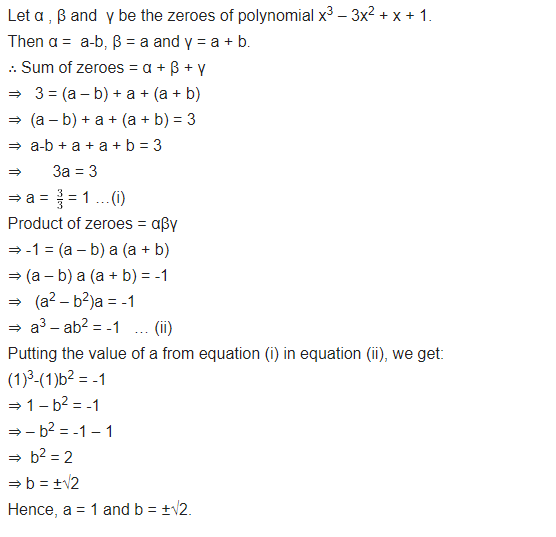
Question 4.
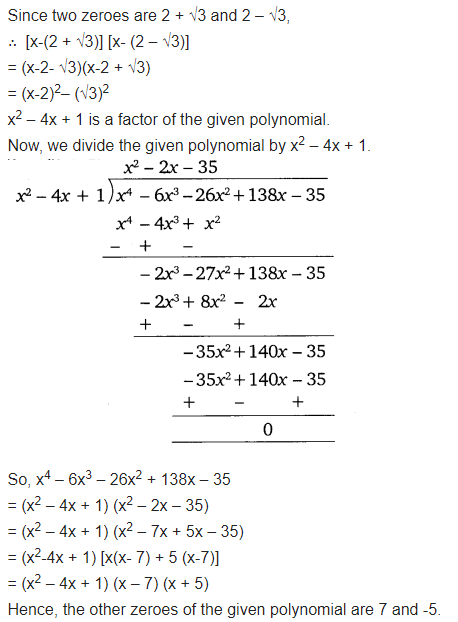
If two zeroes of the polynomial x4 – 6x3 – 26x2 + 138x – 35 are 2 ± √3, find other zeroes.
Solution:

Ex 2.4 Class 10 Maths Question 5.
If the polynomial x4 – 6x3 + 16x2 – 25x + 10 is divided by another polynomial x2 – 2x + k, the remainder comes out to be x + a, find k and a.
Solution: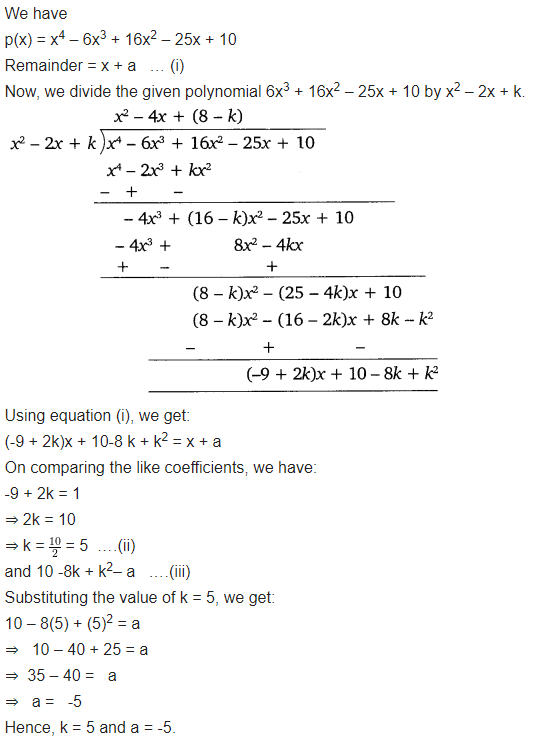
For the official Class 10 Mathematics Solutions, you can visit:
The solutions provided for NCERT Solutions For Class 10 Maths Chapter 2 Polynomials Ex 2.4 help students clearly understand the relationship between zeroes and coefficients of cubic polynomials. By practicing these questions, learners can strengthen their conceptual knowledge and improve their problem-solving skills effectively.
Even though NCERT Solutions For Class 10 Maths Chapter 2 Polynomials Ex 2.4 has been recently excluded from the syllabus, it remains highly useful for building a strong mathematical foundation. Students preparing for higher classes should not skip NCERT Solutions For Class 10 Maths Chapter 2 Polynomials Ex 2.4, as it enhances logical thinking and algebraic understanding.