
Relations and Functions Class 11 NCERT Solutions provides clear and detailed answers to all the questions of Chapter 2. This chapter introduces the concepts of relations, types of relations, functions, domain and range, and different types of functions. On this page, you will find exercise-wise solutions explained step by step to help you build strong fundamentals and score high in your exams.
Relations and Functions Class 11 NCERT Solutions
EXERCISE 2.1
1.If the set A has 3 elements and the set B = {3, 4, 5}, then find the number of
elements in (A×B).
Sol: We use the formula:
Number of elements in A × B = (Number of elements in A) × (Number of elements in B)
Given:
- n(A) = 3
- B = {3, 4, 5} ⇒ n(B) = 3
So,
n(A × B) = 3 × 3 = 9
Therefore, the number of elements in (A × B) is 9
2.If G = {7, 8} and H = {5, 4, 2}, find G × H and H × G.
Sol: 1.
The Cartesian product consists of all ordered pairs where and .
Number of elements:
The Cartesian product H×G consists of all ordered pairs where and .
Number of elements:
3.State whether each of the following statements are true or false. If the statement is false, rewrite the given statement correctly.
(i) If P = {m, n} and Q = { n, m}, then P × Q = {(m, n),(n, m)}.
(ii) If A and B are non-empty sets, then A × B is a non-empty set of ordered pairs (x, y) such that x ∈ A and y ∈ B.
(iii) If A = {1, 2}, B = {3, 4}, then A × (B ∩ φ) = φ.
Sol : (i)
Given:
},
Since sets are unordered,
So,
The given statement says:
False
Correct statement:
(ii)
Statement:
If and are non-empty sets, then is a non-empty set of ordered pairs such that and .
Since both sets are non-empty, at least one ordered pair can be formed.
True
(iii)
Given:
We know:
So,
Now,
True
4.If A = {–1, 1}, find A × A × A.
Sol: Given:
We need to find:
This means all ordered triples where each element belongs to .
Since has 2 elements, the total number of ordered triples is:
Now listing all possible triples:
Thus, contains 8 ordered triples.
5.If A × B = {(a, x),(a , y), (b, x), (b, y)}. Find A and B.
Sol: Given:
In a Cartesian product , the first elements of the ordered pairs come from set , and the second elements come from set .
From the given ordered pairs:
- First components:
- Second components:
Thus,
Since all possible combinations of a,b with x,y are present, this confirms the sets.
6.Let A = {1, 2}, B = {1, 2, 3, 4}, C = {5, 6} and D = {5, 6, 7, 8}. Verify that
(i) A × (B ∩ C) = (A × B) ∩ (A × C). (ii) A × C is a subset of B × D.
Sol:
Given:
(i) Verify
First find:
Since } and , there is no common element.
Now,
Now find A×B:
Find :
Now take intersection:
There are no common ordered pairs between and .
Thus,
Verified.
(ii) Verify
First write :
We already have:
Each ordered pair of is present in .
Therefore,
Verified.
7. Let A = {1, 2} and B = {3, 4}. Write A × B. How many subsets will A × B have? List them.
Given:
(i) Find
Number of elements:
(ii) Number of subsets of
If a set has n elements, then number of subsets is:2n
Here
(iii) List of all subsets
Let
Subsets:
- ∅
- {(1,3)}
- {(1,4)}
- {(2,3)}
- {(2,4)}
- {(1,3),(1,4)}
- {(1,3),(2,3)}
- {(1,3),(2,4)}
- {(1,4),(2,3)}
- {(1,4),(2,4)}
- {(2,3),(2,4)}
- {(1,3),(1,4),(2,3)}
- {(1,3),(1,4),(2,4)}
- {(1,3),(2,3),(2,4)}
- {(1,4),(2,3),(2,4)}
- {(1,3),(1,4),(2,3),(2,4)}
8.Let A and B be two sets such that n(A) = 3 and n(B) = 2. If (x, 1), (y, 2), (z, 1) are in A × B, find A and B, where x, y and z are distinct elements.
Given:
Given elements in :
Since first components belong to A and are distinct:
Second components belong to :
10.The Cartesian product A × A has 9 elements among which are found (–1, 0) and (0,1). Find the set A and the remaining elements o
Given:
We know:
So,
Given that (−1,0) and (0,1) are in ,
So elements −1,0,1 must be in .
Thus,
Now find remaining elements of
Given already:
Remaining elements are:
EXERCISE 2.2
Question 1
Let
Define a relation R from A to A by
Write down its domain, codomain and range.
Solution
Given,
Now and y must also belong to .
Checking values:x=1x=2x=3x=4x=5⇒y=3⇒y=6⇒y=9⇒y=12⇒y=15(not in A)
Thus,
Domain:
Codomain:
Range:
Question 2
Define a relation on the set of natural numbers by
Depict this relation using roster form. Write down the domain and the range.
Solution
Since ,
Now,
Roster form:
Domain:
Range:
Question 3
Let
Define a relation from to by
Write in roster form.
Solution
The difference between two numbers is odd if one is even and the other is odd.
Elements:
A → odd: 1,3,5 ; even: 2
B → even: 4,6 ; odd: 9
Form ordered pairs:
Odd from A with even from B:
Even from A with odd from B:
Thus,
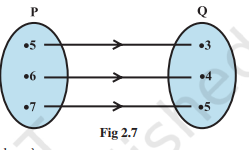
5.The Fig2.7 shows a relationship between the sets P and Q. Write this relation
(i) in set-builder form (ii) roster form (iii) What is its domain and range?
6.Let A = {1, 2, 3, 4, 6}. Let R be the relation on A defined by {(a, b): a , b ∈A, b is exactly divisible by a}.
(i) Write R in roster form
(ii) Find the domain of R
(iii) Find the range of R.
7.Determine the domain and range of the relation R defined by R = {(x, x + 5) : x ∈ {0, 1, 2, 3, 4, 5}}.
8.Write the relation R = {(x, x3) : x is a prime number less than 10} in roster form.
9.Let A = {x, y, z} and B = {1, 2}. Find the number of relations from A to B.
10.Let R be the relation on Z defined by R = {(a,b): a, b ∈ Z, a – b is an integer}.
Find the domain and range of R.
EXERCISE 2.3
1. Which of the following relations are functions? Give reasons. If it is a function, determine its domain and range.
(i)
Each first element has exactly one image.
✅ It is a function.
Domain:
Range:
(ii)
Each first element has exactly one image.
✅ It is a function.
Domain:
Range:
(iii)
The element 1 has two images (3 and 5).
It is not a function.
2. Find the domain and range of the following real functions.
(i)
Domain:
Range:
(ii)
Domain:
Range:
3. A function fff is defined by f(x)=2x−5f(x) = 2x – 5f(x)=2x−5. Write down the values of
(i)
(ii)
(iii)
4. The function ttt which maps temperature in degree Celsius into degree Fahrenheit is defined by
(i)
(ii)
(iii)
(iv) Find when
5. Find the range of each of the following functions.
(i)
Range:
(ii)
Range:
(iii)
Range:
For the official Class 11 Physics Solutions, you can visit:
- NCERT Textbooks
Class-wise Solutions
Class 12:
Class 12 Physics – NCERT Solutions
Class 12 Chemistry – NCERT Solutions
Class 11:
- Class 11 Physics – NCERT Solutions
- Class 11 Chemistry – NCERT Solutions
- Class 11 Biology – NCERT Solutions
- Class 11 Math – NCERT Solutions
Class 10: