
Work, Energy, and Simple Machines
Complete Textbook Solved Examples 7.1 – 7.13
- When she moves the dumbbell upward, the applied force is in the direction of displacement. Therefore, she does positive work.
- When she moves the dumbbell downward, the force applied by her to control the dumbbell is opposite to its displacement. Therefore, she does negative work.
- The goalkeeper applied a force opposite to the motion of the ball. Therefore, the work done is negative.
- Displacement: s = −15 cm = −0.15 m
-
Work done:
W = F × s = 200 × (−0.15)
W = −30 J
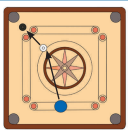
- The moving striker collides with the white coin and applies a force in the direction of its displacement. Thus, it does positive work on the white coin and increases its energy.
- By Newton’s third law, the white coin applies an opposite force on the striker and does negative work on it, decreasing its energy.
- Similarly, the white coin does positive work on the black coin, increasing its energy, while the black coin does negative work on the white coin.
- Let the mass of the vehicle be m and its initial velocity be v.
- Initial kinetic energy: K = ½mv2
- New velocity = 2v.
- New kinetic energy: K’ = ½m(2v)2 = 4 × ½mv2 = 4K
- Therefore, the new kinetic energy is 4 times the original kinetic energy.
- Mass: m = 0.2 kg
- Velocity: v = 154.8 km h−1
- Converting velocity: v = 154.8 ÷ 3.6 = 43 m s−1
-
Kinetic energy:
K = ½mv2
= ½ × 0.2 × 432
= 184.9 J
- Mass: m = 15000 kg
- Force exerted by the wire: F = 367500 N
- Displacement: s = −100 m
-
Work done by the wire:
W = F × s
= 367500 × (−100) = −36,750,000 J - Since the aircraft finally stops: Kf = 0.
- By the work-energy theorem: W = Kf − Ki
- Therefore: −36,750,000 = 0 − ½ × 15000 × v2
-
Solving:
v2 = 4900
v = 70 m s−1 - In km h−1: 70 × 3.6 = 252 km h−1
- Mass: m = 200 g = 0.2 kg
- Height: h = 10 m
- Acceleration due to gravity: g = 10 m s−2
-
Potential energy:
U = mgh
= 0.2 × 10 × 10
= 20 J
- At the top, the child possesses gravitational potential energy: PE = mgh
- At the bottom, this potential energy is converted into kinetic energy, assuming friction is negligible: KE = ½mv2
- By conservation of mechanical energy: mgh = ½mv2
- Cancelling m: gh = ½v2
- Therefore: v = √(2gh)
- Thus, the velocity depends on the height h and does not depend on the mass of the child.
Hint: For a 30° incline, the truck rises 1 m vertically for every 2 m it travels along the ramp.
- Initial velocity: 72 km h−1 = 20 m s−1
- Initial kinetic energy: K = ½mv2 = ½ × 10000 × 202 = 2,000,000 J
- Let the length of the ramp be d. From the given condition, the vertical height gained is: h = d / 2
- Increase in potential energy: PE = mgh = 10000 × 10 × d/2 = 50000d
- Work done by sand: Wsand = −50000d
- Applying energy conservation: 2,000,000 = 50000d + 50000d
-
Therefore:
d = 20 m
Minimum ramp length = 20 m
- Work done: W = mgh = 75 × 10 × 2 = 1500 J
- Power: P = W/t = 1500/5 = 300 W
- Initial velocity: u = 0 m s−1
- Final velocity: v = 72/3.6 = 20 m s−1
- Initial kinetic energy: 0 J
- Final kinetic energy: K = ½mv2 = ½ × 1000 × 202 = 200,000 J
- Work done by the engine: 200,000 J
- Power: P = W/t = 200,000/10 = 20,000 W
- Height: AB = 30 cm
- Width: BC = 40 cm
- Length of ramp: AC = √(302 + 402) = √2500 = 50 cm
- Mechanical advantage of the inclined plane: MA = L/h = 50/30 ≈ 1.67
- Let the 15 kg child sit at seat A, which is 2 m from the fulcrum.
- For balance, the moments about the fulcrum must be equal: 15 × 2 = 30 × L
- Therefore: L = 30/30 = 1 m
- Seat D is 1 m from the fulcrum on the opposite side. Therefore, the 30 kg child should sit on seat D.
Quick Revision
Work: W = F × s • Kinetic Energy: KE = ½mv² • Potential Energy: PE = mgh • Power: P = W/t
Chapter 7: Work, Energy, and Simple Machines
Revise, Reflect, Refine — Exercise Question 1 (True or False with Reasons)
Work, Energy, and Simple Machines
Fill in the Blanks — Exercise Question 2
Revise • Reflect • Refine
W = F × s
1 J = 1 N × 1 m
KE = ½mv2
PE = mgh
where g is the acceleration due to gravity.
P = W / t
where W is the work done and t is the time taken.
When a ball thrown upwards reaches its highest point, tick which of the following statement(s) are correct?
(i) Incorrect: Even at the highest point, the force of gravity acts downward on the ball. Therefore, the force is not zero.
(ii) Incorrect: The acceleration due to gravity continues to act downward. Thus, the acceleration is g ≈ 9.8 m/s², not zero.
(iii) Correct: At the highest point, the velocity of the ball is zero. Therefore, KE = ½mv² = 0.
(iv) Correct: At the highest point, the height of the ball is maximum. Hence, its gravitational potential energy PE = mgh is maximum.
For each of the following situations, identify the energy transformation that takes place:
- A truck moving uphill.
- Unwinding of a watch spring.
- Photosynthesis in green leaves.
- Water flowing from a dam.
- Burning of a matchstick.
- Explosion of a fire cracker.
- Speaking into a microphone.
- A glowing electric bulb.
- A solar panel.
✓ Answer
- Truck moving uphill: Chemical energy of fuel → Kinetic energy → Gravitational potential energy.
- Unwinding of a watch spring: Potential energy stored in the spring → Kinetic energy → Mechanical energy of the watch.
- Photosynthesis in green leaves: Solar energy (light energy) → Chemical energy stored in food.
- Water flowing from a dam: Gravitational potential energy → Kinetic energy → Mechanical energy.
- Burning of a matchstick: Chemical energy → Heat energy + Light energy.
- Explosion of a fire cracker: Chemical energy → Heat energy + Light energy + Sound energy + Kinetic energy.
- Speaking into a microphone: Sound energy → Electrical energy.
- Glowing electric bulb: Electrical energy → Light energy + Heat energy.
- Solar panel: Solar/light energy → Electrical energy.
A student is slowly lifted straight up in an elevator from the ground level to the top floor of a building. Later, the same student climbs the staircase, all the way to the top.
- Height of building, h = 72.5 m
- Acceleration due to gravity, g = 10 m/s²
- Mass of student, m = 50 kg
✓ Complete Answer
(i) Gain in potential energy when lifted by elevator
Gravitational potential energy is:
Substituting the values:
PE = 36,250 J
Therefore, the gain in potential energy is 36,250 J.
(ii) Gain in potential energy when the student climbs the stairs
The student reaches the same height, 72.5 m. Therefore:
PE = 36,250 J
Thus, the gain in potential energy while climbing the stairs is also 36,250 J.
(iii) Conclusion
In both cases, the student reaches the same final height. Hence, the gain in potential energy is the same, irrespective of whether the student is lifted vertically or climbs the staircase.
A crane lifts a mass m to the 10th floor of a building in a certain time. It then raises the same mass to the 20th floor of the same building in double the time. How much more energy and power are required? Assume that the height of all floors is equal.
✓ Complete Answer
Let the height of each floor be h.
Energy required to lift a mass through height H is:
Energy for the 10th floor
Height = 10h
Energy for the 20th floor
Height = 20h
Therefore:
So, the energy required is twice that required for the 10th floor, or 100% more energy.
Power comparison
Let the time taken to reach the 10th floor be t. The time taken to reach the 20th floor is 2t.
Therefore, P₂ = P₁.
Power required = Same as before.
Which factors determine the energy required to raise a flag from the ground to the top of a tall flagpole using a pulley? Does raising the flag slowly or quickly change the amount of work done? If the speed at which the flag is raised is doubled, how does the power requirement change? Explain your answers.
✓ Complete Answer
1. Factors determining the energy required
The energy required to raise the flag is equal to the gain in its gravitational potential energy:
Therefore, the energy depends on:
- Mass (m) of the flag.
- Acceleration due to gravity (g).
- Height (h) through which the flag is raised.
2. Does speed affect the amount of work done?
No. If the flag is raised to the same height, the gain in gravitational potential energy is the same.
Therefore, raising the flag slowly or quickly does not change the amount of work done, assuming there are no energy losses.
3. What happens to power when speed is doubled?
Power is the rate of doing work:
If the speed of raising the flag is doubled, the same distance is covered in half the time. Therefore:
Hence, when the speed is doubled, the power requirement becomes twice.
A man of mass 60 kg rides a scooter of mass 100 kg. He accelerates the scooter to a velocity v. The next day, his son with a mass of 40 kg joins him as a passenger. If the scooter reaches the same speed on both days in the same time interval, what is the ratio of the fuel of the tank used on the two days? Assume that the energy transfer to the scooter happens entirely due to fuel, and no other losses occur due to air resistance and friction.
✓ Complete Answer
Since the energy supplied by the fuel is converted entirely into the kinetic energy of the scooter and riders:
First day
Mass of scooter = 100 kg
Mass of man = 60 kg
Total mass:
Therefore:
Second day
Mass of scooter = 100 kg
Mass of man = 60 kg
Mass of son = 40 kg
Total mass:
Therefore:
Ratio of fuel used
Since fuel consumption is directly proportional to the energy required:
Thus, the fuel used on the first day : second day is 4 : 5.
On a seesaw with sliding seats, a child is sitting on one side and an adult on the other side. The adult weighs twice that of the child. The seesaw, however, is balanced. Draw a figure which depicts this situation showing the distances from the fulcrum where the child and the adult are seated.
✓ Answer
For the seesaw to remain balanced, the clockwise moment must be equal to the anticlockwise moment.
Let the weight of the child be W. Therefore, the weight of the adult is 2W.
Let the child sit at a distance d from the fulcrum. If the adult sits at a distance D, then for balance:
Cancelling W:
Therefore, the child must sit at twice the distance from the fulcrum compared with the adult.
Since the adult weighs twice as much as the child, the adult must sit at half the distance from the fulcrum compared with the child. Thus, if the adult sits at distance d, the child should sit at distance 2d.
A ball of mass 2 kg is thrown up with a velocity of 20 m s−1.
(i) Identify the sign of the work done by gravity on the ball during its upward motion and its downward motion.
(ii) If the ball reaches a height of 19.4 m, how much work was done by air resistance? (Assume g = 10 m s−2.)
✓ Complete Answer
(i) Sign of work done by gravity
Work done is given by:
During the upward motion, the displacement of the ball is upward, while the gravitational force acts downward. Therefore, the angle between force and displacement is 180°.
During the downward motion, both the displacement and gravitational force are in the downward direction. Therefore, the angle between them is 0°.
(ii) Work done by air resistance
Given:
- Mass, m = 2 kg
- Initial velocity, u = 20 m s−1
- Height reached, h = 19.4 m
- Acceleration due to gravity, g = 10 m s−2
Step 1: Initial kinetic energy
Step 2: Gain in gravitational potential energy
Step 3: Apply the work-energy theorem
The total work done on the ball equals the change in its kinetic energy. At the maximum height, the velocity of the ball is zero.
Therefore, the change in kinetic energy is:
The work done by gravity is:
Let the work done by air resistance be Wair.
By the work-energy theorem:
(i) Work done by gravity is negative during upward motion and positive during downward motion.
(ii) Work done by air resistance = −12 J.
The negative sign indicates that air resistance acts opposite to the direction of motion and therefore removes energy from the ball.
A 10.0 kg block is moving on a horizontal floor with negligible friction. As shown in Fig. 7.37, a variable force is applied on the block in its direction of motion from its position at 0 m till 4 m. If the block had a kinetic energy of 180 J when it was at 0 m, find the block’s speed (i) at 0 m, and (ii) at 4 m. Does the block have negative acceleration in any portion of its motion?
Given:
- Mass of block, m = 10.0 kg
- Initial kinetic energy, Ki = 180 J
- Friction is negligible.
- The variable force acts in the direction of motion.
✓ Complete Answer
(i) Speed of the block at 0 m
The kinetic energy of a body is given by:
At 0 m, the kinetic energy is 180 J.
Therefore, the speed of the block at 0 m is 6 m/s.
(ii) Speed of the block at 4 m
The work done by a variable force is equal to the area under the force–displacement graph.
Work done from 0 m to 4 m
From the graph:
- From 0–1 m: triangular region
- From 1–3 m: rectangular region
- From 3–4 m: triangular region
Using the Work–Energy Theorem
According to the work–energy theorem:
Therefore:
Finding the speed at 4 m
At 4 m:
Does the block have negative acceleration?
No. The applied force is always in the direction of the block’s motion. Therefore, the force is either positive or zero.
Since friction is negligible:
Thus, the acceleration is positive wherever the force is positive and becomes zero where the force becomes zero. It never becomes negative.
(i) Speed at 0 m = 6 m/s
(ii) Speed at 4 m = √66 ≈ 8.12 m/s
Negative acceleration: No, the block does not have negative acceleration in any portion of its motion.
The gravitational attraction on the surface of the Moon (lunar surface) is about 1/6 of that on the surface of the Earth. An astronaut can throw a ball up to a height of 8 m from the surface of the Earth. How far up will the ball thrown with the same upward velocity travel from the surface of the Moon?
Given:
- Maximum height on Earth, hE = 8 m
- Moon’s gravity, gM = gE/6
- The ball is thrown with the same initial velocity on Earth and Moon.
✓ Complete Answer
Step 1: Use the equation for maximum height
When a ball is thrown vertically upward, its final velocity at the maximum height becomes zero.
At the maximum height, v = 0. Therefore:
Hence:
Step 2: For the Earth
The astronaut can throw the ball to a height of 8 m:
Since hE = 8 m:
Step 3: For the Moon
The same ball is thrown with the same initial velocity. Let its maximum height on the Moon be hM.
Since the gravitational acceleration on the Moon is:
Therefore:
Since the initial velocity u is the same:
Cancelling 2:
Substitute gM = gE/6 and hE = 8 m:
Cancelling gE:
The ball will rise to a height of 48 m above the lunar surface.
Reason: The Moon’s gravitational acceleration is only one-sixth of Earth’s. For the same initial velocity, the maximum height is inversely proportional to gravitational acceleration. Therefore, the height on the Moon is 6 times the height on Earth.
Question 13
A 1000 kg car is moving along a road at a constant speed. Suddenly, the driver notices some obstruction ahead and applies the brakes to come to a complete stop. The graphical representation of motion of the car starting from the instant the driver spots the traffic ahead is shown in Fig. 7.38.
- Describe how the car moves between positions A and B.
- Calculate the kinetic energy of the car at A.
- State the work done by the brakes in bringing the car to a halt between B and C.
- What does the kinetic energy of the car transform into?
Answer
(i) Motion between A and B
From the speed–time graph, the speed of the car remains constant at 35 m s−1 between A and B.
(ii) Kinetic Energy at A
Given:
- Mass of car, m = 1000 kg
- Speed at A, v = 35 m s−1
KE = ½mv2
= 500 × 1225
= 612500 J
Therefore, the kinetic energy of the car at A is 6.125 × 10⁵ J.
(iii) Work Done by the Brakes
Between B and C, the brakes bring the car to rest.
Initial kinetic energy at B: 612500 J
Final kinetic energy at C: 0 J
W = 0 − 612500
W = −612500 J
The negative sign indicates that the braking force acts opposite to the direction of motion.
(iv) Transformation of Kinetic Energy
When the brakes are applied, the kinetic energy of the moving car is mainly transformed into thermal energy (heat) due to friction in the brakes, tyres and road.
A small part of the energy is also transformed into sound energy.
Quick Revision
A → B: Uniform speed = 35 m s−1
KE at A: 6.125 × 10⁵ J
Work by brakes: −6.125 × 10⁵ J
Energy transformation: Kinetic energy → mainly heat energy + some sound energy
Question 15
A coconut of mass 1.5 kg falls from the top of a coconut tree onto the wet sand on a beach. The height of the tree is 10 m. On impact, the coconut comes to rest by making a depression in the sand.
- Calculate the velocity of the coconut just before it hits the sand.
- Assume that the average resistive force of sand is 3000 N and all of the coconut’s energy is used to create the depression in the sand. Calculate the depth of the depression the coconut makes in the sand. Assume g = 10 m s−2.
Answer
(i) Velocity just before hitting the sand
Given:
- Mass of coconut, m = 1.5 kg
- Height, h = 10 m
- Acceleration due to gravity, g = 10 m s−2
- Initial velocity, u = 0
Using the equation of motion:
v2 = 0 + 2 × 10 × 10
v2 = 200
v = √200 = 10√2 ≈ 14.14 m s−1
(ii) Depth of the depression
Just before hitting the sand, the coconut has kinetic energy.
Kinetic energy:
KE = ½ × 1.5 × 200
KE = 150 J
This entire kinetic energy is used to overcome the resistive force of the sand and create the depression.
Work done by the resistive force is:
150 = 3000 × d
d = 150 / 3000
d = 0.05 m = 5 cm
Quick Revision
(i) Velocity: 14.14 m s−1 downward
(ii) Depth of depression: 0.05 m = 5 cm
Question 1: State the Law of Conservation of Energy
State the law of conservation of energy. Explain it with the help of a falling object and a simple pendulum. Also derive mathematically how mechanical energy remains conserved in these situations.
Answer
1. Law of Conservation of Energy
It can only be transformed from one form to another.
Therefore, the total energy of an isolated system always remains constant.
In mechanical systems, energy commonly changes between potential energy and kinetic energy.
KE + PE = Constant
2. Conservation of Energy in a Falling Object
Consider an object of mass m held at a height h above the ground. Let it be released from rest. Ignore air resistance.
Velocity, u = 0
Height = h
Step 1: Energy at the top
Since the object is initially at rest, its kinetic energy is zero.
PE = mgh
Therefore, the total mechanical energy at the top is:
Step 2: Object falls through a distance
Suppose the object has fallen through a distance x. Its height above the ground is now:
Using the equation of motion:
Since u = 0:
v² = 2gx
Step 3: Kinetic Energy at this position
The kinetic energy of the object is:
KE = ½m(2gx)
KE = mgx
Step 4: Potential Energy at this position
The object is now at height (h − x). Therefore:
PE = mgh − mgx
Step 5: Total Mechanical Energy
Adding kinetic energy and potential energy:
= mgx + (mgh − mgx)
= mgh
Thus, at every position during the fall:
As the object falls, potential energy decreases and kinetic energy increases by exactly the same amount. Hence, total mechanical energy remains constant.
3. Conservation of Energy in a Simple Pendulum
Consider a simple pendulum consisting of a bob of mass m attached to a light, inextensible string. The bob is displaced to one side and released from rest.
Let the maximum vertical height of the bob above its lowest position be h.
Position A — Extreme Position
At the extreme position, the bob is momentarily at rest. Therefore:
KE = 0
PE = mgh
Hence:
Position B — Intermediate Position
Suppose the bob is at an intermediate position at height y above the lowest point.
If the bob has fallen through a vertical distance (h − y), then using:
Therefore its kinetic energy is:
= ½m[2g(h − y)]
KE = mg(h − y)
Its potential energy is:
Therefore, total mechanical energy is:
= mg(h − y) + mgy
= mgh − mgy + mgy
= mgh
Position C — Lowest Position
At the lowest position, the height is taken as zero. Therefore:
This page will guide you to the textbook and solutions, as provided by the National Council of Educational Research and Training (NCERT).