
Class 11 Chapter 1 Some Basic Concepts of Chemistry
Class 11 Chapter 1 Some Basic Concepts of Chemistry introduces the fundamental ideas of chemistry, including the mole concept, atomic and molecular masses, chemical equations, percentage composition and stoichiometric calculations.
Class 11 Chapter 1 Some Basic Concepts of Chemistry – NCERT Solutions
Class 11 Chapter 1 Some Basic Concepts of Chemistry is a foundation chapter that introduces students to the basic quantitative ideas used in chemistry.
In this chapter, students learn how matter is measured and how chemical substances combine in definite quantities. The chapter also introduces important concepts such as atomic mass, molecular mass, mole, molar mass, percentage composition, empirical formula, molecular formula and stoichiometry.
This page provides a structured revision of the important concepts from the chapter along with formulas, examples and guidance for solving numerical problems.
Try to understand the meaning of each quantity before memorising a formula. Pay special attention to units while solving numerical problems.
Table of Contents
- Why Class 11 Chapter 1 Some Basic Concepts of Chemistry Is Important
- Important Topics in Class 11 Chemistry Chapter 1
- Laws of Chemical Combination
- Atomic Mass and Molecular Mass
- Mole Concept and Molar Mass
- Percentage Composition
- Empirical Formula and Molecular Formula
- Stoichiometry
- Limiting Reagent
- Quick Revision
- Frequently Asked Questions
Why Class 11 Chapter 1 Some Basic Concepts of Chemistry Is Important
Chemistry involves the study of substances, their properties and the changes they undergo. Many of these changes can be described quantitatively.
The concepts introduced in this chapter help students understand how chemists calculate the amounts of substances involved in chemical reactions.
The mole concept, molar mass and stoichiometry are particularly useful because they are applied in many other areas of chemistry.
Important Topics in Class 11 Chemistry Chapter 1
Laws of Chemical Combination
These laws describe the quantitative relationships between elements and compounds in chemical reactions.
Atomic and Molecular Masses
Learn how relative atomic mass and molecular mass are determined and used in chemical calculations.
Mole Concept
The mole provides a convenient way to express very large numbers of atoms, molecules and other particles.
Molar Mass
Molar mass connects the mass of a substance with the number of moles present.
Percentage Composition
Percentage composition determines the percentage by mass of each element present in a compound.
Empirical and Molecular Formula
These formulas describe the simplest ratio and actual number of atoms of elements in a compound.
Stoichiometry
Stoichiometry is used to calculate the quantitative relationships between reactants and products.
Limiting Reagent
Learn how to identify the reactant that determines the maximum amount of product that can be formed.
Laws of Chemical Combination
The laws of chemical combination form an important foundation for understanding how elements combine to form compounds.
Law of Conservation of Mass
The law of conservation of mass states that mass is conserved during a chemical reaction. In a closed system, the total mass of the reactants is equal to the total mass of the products.
Law of Definite Proportions
A pure compound contains the same elements combined in a fixed proportion by mass.
Law of Multiple Proportions
When two elements form more than one compound, the masses of one element that combine with a fixed mass of the other show a simple whole-number ratio.
Atomic Mass and Molecular Mass
Atomic mass is used to express the relative mass of an atom. Molecular mass is obtained by adding the atomic masses of all the atoms present in a molecule.
How to Calculate Molecular Mass
To calculate molecular mass, multiply the atomic mass of each element by the number of atoms of that element and then add the values.
H2O contains two hydrogen atoms and one oxygen atom.
= 2 × 1 + 16
= 18 u
Mole Concept and Molar Mass
The mole concept is one of the most important topics in Class 11 Chemistry. It allows chemists to work with the enormous number of particles present in ordinary quantities of matter.
Avogadro Constant
One mole contains approximately 6.022 × 10²³ elementary entities. This value is known as the Avogadro constant.
NA ≈ 6.022 × 10²³ mol−1
Number of Moles
n = m / M
where:
n = number of moles
m = given mass
M = molar mass
Number of Particles
N = n × NA
Percentage Composition
Percentage composition gives the percentage by mass of each element present in a compound.
Percentage =(Mass of element in one mole of compound ÷ Molar mass of compound) × 100
Why Percentage Composition Is Useful
Percentage composition can be used to determine the relative contribution of different elements to the total mass of a compound. It is also useful when working with empirical and molecular formula problems.
Empirical Formula and Molecular Formula
What Is an Empirical Formula?
An empirical formula represents the simplest whole-number ratio of the atoms of different elements present in a compound.
What Is a Molecular Formula?
A molecular formula shows the actual number of atoms of each element present in one molecule of a compound.
Molecular Formula = (Empirical Formula)n
n = Molecular Mass ÷ Empirical Formula Mass
Steps to Find an Empirical Formula
- Find the mass or percentage of each element.
- Convert the mass of each element into moles.
- Divide all mole values by the smallest mole value.
- Convert the ratios into simple whole numbers.
- Write the empirical formula.
Stoichiometry in Class 11 Chapter 1
Stoichiometry deals with the quantitative relationships between reactants and products in a chemical reaction.
Importance of a Balanced Chemical Equation
A balanced chemical equation provides the correct mole ratio between the reactants and products. These ratios are used to perform stoichiometric calculations.
General Steps for Stoichiometric Calculations
- Write the correct chemical equation.
- Balance the chemical equation.
- Identify the quantity given in the question.
- Convert the given quantity into moles when necessary.
- Use the mole ratio from the balanced equation.
- Convert the result into the required unit.
- Check the final answer and units.
Always balance the chemical equation before using its coefficients for mole-ratio calculations.
Limiting Reagent
In a chemical reaction, reactants may not always be present in exactly the quantities required by the balanced equation.
The reactant that is completely consumed first limits the amount of product that can be formed. This reactant is called the limiting reagent.
How to Identify the Limiting Reagent
- Write and balance the chemical equation.
- Convert the given amounts of reactants into moles.
- Compare the available mole amounts with the required mole ratio.
- Identify the reactant that is consumed first.
- Use the limiting reagent to calculate the maximum product.
Class 11 Chapter 1 NCERT Solutions
The NCERT questions from Class 11 Chapter 1 Some Basic Concepts of Chemistry test students’ understanding of chemical quantities and numerical relationships.
While using solutions, students should first attempt each question independently. Solutions are most useful when they help you understand the method used to reach the answer.
How to Study NCERT Questions
- Read the question carefully.
- Write down the given quantities.
- Identify what needs to be calculated.
- Select the appropriate formula or chemical relationship.
- Show the calculation step by step.
- Check units and significant figures where applicable.
Important Formulas from Class 11 Chemistry Chapter 1
| Concept | Formula / Relation |
|---|---|
| Number of moles | n = m / M |
| Number of particles | N = n × NA |
| Avogadro constant | NA ≈ 6.022 × 10²³ mol−1 |
| Molar mass | Mass of one mole of a substance |
| Percentage composition | (Mass of element / Molar mass of compound) × 100 |
| Molecular formula | (Empirical formula)n |
| Value of n | Molecular mass / Empirical formula mass |
Class 11 Chapter 1 Some Basic Concepts of Chemistry – Quick Revision
- Chemistry deals with matter, its properties and its transformations.
- The laws of chemical combination describe quantitative relationships between elements and compounds.
- Atomic mass and molecular mass are used to express relative masses.
- One mole contains approximately 6.022 × 10²³ entities.
- Molar mass is the mass of one mole of a substance.
- Percentage composition gives the percentage by mass of each element.
- The empirical formula gives the simplest whole-number ratio of atoms.
- The molecular formula gives the actual number of atoms in a molecule.
- Stoichiometry is based on the quantitative relationships in balanced chemical equations.
- The limiting reagent determines the maximum amount of product that can be formed in a reaction.
Common Mistakes in Class 11 Chapter 1
1. Not Checking Units
Always check whether the given quantity is expressed in grams, kilograms, moles or another unit before starting a calculation.
2. Using an Unbalanced Equation
A stoichiometric calculation should be based on a properly balanced chemical equation.
3. Confusing Molecular Mass and Molar Mass
Although they are numerically related in appropriate contexts, molecular mass and molar mass represent different physical quantities and use different units.
4. Skipping Calculation Steps
Writing the steps clearly makes numerical problems easier to check and reduces calculation errors.
Frequently Asked Questions About Class 11 Chapter 1 Some Basic Concepts of Chemistry
What is Class 11 Chapter 1 Some Basic Concepts of Chemistry about?
Class 11 Chapter 1 Some Basic Concepts of Chemistry introduces fundamental concepts such as laws of chemical combination, atomic and molecular masses, mole concept, molar mass, percentage composition, empirical and molecular formulae and stoichiometry.
What are the important topics in Class 11 Chemistry Chapter 1?
Important topics include laws of chemical combination, atomic and molecular masses, mole concept, molar mass, percentage composition, empirical and molecular formulae, stoichiometry and limiting reagent.
What is the mole concept?
The mole is a unit used to express the amount of a substance. One mole contains approximately 6.022 × 10²³ elementary entities.
What is Avogadro constant?
Avogadro constant is approximately 6.022 × 10²³ entities per mole.
What is stoichiometry?
Stoichiometry is the quantitative study of the relationships between reactants and products in chemical reactions.
Why is Class 11 Chemistry Chapter 1 important?
The chapter provides fundamental quantitative concepts that are used in many later topics of chemistry, including mole calculations, molar mass and stoichiometry.
More Class 11 Chemistry Resources
Explore more Class 11 Chemistry learning resources and chapter-wise NCERT solutions on Mathscience.in.
Continue Learning Class 11 Chemistry
Strengthen your Chemistry fundamentals with clear explanations, NCERT-focused solutions, formulas and numerical practice.
Reference
For the complete prescribed textbook content, exercises and curriculum, students should refer to the official NCERT resources.
Class 11 Chapter 1 Some Basic Concepts of Chemistry – Textbook Answers
Here are the textbook answers for Class 11 Chapter 1 Some Basic Concepts of Chemistry. The answers are presented separately so that students can easily read and refer to each question and answer.
Class 11 Chapter 1 Some Basic Concepts of Chemistry – Textbook Answer 1

Class 11 Chapter 1 Some Basic Concepts of Chemistry – Textbook Answer 2
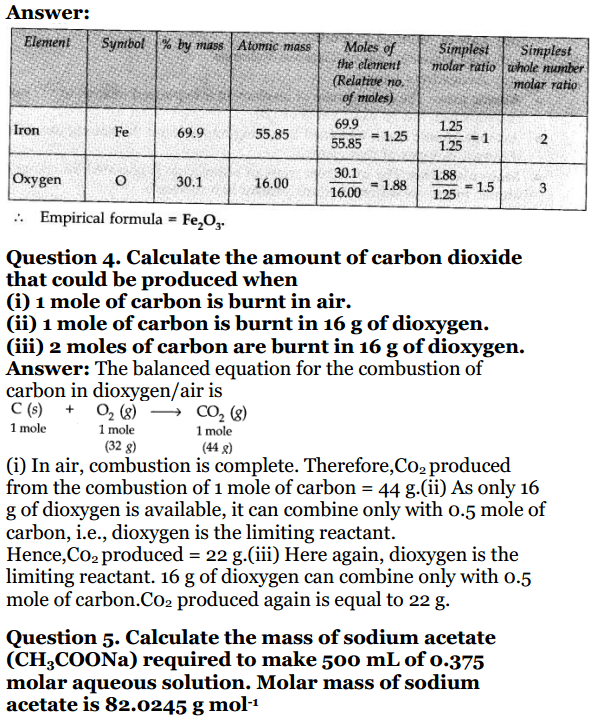
Class 11 Chapter 1 Some Basic Concepts of Chemistry – Textbook Answer 3

Class 11 Chapter 1 Some Basic Concepts of Chemistry – Textbook Answer 4

Class 11 Chapter 1 Some Basic Concepts of Chemistry – Textbook Answer 5

Class 11 Chapter 1 Some Basic Concepts of Chemistry – Textbook Answer 6

Class 11 Chapter 1 Some Basic Concepts of Chemistry – Textbook Answer 7

Class 11 Chapter 1 Some Basic Concepts of Chemistry – Textbook Answer 8

Class 11 Chapter 1 Some Basic Concepts of Chemistry – Textbook Answer 9

Class 11 Chapter 1 Some Basic Concepts of Chemistry – Textbook Answer 10

Class 11 Chapter 1 Some Basic Concepts of Chemistry – Textbook Answer 11

Class 11 Chapter 1 Some Basic Concepts of Chemistry – Textbook Answer 12

Class 11 Chapter 1 Some Basic Concepts of Chemistry – Textbook Answer 13

Class 11 Chapter 1 Some Basic Concepts of Chemistry – Textbook Answer 14

Class 11 Chapter 1 Some Basic Concepts of Chemistry – Textbook Answer 15

Class 11 Chapter 1 Some Basic Concepts of Chemistry – Textbook Answer 16

Understanding the fundamentals of chemistry is essential for every science student, and Class 11 Chapter 1 Some Basic Concepts of Chemistry serves as the cornerstone of this journey. This chapter is not just an introduction to chemistry but also a framework that helps students grasp deeper chemical concepts in later chapters. With topics like the mole concept, laws of chemical combination, atomic and molecular masses, and stoichiometry, students begin to see how chemistry applies to the real world and how quantitative relationships are established in chemical reactions.
The real strength of Class 11 Chapter 1 Some Basic Concepts of Chemistry lies in its ability to train students in logical thinking and accurate calculation. The use of SI units, significant figures, and chemical formulas helps create a scientific mindset that is crucial for both academic success and practical applications in laboratory work. A strong grip on this chapter means students are well-prepared for numerical problems that appear in school exams and competitive tests like NEET, JEE, and other entrance examinations.
What makes Class 11 Chapter 1 Some Basic Concepts of Chemistry so valuable is that it simplifies complex ideas into understandable segments. Whether it is understanding the relationship between mass and moles or interpreting chemical equations, the chapter strengthens the core understanding of the subject. It is important that students regularly revise and practice the problems given in the NCERT textbook to reinforce their learning.
Moreover, Class 11 Chapter 1 Some Basic Concepts of Chemistry is not isolated in its relevance. It connects directly to future chapters such as chemical bonding, thermodynamics, and equilibrium, where the principles introduced here are applied more extensively. Without a strong foundation in these basic concepts, progressing in chemistry becomes challenging.
At mathscience.in, we aim to make Class 11 Chapter 1 Some Basic Concepts of Chemistry simple, accessible, and student-friendly by offering clear notes, NCERT solutions, and practice questions. By engaging with these resources, students can overcome common difficulties and gain the confidence needed to excel.
In conclusion, mastering Class 11 Chapter 1 Some Basic Concepts of Chemistry is the first and most crucial step toward building a strong base in chemistry. Consistent effort, proper understanding, and regular practice are the keys to success.
Stay curious, question every concept, and don’t just memorize—understand.
Chemistry begins here, and with the right approach, it becomes not just a subject, but a fascinating journey.
Let Class 11 Chapter 1 Some Basic Concepts of Chemistry be your first step toward mastering the world of molecules and reactions.
Build your basics strong now, and complex topics will feel easier ahead.
Each formula and concept here is a tool for solving real-world chemical problems.
Make Class 11 Chapter 1 Some Basic Concepts of Chemistry your strength, and the rest of the syllabus will follow smoothly.
For the official Class 11 Chemistry Solutions, you can visit:
- NCERT Textbooks (for Class 11):
Class-Wise NCERT Solutions
Class 8
Class 9
Class 10
Oxford Science Solutions (Classes 6 to 8)
Periodic Assessment 1 (PA1) Class Test – Questions & Answers
Class 11 NCERT Solutions
- Class 11 Physics Solutions
- Class 11 Chemistry Solutions
- Class 11 Biology Solutions
- Class 11 Maths Solutions
Class 12 NCERT Solutions
- Class 12 Physics Solutions
- Class 12 Chemistry Solutions
- Class 12 Biology Solutions
- Class 12 Maths Solutions
Class 10 Sample Papers with Answers (2018–2025)
- 2018 Sample Paper with Answers
- 2019 Sample Paper with Answers
- 2020 Sample Paper with Answers
- 2021 Sample Paper with Answers
- 2022 Sample Paper with Answers
- 2023 Sample Paper with Answers
- 2024 Sample Paper with Answers
- 2025 Sample Paper with Answers
NEET Biology MCQs – Solved Previous Year Questions
NCERT Resource Hub
Math & Science Solutions by Class
Class 10
Class 9
Class 8
Class 7
Class 6
Class 12
Class 11
- Class 11 Math Solutions
- Class 11 Physics Solutions
- Class 11 Chemistry Solutions
- Class 11 Biology Solutions
Class-wise Solutions
Class 12:
Class 12 Physics – NCERT Solutions
Class 12 Chemistry – NCERT Solutions
Class 11:
- Class 11 Physics – NCERT Solutions
- Class 11 Chemistry – NCERT Solutions
- Class 11 Biology – NCERT Solutions
- Class 11 Math – NCERT Solutions
Class 10:
Class 9:
Class 8:
Class 7:
Class 6:
Subject-wise Solutions
Physics:
Chemistry:
Biology:
Math:
- Class 11 Math – NCERT Solutions
- Class 10 Math – NCERT Solutions
- Class 9 Math – NCERT Solutions
- Class 8 Math – NCERT Solutions
Science:
- Class 10 Science – NCERT Solutions
- Class 9 Science – NCERT Solutions
- Class 8 Science – Oxford Solutions
- Class 7 Science – Oxford Solutions
- Class 6 Science – Oxford Solutions