
In our everyday life, we experience the effects of electric charges without always realizing it. From the simple shock we get when touching a doorknob after walking on a carpet to the complex working of electronic devices, electric charges play a fundamental role in shaping the physical world around us.
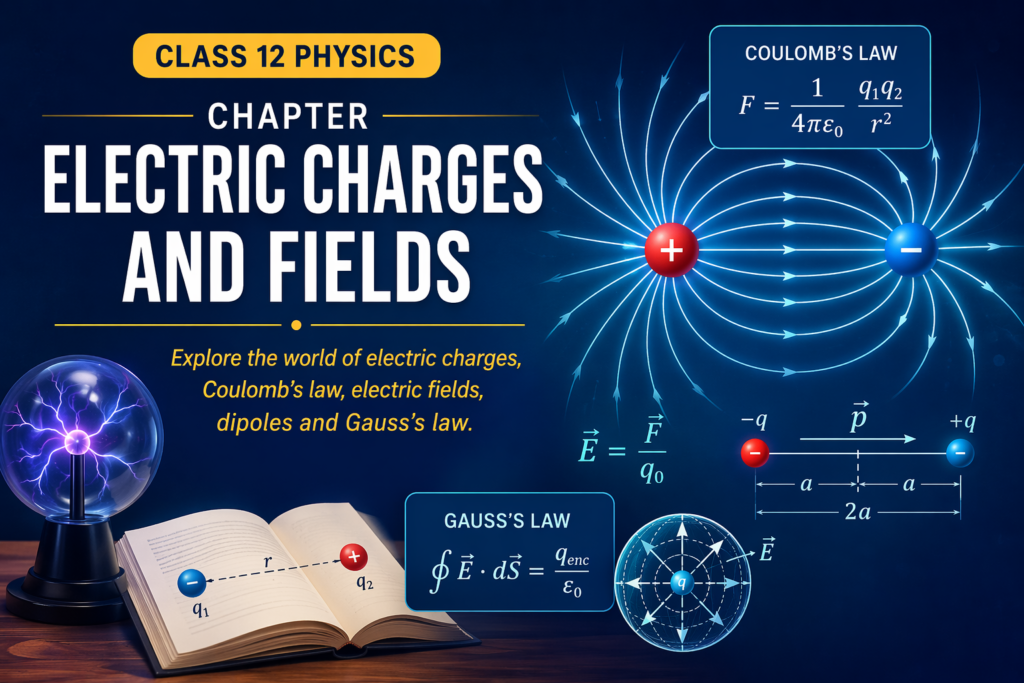
Class 12 Physics Ch Electric Charges and Fields
1. Basic Forces
Electric and magnetic forces determine the properties of atoms, molecules, and bulk matter.
2. Types of Charges
- There are two types of charges:
- Positive charge
- Negative charge
- Like charges repel, and unlike charges attract.
- By convention:
- Glass rod rubbed with silk → positive
- Plastic rod rubbed with fur → negative
3. Conductors and Insulators
- Conductors: Allow movement of electric charges
- Insulators: Do not allow movement of charges
- In:
- Metals → charges are electrons
- Electrolytes → both positive and negative ions move
4. Properties of Electric Charge
(i) Quantisation
- Charge exists in discrete amounts:
- Charge on:
- Proton =
- Electron =
(ii) Additivity
- Total charge = algebraic sum of individual charges
(iii) Conservation
- Total charge of an isolated system remains constant
- Charge can be transferred, not created or destroyed
5. Coulomb’s Law
Coulomb verified this law using a torsion balance experiment.
- When the charges q1 and q2 are increased, the force also increases:
- When the distance r between them increases, the force decreases:
Combining both:
Introducing constant:
👉 Hence, Coulomb’s Law is experimentally verified.
- Force between two charges:
- Direction: Along the line joining the charges
- Constant:
6. Electric vs Gravitational Force
The electric force between a charged particle and the gravitational force between masses can be compared.
For a proton–electron system:
- = electric force
- = gravitational force
- = Coulomb constant
- = gravitational constant
👉 On calculation:
Conclusion
- Electric force is extremely stronger than gravitational force.
- Gravitational force is usually negligible at atomic level.
7. Superposition Principle
- The Superposition Principle states that the force between any two charges is independent of the presence of other charges.
- In a system containing multiple charges ) is the vector sum of the forces exerted on it by all the other charges.
- Mathematically,
- where:
- = force on , and so on
- Each individual force is calculated using Coulomb’s Law.
8. Electric Field
- Defined as:
- For a point charge:
- Direction:
- Away from positive charge
- Towards negative charge
9. Electric Field Lines
- Tangent gives field direction
- Closer lines → stronger field
- Properties:
- Continuous curves
- Never intersect
- Start from positive and end at negative charges
10. Electric Dipole
An electric dipole consists of two equal and opposite charges +and separated by a small distance.
Dipole Moment
The dipole moment is defined as:
- Magnitude:
- Direction: From negative charge to positive charge
Key Points
- It is a vector quantity
- Unit: coulomb–meter (C·m)
- The line joining the charges is called the dipole axis
11. Electric Field of Dipole
- Equatorial Line:
- Axial Line:
- Dipole field varies as:
12. Dipole in Uniform Electric Field
- Torque:
- No net force acts on dipole
13. Electric Flux
Electric flux is the measure of the total electric field passing through a surface.
Definition
Electric flux through a small area element is given by:
where:
- = electric field
- = area vector (normal to the surface)
For a Uniform Field
- = angle between electric field and area vector
Unit
SI unit of electric flux = N·m²/C
Key Points
Zero flux when
Flux depends on field strength, area, and orientation
Maximum flux when
14. Gauss’s Law
Gauss’s Law states that the total electric flux through any closed surface is equal to 1/ε0 times the total charge enclosed inside the surface.
Mathematical Form
Key Points
- Applies to closed surfaces only
- Depends only on enclosed charge, not on charges outside
- Very useful for finding electric field in symmetrical charge distributions
Conclusion
Gauss’s Law relates electric field and charge distribution in a simple and powerful way.
15. Applications of Gauss’s Law
(i) Infinite Line Charge
(ii) Infinite Plane Sheet
(iii) Spherical Shell
- Outside:
- Inside:
Key Concepts Covered: Class 12 Physics Ch Electric Charges and Fields
Dipole field varies as 1/r³
Point charge field varies as 1/r²
Class 12 Physics Ch Electric Charges and Fields – Solutions
Additional Exercises
Question 1.25
An oil drop of 12 excess electrons is held stationary under a constant electric field of 2.55 × 10⁴ N C−1 in Millikan’s oil drop experiment. The density of the oil is 1.26 g cm−3. Estimate the radius of the drop. (g = 9.81 m s−2; e = 1.60 × 10⁻¹⁹ C).
Answer :
Given:
Number of excess electrons (n) = 12
Electric field (E) = 2.55 × 10⁴ N/C
Charge (q) = n × e = 12 × 1.60 × 10⁻¹⁹ = 1.92 × 10⁻¹⁸ C
Density of oil (ρ) = 1.26 × 10³ kg/m³
Gravitational acceleration (g) = 9.81 m/s²
When the drop is stationary:
Electric force = Gravitational force
So,
qE = mg
Mass of spherical drop:
m = (4/3) × π × r³ × ρ
Now,
qE = (4/3) × π × r³ × ρ × g
Solving for r³:
r³ = (3 × q × E) / (4 × π × ρ × g)
Substitute values:
r³ = (3 × 1.92 × 10⁻¹⁸ × 2.55 × 10⁴) / (4 × 3.1416 × 1.26 × 10³ × 9.81)
r³ ≈ 9.47 × 10⁻¹⁸ m³
Take cube root:
r ≈ (9.47 × 10⁻¹⁸)^(1/3)
r ≈ 2.08 × 10⁻⁶ m
Final Answer:
Radius of the oil drop ≈ 2.08 micrometres (μm)
Question 1.27
In a certain region of space, electric field is along the z-direction throughout. The magnitude of electric field is, however, not constant but increases uniformly along the positive z-direction, at the rate of 105 NC−1 per metre. What are the force and torque experienced by a system having a total dipole moment equal to 10−7 Cm in the negative z-direction?
Answer :
Given:
- Electric field direction: along the z-axis
- Electric field varies uniformly:
dE/dz = 10⁵ N/C per metre - Dipole moment (p) = 10⁻⁷ C·m, along the negative z-direction
Force on a Dipole in a Non-uniform Electric Field:
In a non-uniform electric field, the net force on a dipole is given by:
F = (p · ∇)E
Here, the dipole moment is along the z-direction, and the field varies only along z.
So,
F = p × (dE/dz)
Now substitute values:
F = 10⁻⁷ C·m × 10⁵ N/C/m
F = 0.01 N
The direction is along the negative z-axis (because the dipole moment is in that direction).
Torque on the Dipole:
Torque (τ) is given by:
τ = p × E
Since both p and E are along the z-direction, the angle between them is either 0° or 180°, so:
τ = 0
No torque acts on the dipole in this case.
Final Answer:
- Force on the dipole = 0.01 N in the negative z-direction
- Torque = 0
Question 1.28:
(a) A conductor A with a cavity as shown in Figure (a) is given a charge
Q. Show that the entire charge must appear on the outer surface of the conductor.
(b) Another conductor B with charge q is inserted into the cavity keeping B insulated from A. Show that the total charge on the outside surface of A is Q + q [Figure (b)].
(c) A sensitive instrument is to be shielded from the strong electrostatic fields in its environment. Suggest a possible way.
Solution:
(a) Entire charge Q appears on the outer surface of conductor A:
- A conductor in electrostatic equilibrium has zero electric field inside its bulk.
- If any charge remained on the inner surface or inside the conductor material, it would create an internal electric field, violating electrostatic equilibrium.
- Hence, all charge Q must reside on the outer surface of conductor A.
(b) Conductor B with charge q placed inside the cavity:
- When conductor B with charge q is inserted into the cavity (without touching A), it induces an equal and opposite charge (−q) on the inner surface of A (facing the cavity) to maintain zero field inside the conductor material of A.
- Since conductor A already had a total charge Q, and now −q appears on the inner surface, the remaining charge on the outer surface of A must be: Outer charge = Q − (−q) = Q + q
Hence, total charge on the outside surface of A becomes Q + q.
(c) Shielding a sensitive instrument:
- To protect a sensitive instrument from external electric fields, place it inside a hollow conducting shell (like a metal box).
- This method is known as electrostatic shielding.
- The conductor redistributes its charges in such a way that electric field inside the cavity is zero, regardless of external fields.
This principle is used in Faraday cages, which block external electric fields completely.
Final Answer Summary:
- (a) All charge Q resides on the outer surface of conductor A.
- (b) When a charge q is inserted inside the cavity, outer surface charge becomes Q + q.
- (c) Use a hollow conductor (Faraday cage) to shield sensitive instruments from electric fields.
Question 1.30:
Obtain the formula for the electric field due to a long thin wire of uniform linear charge density λ without using Gauss’s law. [Hint: Use Coulomb’s law directly and evaluate the necessary integral.]
Answer 1.30:
Let’s consider a long thin wire placed along the x-axis with a uniform linear charge density λ (lambda), which means charge per unit length.
We want to find the electric field at a point located a perpendicular distance r from the wire along the y-axis (at the point (0, r)).
Step 1: Choose a small element of the wire
Take a small length element dx at a position x on the x-axis.
The charge of this small element is:dq = λ dx
Step 2: Use Coulomb’s Law
According to Coulomb’s Law, the electric field dE at point P due to this element is:
dE = (1 / (4πϵ₀)) * (dq / (x² + r²)) * (unit vector)
The distance from the element to point P is:sqrt(x² + r²)
The direction (unit vector) from the element to P is:(-x î + r ĵ) / sqrt(x² + r²)
So,dE = (λ / (4πϵ₀)) * (-x î + r ĵ) dx / (x² + r²)^(3/2)
Step 3: Integrate over the wire
To find the total electric field, integrate from x = -∞ to x = ∞.
X-component (Ex):Ex = (λ / (4πϵ₀)) * ∫[-∞ to ∞] (-x / (x² + r²)^(3/2)) dx
This integral is an odd function over symmetric limits, so:Ex = 0
Y-component (Ey):Ey = (λ / (4πϵ₀)) * ∫[-∞ to ∞] (r / (x² + r²)^(3/2)) dx
Take r outside:Ey = (λ * r / (4πϵ₀)) * ∫[-∞ to ∞] (1 / (x² + r²)^(3/2)) dx
This standard integral evaluates to:∫[-∞ to ∞] (1 / (x² + r²)^(3/2)) dx = 2 / r²
So:Ey = (λ * r / (4πϵ₀)) * (2 / r²) = λ / (2πϵ₀r)
Final Result:
The total electric field at a distance r from the wire is:
E = λ / (2πϵ₀r)
This field is directed radially outward from the wire (if λ is positive), and is perpendicular to the wire.
Question 1.31:
It is now believed that protons and neutrons (which constitute nuclei of ordinary matter) are themselves built out of more elementary units called quarks. A proton and a neutron consist of three quarks each. Two types of quarks, the so called ‘up’ quark (denoted by u) of charge (+2/3) e, and the ‘down’ quark (denoted by d) of charge (−1/3) e, together with electrons build up ordinary matter. (Quarks of other types have also been found which give rise to different unusual varieties of matter.) Suggest a possible quark composition of a proton and neutron.
Answer 1.31
Quark Composition of Proton and Neutron
Protons and neutrons, which make up the nuclei of atoms, are not fundamental particles. They are composed of even more basic particles known as quarks.
There are different types of quarks, but only two types are needed to explain the structure of ordinary matter:
- Up quark (u): has a charge of (+2/3) e
- Down quark (d): has a charge of (−1/3) e
Each proton or neutron is made up of three quarks.
Quark Composition of a Proton
A proton has a total charge of +1 e.
Let’s consider a combination of quarks that gives this charge:
- 2 up quarks → 2 × (+2/3) e = +4/3 e
- 1 down quark → (−1/3) e
Total charge = (+4/3) + (−1/3) = +1 e
So, the quark composition of a proton is:
Proton = u + u + d
Quark Composition of a Neutron
A neutron has a total charge of 0 e.
Let’s consider a combination of quarks that gives zero total charge:
- 1 up quark → (+2/3) e
- 2 down quarks → 2 × (−1/3) e = −2/3 e
Total charge = (+2/3) + (−2/3) = 0 e
So, the quark composition of a neutron is:
Neutron = u + d + d
Summary
- Proton = up + up + down (u u d) → charge = +1 e
- Neutron = up + down + down (u d d) → charge = 0 e
These combinations of quarks form the building blocks of all ordinary atomic nuclei.
Question 1.32:
(a) Consider an arbitrary electrostatic field configuration. A small test charge is placed at a null point (i.e., where E = 0) of the configuration. Show that the equilibrium of the test charge is necessarily unstable.
(b) Verify this result for the simple configuration of two charges of the same magnitude and sign placed a certain distance apart.
Answer 1.32:
(a) Let the equilibrium of the test charge be stable. If a test charge is in equilibrium and displaced from its position in any direction, then it experiences a restoring force towards a null point, where the electric field is
zero.
All the field lines near the null point are directed inwards towards the null point. There is a net inward flux of electric field through a closed surface around the null point. According to Gauss’s law, the flux of electric field
through a surface, which is not enclosing any charge, is zero. Hence, the equilibrium of the test charge can be stable.
(b) Two charges of same magnitude and same sign are placed at a certain distance. The mid-point of the joining line of the charges is the null point. When a test charged is displaced along the line, it experiences a restoring force. If it is displaced normal to the joining line, then the net force takes it away from the null point. Hence, the charge is unstable because stability of equilibrium requires restoring force in all directions.
Question 1.33
A particle of mass m and charge (−q) enters the region between the two charged plates initially moving along x-axis with speed vx (like particle 1 in Figure). The length of plate is L and an uniform electric field E is maintained between the plates. Show that the vertical deflection of the particle at the far edge of the plate is qEL2/(2m𝑣𝑥2). Compare this motion with motion of a projectile in gravitational field
Answer 1.33
Vertical Deflection of a Charged Particle in an Electric Field Between Plates
Let a particle of mass m and charge −q enter the region between two charged plates.
- It enters horizontally along the x-axis with an initial speed
vₓ. - The length of the plates is
L. - A uniform electric field
Eis present vertically upward between the plates.
We are asked to find the vertical deflection y of the particle as it exits the plates (i.e., when it has traveled a horizontal distance L).
Step-by-Step Derivation
1. Horizontal Motion (along x-axis):
- There is no force acting in the horizontal direction.
- So, the horizontal velocity remains constant at
vₓ. - Time taken to cross the plates of length
Lis:t = L / vₓ
2. Vertical Motion (along y-axis):
- The particle has charge
−q. - The electric field
Eis upward → force on the particle is downward (because the charge is negative):F = −qE(direction: downward) - The vertical acceleration
ais:a = F / m = −qE / m - Initial vertical velocity is
0(since particle enters horizontally). - Using the equation of motion:
y = 0 * t + (1/2) * a * t²y = (1/2) * (−qE / m) * (L / vₓ)²y = −(qE * L²) / (2m * vₓ²)
So, the vertical deflection at the far edge is:
iniCopyEdity = −qEL² / (2mvₓ²)
The negative sign indicates that the deflection is downward.
Comparison with Projectile Motion in a Gravitational Field
This motion is very similar to the motion of a projectile:
- In projectile motion:
- Horizontal motion: constant velocity
- Vertical motion: uniform acceleration due to gravity
g
- In this electric field case:
- Horizontal motion: constant velocity
vₓ - Vertical motion: uniform acceleration
a = −qE/m(acts like “electric gravity”)
- Horizontal motion: constant velocity
So, the electric field plays the same role in this case as gravity does in projectile motion.
Just like in projectile motion:
- Time of flight depends on horizontal velocity
- Vertical displacement depends on acceleration and time squared
Conclusion
The motion of a charged particle in a uniform electric field between plates is analogous to a projectile motion under gravity.
- Vertical deflection of the particle is:
y = −qEL² / (2mvₓ²) - The trajectory is parabolic, just like in projectile motion.
Question 1.34
Suppose that the particle in Exercise in 1.33 is an electron projected with velocity vx= 2.0 × 10⁶ m s−1. If E between the plates separated by 0.5 cm is 9.1 × 10² N/C, where will the electron strike the upper plate?
(| e | =1.6 × 10⁻¹⁹ C, me = 9.1 × 10⁻³¹ kg.)
Answer 1.34:
Given:
- Initial horizontal velocity,
vₓ = 2.0 × 10⁶ m/s - Electric field,
E = 9.1 × 10² N/C - Separation between plates,
d = 0.5 cm = 0.005 m - Charge of electron,
q = 1.6 × 10⁻¹⁹ C(electron has negative charge, so direction matters) - Mass of electron,
m = 9.1 × 10⁻³¹ kg
Step-by-Step Calculation:
1. Vertical acceleration due to electric field
For an electron in an electric field,a = F / m = (−eE) / m
So,
a = − (1.6 × 10⁻¹⁹ × 9.1 × 10²) / (9.1 × 10⁻³¹)
Let’s compute this:
a = − (1.6 × 9.1 × 10⁻¹⁷) / (9.1 × 10⁻³¹)a = − (1.6 × 10⁻¹⁷) / (10⁻³¹)a = − 1.6 × 10¹⁴ m/s²
So, vertical acceleration:
a = −1.6 × 10¹⁴ m/s²
2. Time taken to cross the plates (horizontal direction)
We don’t know the length L, but we are told to find where the electron strikes the upper plate. That means we need to find when vertical displacement equals the plate separation.
So,
Let vertical displacement y = +0.005 m (upward, since field is upward and electron is pulled downward due to negative charge).
We use:
y = (1/2) a t²
Substitute values:
0.005 = (1/2) * 1.6 × 10¹⁴ * t²
Solving:
t² = (2 × 0.005) / (1.6 × 10¹⁴)t² = 0.01 / (1.6 × 10¹⁴)t² = 6.25 × 10⁻¹٧t = √(6.25 × 10⁻¹٧) = 2.5 × 10⁻⁹ s
3. Horizontal distance traveled before striking the plate
Use:
x = vₓ * t = (2.0 × 10⁶) * (2.5 × 10⁻⁹)x = 5.0 × 10⁻³ m = 0.005 m = 0.5 cm
Final Answer:
The electron will strike the upper plate after traveling 0.5 cm horizontally, which means it just hits the upper plate exactly at the exit point of the plates if their length is also 0.5 cm.
Conclusion: Class 12 Physics Ch Electric Charges and Fields
In this chapter Class 12 Physics Ch Electric Charges and Fields, we explored the fundamental concepts of electric charges and electric fields, which are essential in understanding the behavior of charged particles in different environments. The study of electric forces, Coulomb’s law, and the electric field concept provides the foundation for analyzing the interactions between charged objects. By studying electric fields, we are able to comprehend the behavior of charged particles and the effects of external fields on them.
In conclusion, the study of electric fields and forces not only enhances our theoretical understanding but also prepares us to explore more complex concepts in physics. From everyday applications to advanced scientific research, the electric field plays a pivotal role in shaping our understanding of the universe.
For the official site, you can visit:
- NCERT Textbooks :