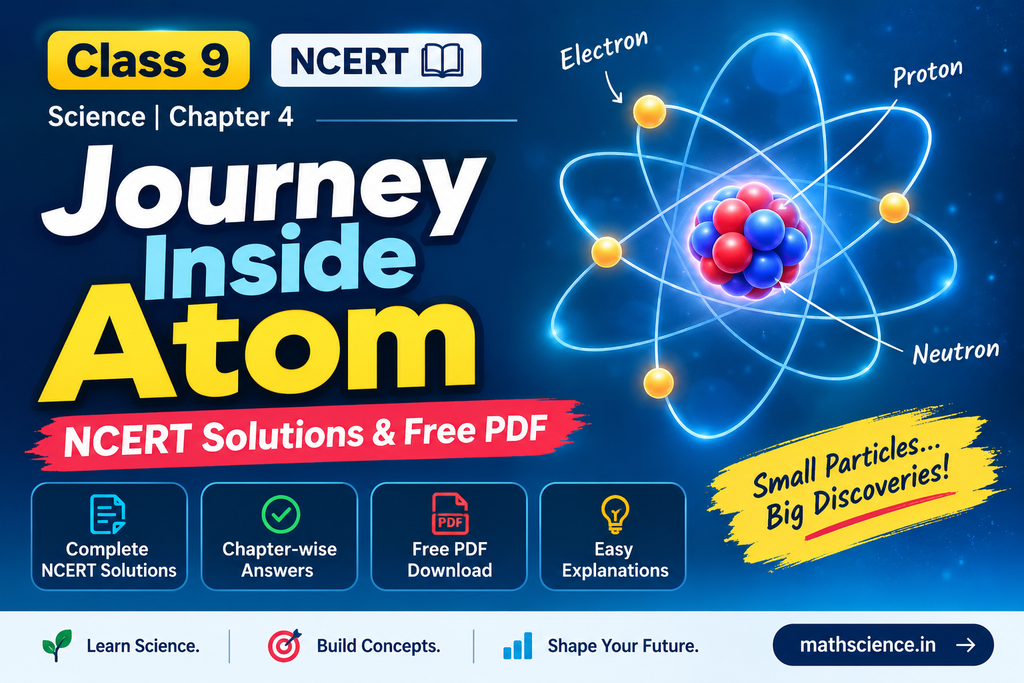
Journey Inside Atom Class 9
Access complete step-by-step NCERT in-text and textbook exercise solutions for Journey Inside Atom Class 9. Prepared by MathScience Academy, this page covers all solved questions on subatomic particles, Thomson and Rutherford atomic models, Bohr-Bury electronic configurations, valency calculations, and isotope problems.
Journey Inside Atom Class 9 Solutions Directory
Find step-by-step worked answers to all in-text questions and chapter-end exercises from the latest Class 9 Science textbook below.
In-Text & Chapter Solutions
Answer:
Canal rays (or anode rays) are streams of positively charged subatomic particles that travel in a direction opposite to cathode rays in a gas discharge tube experiment. They were discovered by E. Goldstein in 1886 and eventually led to the identification of the proton.
Answer:
- Most of the fast-moving α-particles passed straight through the gold foil without experiencing any deflection.
- A small fraction of the particles were deflected by small angles.
- Surprisingly, roughly one in every 12,000 particles rebounded back at an angle close to 180°.
Answer:
- Total Electrons: 17
- Shell Distribution (Bohr-Bury Rule): K = 2, L = 8, M = 7 (Configuration: 2, 8, 7)
- Valence Electrons: 7
- Valency: Since valence electrons > 4, Valency = 8 − 7 = 1.
Answer:
Using the isotopic average formula:
Average Atomic Mass = (79 × 50⁄100) + (81 × 50⁄100)
Average Atomic Mass = 39.5 + 40.5 = 80 u
Answer:
- Isotopes: Atoms of the same element having the same atomic number (Z) but different mass numbers (A).
Example: Protium (11H), Deuterium (21H), and Tritium (31H). - Isobars: Atoms of different elements having the same mass number (A) but different atomic numbers (Z).
Example: 4018Ar (Argon) and 4020Ca (Calcium).
Official Reference Credit:
🌐 Visit Official NCERT Portal ↗Explore Related Resources
- Main Science Library: Free Science Study Materials
- Class 10 Mathematics: Class 10 Coordinate Geometry Olympiad
Frequently Asked Questions (FAQs)
Are these Journey Inside Atom Class 9 solutions based on the latest syllabus?
Yes, all solutions strictly follow the updated NCERT / CBSE Class 9 Science curriculum guidelines.
What is the maximum number of electrons that can be accommodated in the outermost shell?
According to the Bohr-Bury scheme, the maximum capacity of the outermost shell is 8 electrons (Octet Rule).
Journey Inside Atom Class 9 Solutions
Complete, step-by-step textbook solutions and in-text question answers for Journey Inside Atom Class 9 Solutions. Master Thomson’s model, Rutherford’s scattering experiment, Bohr’s energy shells, subatomic calculations, electronic configurations, and valency rules.
Chapter Exercise Solutions (Q1 to Q17)
(i) the positive charge on the clay is lesser than the total negative charge of the beads?
(ii) by mistake, the clay itself carries a bit of negative charge? Would your model still represent a neutral atom?
Answer:
(i) The model will no longer represent a neutral atom. Instead, the atom will possess a net negative charge, behaving like a negatively charged ion (an anion). For an atom to be electrically neutral, the total positive charge must exactly balance the total negative charge.
(ii) No, it would not represent a neutral atom. If both the clay and the embedded beads carry a negative charge, the entire structure will have a cumulative negative charge. A neutral atom requires an exact balance of positive and negative charges resulting in zero net charge.
Answer:
Where it matches: The structural layout is conceptually similar. Just like seeds embedded in a fruit’s pulp, Thomson envisioned electrons (negative charges) embedded uniformly inside a continuous sphere of positive charge (the pulp).
Where it falls short:
- Charge Nature: The seeds of a fruit do not carry an electrical charge, and the pulp is not a sea of positive electricity; it is made of biological cells.
- Scale and Proportions: Relative to the size of a fruit, seeds are massive compared to how tiny electrons are relative to the entire atom.
- Dynamics: Electrons are dynamic subatomic particles interacting via electrostatic forces, whereas fruit seeds are static biological structures.
Answer:
J.J. Thomson concluded that electrons are present in all atoms based on his cathode ray tube experiments (1897):
- Universal Properties: When he experimented with different gases inside the cathode ray tube and changed the metal of the electrodes, the emitted particles always exhibited the exact same mass-to-charge ratio.
- Fundamental Building Block: Because identical negative particles were produced regardless of the gas or electrode material used, Thomson deduced that electrons are universal constituents of all atoms.
Answer:
- Attraction instead of repulsion: α-particles are positively charged (helium nuclei). If replaced with negatively charged particles (such as electrons or beta particles), they would experience electrostatic attraction toward the positive gold nucleus rather than repulsion.
- Behavior change: Instead of bouncing backward at wide angles, the negative particles would be pulled inward toward the concentrated positive nucleus or deflected along attraction curves. The classic scattering pattern would fundamentally change.
Answer:
- Diffuse vs. Concentrated Charge: In Thomson’s model, positive charge was thought to be spread out uniformly over the whole atom like a diffuse cloud. A spread-out positive charge lacks the intense electrical field required to repel heavy, fast-moving α-particles backward.
- The Turning Point: The sharp bounce-back of a few α-particles proved that almost all of the atom’s positive charge and mass must be concentrated in an extremely small, dense central region—the nucleus.
Answer:
Example Question: “When you first saw those few alpha-particles bounce straight back, did you immediately suspect a tiny, dense nucleus, or did you initially suspect an unexpected experimental error?”
Why: Rutherford famously remarked that it was as incredible as firing a 15-inch artillery shell at a piece of tissue paper and having it bounce back and hit you. Asking this gives insight into how one of history’s greatest breakthroughs transitioned from unexpected data to revolutionary science.
Reason (R): According to Thomson’s model, electrons are embedded in a uniformly distributed positive charge sphere.
Choose the correct option:
(i) Both A and R are true, and R is the correct explanation of A.
(ii) Both A and R are true, but R is not the correct explanation of A.
(iii) A is true, but R is false.
(iv) A is false, but R is true.
Answer: (ii) Both A and R are true, but R is not the correct explanation of A.
Explanation: Assertion (A) is correct based on Rutherford’s α-particle scattering experiment. Reason (R) is also factually correct in describing Thomson’s model. However, (R) does not explain how or why Rutherford arrived at the nuclear model.
Answer:
- Element Name: Lumenium (Lm)
- IUPAC Justification:
- Letter Composition: The symbol consists of the first two letters of the element’s name (“L” and “m”).
- Capitalization: The first letter (L) is uppercase and the second letter (m) is lowercase, strictly adhering to IUPAC nomenclature conventions.
Answer:
- Communication Breakdown: Scientific papers and chemical formulas published in one country would become unintelligible to researchers elsewhere.
- Global Hazards in Medicine & Industry: Chemical manufacturing and medical prescriptions rely on standard symbols; ambiguity could lead to toxic industrial accidents or fatal dosage errors.
- Loss of Universal Standardization: Maintaining a coherent periodic table and advancing global chemical education would become impossible.
Answer:
- Protons: Atomic Number = 26 protons
- Electrons: In a neutral atom, Electrons = Protons = 26 electrons
- Neutrons: Nucleons (Mass Number) − Protons = 56 − 26 = 30 neutrons
Answer:
Number of Neutrons = Mass Number − Number of Protons
Neutrons = 41 − 20 = 21 neutrons
Answer:
Mass Number = Atomic Number (Protons) + Number of Neutrons
Mass Number = 17 + 18 = 35
Answer:
- Mass Number (A) = 23
- Number of Protons = Number of Electrons = 11
- Number of Neutrons = Mass Number − Protons = 23 − 11 = 12 neutrons
(i) Carbon-12 | (ii) Fluorine-19 | (iii) Silicon-14
Answer:
- (i) Carbon-12: Atomic number = 6. Configuration = 2, 4. → 4 valence electrons.
- (ii) Fluorine-19: Atomic number = 9. Configuration = 2, 7. → 7 valence electrons.
- (iii) Silicon-14: Atomic number = 14. Configuration = 2, 8, 4. → 4 valence electrons.
Answer:
- Atomic Number 12 (Magnesium – Mg): 2, 8, 2
- Atomic Number 16 (Sulfur – S): 2, 8, 6
- Atomic Number 18 (Argon – Ar): 2, 8, 8
Answer:
- Identity: Sodium (Na) (Atomic number 11 is sodium, a soft reactive alkali metal).
- Number of Neutrons: Mass Number − Protons = 23 − 11 = 12 neutrons.
Bonus Riddle: “I have 8 protons, a mass number of 16, and I am essential for life to breathe. Who am I and how many valence electrons do I have?” → Oxygen (O); 6 valence electrons (Configuration: 2, 6).
Answer:
- Atomic Numbers: Both have 11 protons, so their atomic numbers are identical (Z = 11).
- Mass Numbers: Atom 1 = 11 + 12 = 23; Atom 2 = 11 + 13 = 24. Their mass numbers are different.
- Same or Different Element: They are atoms of the same element (Sodium, Na). Because they have the same atomic number but different mass numbers, they are isotopes.
In-Text Solutions (Q1 to Q15)
(i) The experiment clearly showed the existence of neutrons in the nucleus.
• Status: Incorrect
• Reason: Rutherford proved the presence of a nucleus, but neutrons were discovered in 1932 by James Chadwick.
(ii) The results disproved the plum pudding model and led to the idea of a nucleus at the centre of the atom.
• Status: Correct
• Reason: The large-angle deflections proved positive charge is not spread out thinly, but packed densely in the center.
(iii) The large deflection of a few alpha particles indicated that most of the mass and positive charge are packed into a tiny centre.
• Status: Correct
• Reason: Only a massive, positively charged center could repel heavy, fast-moving α-particles backward.
(iv) The way alpha particles were deflected showed that electrons move around the nucleus.
• Status: Incorrect
• Reason: α-particles were deflected by the positive nucleus. Electrons are too light to affect α-particle trajectories.
(i) Electrons lose energy while moving in fixed orbits and slowly fall into the nucleus.
• Status: Incorrect — Bohr postulated electrons do not radiate energy in discrete stationary orbits.
(ii) Electrons can exist anywhere around the nucleus with no fixed energy.
• Status: Incorrect — Electrons are restricted to specific, quantized energy levels.
(iii) Electrons revolve around the nucleus in orbits of fixed energy without losing energy.
• Status: Correct — This is the fundamental postulate explaining atomic stability.
(iv) Electrons can be found between energy levels as they move around the nucleus.
• Status: Incorrect — Energy levels are quantized; electrons cannot exist in between levels.
Answer:
- (i) Relation between Y and Z: Both have 17 protons (same atomic number) but different neutrons (18 and 20). Therefore, Y and Z are isotopes.
- (ii) Relation between Z and X: Mass number of Z = 17 + 20 = 37. Mass number of X = 18 + 19 = 37. They have the same mass number (37) but different atomic numbers (17 and 18). Therefore, Z and X are isobars.
Answer:
Rutherford concluded that the positive charge and nearly the entire mass of an atom are concentrated in an extremely small, dense central region called the nucleus.
Answer:
(iv) Dalton → (ii) Thomson → (iii) Rutherford → (i) Bohr
- Dalton: Atoms are indivisible, indestructible building blocks.
- Thomson: Discovered electrons; proposed positive sphere model.
- Rutherford: Discovered the dense positive central nucleus.
- Bohr: Proposed discrete non-radiating electron energy shells.
Answer:
Electrons carry a negative charge and the nucleus carries a positive charge. The strong electrostatic force of attraction between them provides the necessary centripetal force to hold the electrons in orbit.
Reason (R): The number of electrons is equal to the number of protons in an atom.
Answer: (ii) Both A and R are true, but R is not the correct explanation of A.
Answer:
- (i) Protons = 12
- (ii) Neutrons = 24 − 12 = 12
- (iii) Electrons = 12
- Electronic Configuration: K = 2, L = 8, M = 2 → 2, 8, 2
(a) Beryllium (Be): Electrons = 4 | Valence = 2 | Valency = 2 | Protons = 4 | Z = 4
(b) Carbon (C): Electrons = 6 | Valence = 4 | Valency = 4 | Protons = 6 | Z = 6
(c) Sodium (Na): Electrons = 11 | Valence = 1 | Valency = 1 | Protons = 11 | Z = 11
(d) Nitrogen (N): Electrons = 7 | Valence = 5 | Valency = 3 (8 − 5) | Protons = 7 | Z = 7
Answer:
According to classical electromagnetic theory, accelerating charged electrons revolving in an orbit must continuously radiate energy, lose speed, and spiral into the nucleus within a fraction of a second.
Bohr succeeded by postulating that electrons revolve only in discrete, stationary orbits where they do not radiate energy, ensuring atomic stability.
Answer:
Protons = Electrons = 31 | Mass Number = 70
Neutrons = 70 − 31 = 39 neutrons
Answer:
- (i) Neutrons: 197 − 79 = 118 neutrons
- (ii) Electrons: In a neutral atom, Electrons = Protons = 79 electrons
(i) Protons/Electrons, (ii) Atomic number, (iii) Element name, (iv) Configuration, (v) Valence electrons, (vi) Mass number if 2 neutrons are added, (vii) Relation between original and new atom.
Answer:
- (i) Protons = 35 − 18 = 17 protons; Electrons = 17 electrons
- (ii) Atomic Number = 17
- (iii) Element X is Chlorine (Cl)
- (iv) Electronic Configuration = 2, 8, 7
- (v) Valence Electrons = 7
- (vi) New Mass Number = 35 + 2 = 37
- (vii) The original (35Cl) and new atom (37Cl) are isotopes of each other.
Answer:
- (i) Atomic number: No change (12) (depends strictly on proton count).
- (ii) Atomic mass: Increases (because extra mass from the heavier particles adds to total atomic weight).
- (iii) Mass number: No change (24) (defined strictly as sum of protons and neutrons in the nucleus: 12 + 12 = 24).
- (iv) Overall charge: No change (0 / Neutral) (the particles have the exact same negative charge as electrons, balancing the 12 protons).
Official Reference Portal:
🌐 Visit Official NCERT Portal ↗Explore Related Resources
- Main Science Library: Free Science Study Materials
- Class 10 Mathematics: Class 10 Coordinate Geometry Olympiad
Frequently Asked Questions (FAQs)
Are all questions from the new Class 9 Science textbook covered?
Yes, all textbook exercises (Q1–Q17) and in-text questions are solved with complete explanations and step-by-step calculations.
How is valency determined from electronic configuration?
For atoms with 1 to 4 valence electrons, valency equals the number of valence electrons. For atoms with 5 to 8 valence electrons, valency equals 8 minus the number of valence electrons.