
In Class 10 Maths Chapter 4 Quadratic Equations Ex 4.3, we learn how to find the nature of the roots of quadratic equations. The nature of the roots depends on the value of the discriminant (Δ=b2−4ac).
- If Δ>0 the equation has two distinct real roots.
- If Δ=0, the equation has two equal real roots.
- If Δ<0 the equation has no real roots.
This exercise helps us determine the type of roots of a quadratic equation based on the discriminant, without needing to solve the equation completely. It is an important concept for understanding the behavior of quadratic equations in various situations.
Class 10 Maths Chapter 4 Quadratic Equations Ex 4.3
Question 1.
Find the roots of the following quadratic equations, if they exist, by the method of completing the square:
(i) 2x2 – 7x + 3 = 0
(ii) 2x2 + x – 4 = 0
(iii) 4x2 + 4√3x + 3 = 0
(iv) 2x2 + x + 4 = 0
Solution: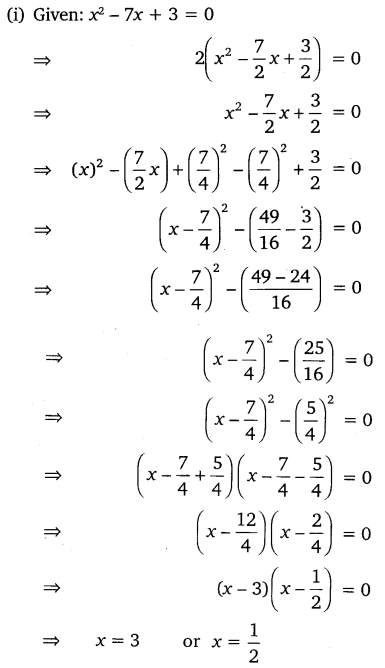
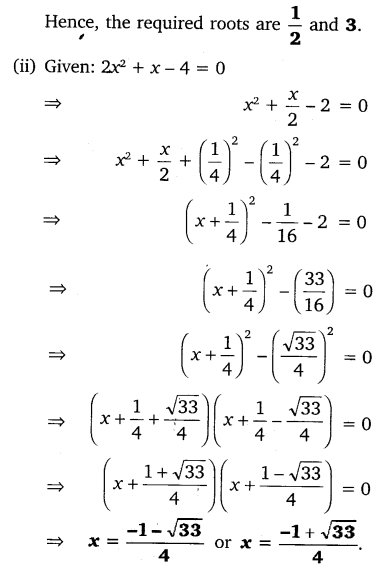
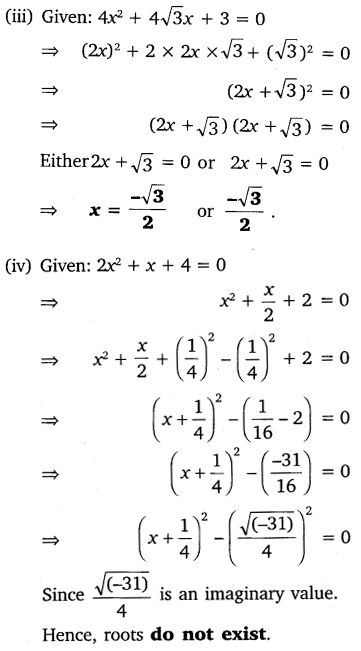
Question 2.
Find the roots of the quadratic equations by applying the quadratic formula.
(i) 2x2 – 7x + 3 = 0
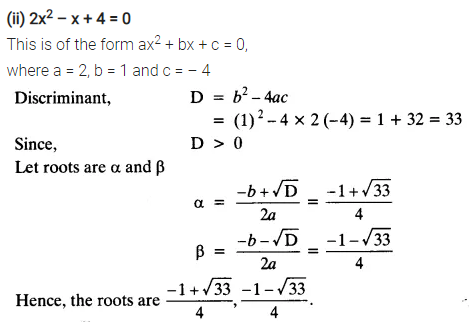
(ii) 2x2 – x + 4 = 0
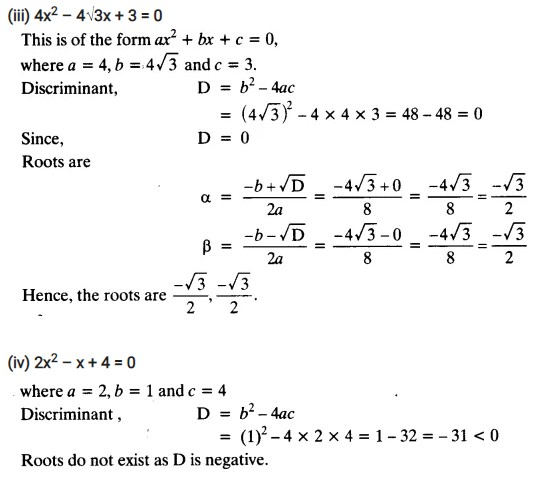
(iii) 4x2 – 4√3x + 3 = 0
(iv) 2x2 – x + 4 = 0
Solution: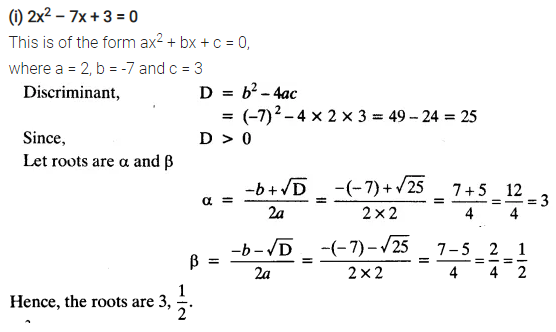
Question 3.
Find the roots of the following equations: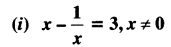

Solution: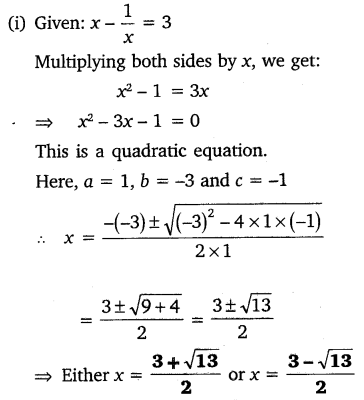
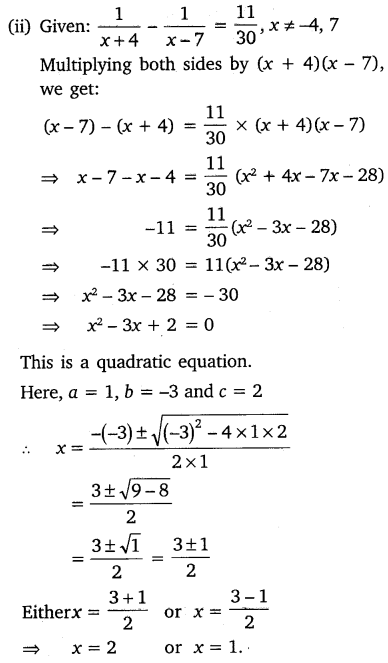
Ex 4.3 Class 10 | Maths NCERT Solutions for Class 10 Maths Chapter 4 | Quadratic Equations Ex 4.3
Question 4.
The sum of the reciprocals of Rehman’s ages, (in years) 3 years ago and 5 years from now is 13 Find his present age.
Solution: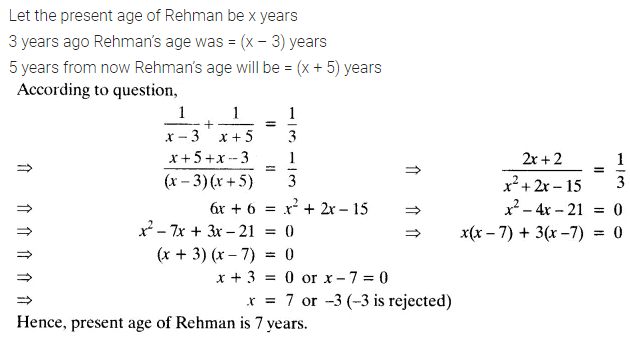
Question 5.
In a class test, the sum of Shefali’s marks in Mathematics and English is 30. Had she got 2 marks more in Mathematics and 3 marks less in English, the product of their marks would have been 210. Find her marks in the two subjects.
Solution: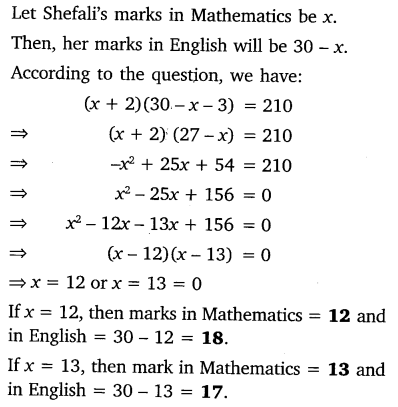
Question 6.
The diagonal of a rectangular field is 60 metres more than the shorter side. If the longer side is 30 metres more than the shorter side, find the sides of the field.
Solution: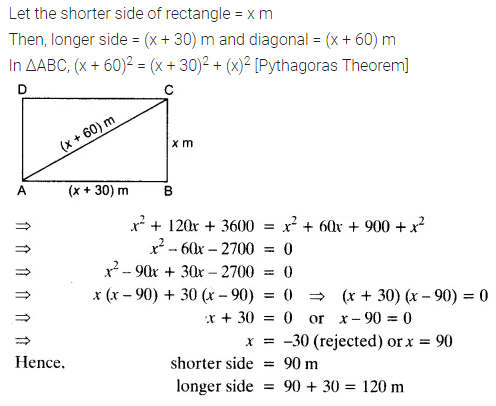
Question 7.
The difference of squares of two numbers is 180. The square of the smaller number is 8 times the larger number. Find the two numbers.
Solution: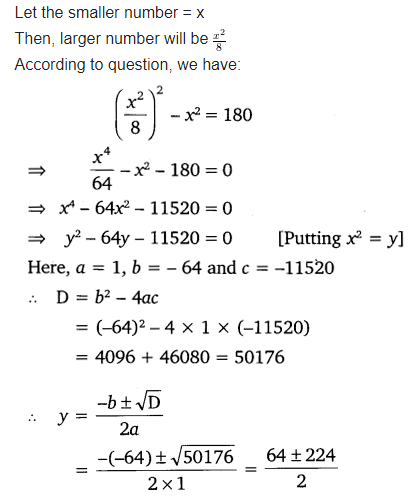

Question 8.
A train travels 360 km at a uniform speed. If the speed had been 5 km/h more, it would have taken 1 hour less for the same journey. Find the speed of the train.
Solution: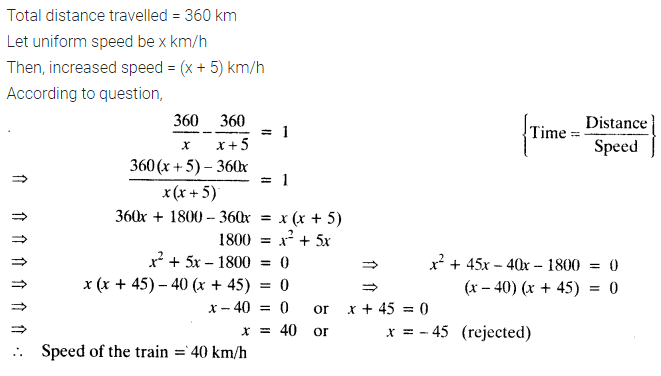
Question 9.
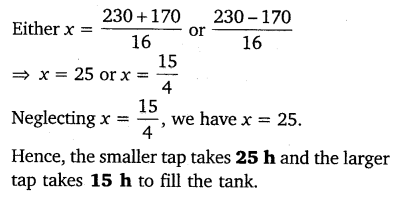
Two water taps together can fill a tank in 938 hours. The tap of larger diameter takes 10 hours less than the smaller one to fill the tank separately. Find the time in which each tap can separately fill the tank.
Solution: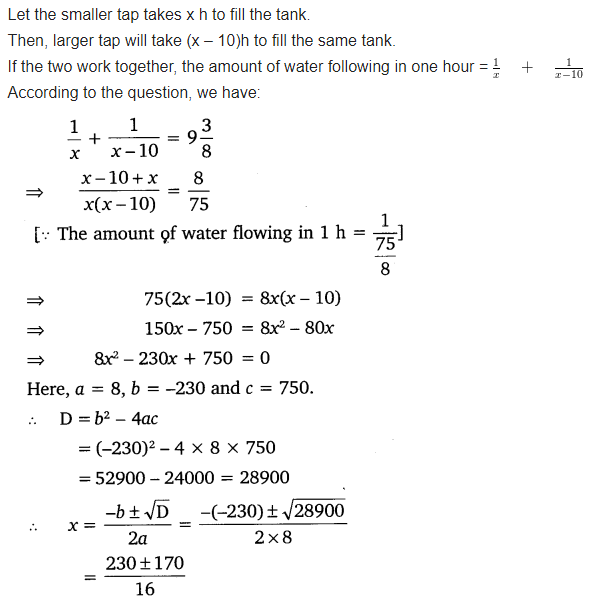
Question 10.
An express train takes 1 hour less than a passenger train to travel 132 km between Mysore and Bengaluru (without taking into consideration the time they stop at intermediate stations). If the average speed of the express train is 11 km/h more than that of the passenger train, find the average speed of the two trains.
Solution: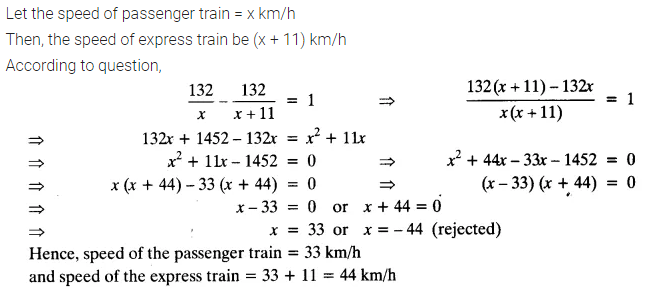
Question 11.
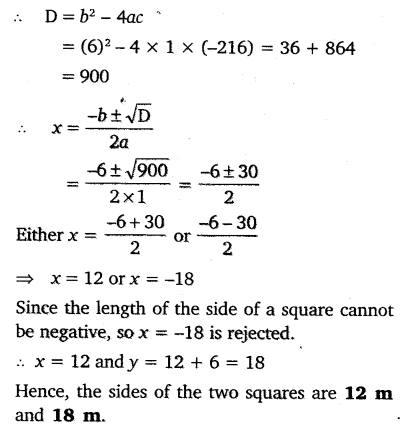
Sum of the areas of two squares is 468 m2. If the difference of their perimeters is 24 m, find the sides of the two squares.
Solution: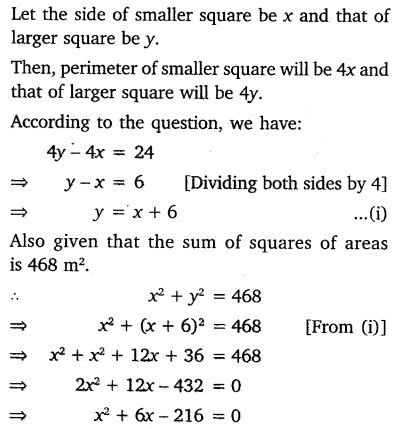
New Syllabus – Class 10 Maths Chapter 4 Quadratic Equations Ex 4.3
Question 1: Find the nature of the roots of the following quadratic equations. If real roots exist, find them:
(i) 2x² – 3x + 5 = 0
Solution:
For the quadratic equation 2x² – 3x + 5 = 0, we have:
- a = 2
- b = -3
- c = 5
The discriminant (Δ) is:
Δ = b² – 4ac = (-3)² – 4(2)(5) = 9 – 40 = -31
Since Δ < 0, the equation has no real roots.
(ii) 3x² – 4x + 4 = 0
Solution:
For the quadratic equation 3x² – 4x + 4 = 0, we have:
- a = 3
- b = -4
- c = 4
The discriminant (Δ) is:
Δ = b² – 4ac = (-4)² – 4(3)(4) = 16 – 48 = -32
Since Δ < 0, the equation has no real roots.
(iii) 2x² – 6x + 3 = 0
Solution:
For the quadratic equation 2x² – 6x + 3 = 0, we have:
- a = 2
- b = -6
- c = 3
The discriminant (Δ) is:
Δ = b² – 4ac = (-6)² – 4(2)(3) = 36 – 24 = 12
Since Δ > 0, the equation has two distinct real roots.
To find the roots, we use the quadratic formula:
x = (-b ± √Δ) / 2a
x = (-(-6) ± √12) / 2(2) = (6 ± 2√3) / 4 = (3 ± √3) / 2
Thus, the roots are:
x = (3 + √3) / 2 or x = (3 – √3) / 2
Question 2: Find the values of k for each of the following quadratic equations, so that they have two equal roots.
(i) 2x² + kx + 3 = 0
Solution:
For the quadratic equation 2x² + kx + 3 = 0, the condition for two equal roots is that the discriminant Δ = 0.
The discriminant is:
Δ = b² – 4ac
Here, a = 2, b = k, and c = 3, so:
Δ = k² – 4(2)(3) = k² – 24
For two equal roots, Δ = 0:
k² – 24 = 0
k² = 24
k = ±√24 = ± 2√6
Thus, the values of k are k = 2√6 or k = -2√6.
(ii) kx(x – 2) + 6 = 0
Solution:
First, expand the equation:
kx(x – 2) + 6 = 0 → kx² – 2kx + 6 = 0
For this quadratic equation to have two equal roots, the discriminant must be zero. So:
Δ = b² – 4ac = 0
Here, a = k, b = -2k, and c = 6. The discriminant is:
Δ = (-2k)² – 4(k)(6) = 4k² – 24k
For two equal roots, Δ = 0:
4k² – 24k = 0
4k(k – 6) = 0
Thus, k = 0 or k = 6.
Therefore, the values of k are k = 0 or k = 6.
You can access the official NCERT Solutions for Class 10 Mathematics on the NCERT website at the following link:
NCERT Class 10 Mathematics Solutions
This page will guide you to the textbook and solutions, as provided by the National Council of Educational Research and Training (NCERT).
You can access the official NCERT Solutions for Class 10 Mathematics on the NCERT website at the following link:
NCERT Class 10 Mathematics Solutions
📘 Math & Science Solutions by Class
🔹 Class 10
🔹 Class 9
🔹 Class 8
🔹 Class 7
🔹 Class 6
🔹 Class 12
🔹 Class 11
- Class 11 Math Solutions
- Class 11 Physics Solutions
- Class 11 Chemistry Solutions
- Class 11 Biology Solutions
Class-wise Solutions
Class 12:
Class 12 Physics – NCERT Solutions
Class 12 Chemistry – NCERT Solutions
Class 11:
- Class 11 Physics – NCERT Solutions
- Class 11 Chemistry – NCERT Solutions
- Class 11 Biology – NCERT Solutions
- Class 11 Math – NCERT Solutions
Class 10:
Class 9:
Class 8:
Class 7:
Class 6:
Subject-wise Solutions
Physics:
Chemistry:
Biology:
Math:
- Class 11 Math – NCERT Solutions
- Class 10 Math – NCERT Solutions
- Class 9 Math – NCERT Solutions
- Class 8 Math – NCERT Solutions
Science:
- Class 10 Science – NCERT Solutions
- Class 9 Science – NCERT Solutions
- Class 8 Science – Oxford Solutions
- Class 7 Science – Oxford Solutions
- Class 6 Science – Oxford Solutions