
Smart Techniques to Boost Science Study Habits
Mastering physics formulas, organic mechanisms, and complex biological pathways demands more than passive reading. Implementing Smart Techniques to Boost Science Study Habits—such as active recall, spaced repetition, and graphical summarization—transforms abstract theory into permanent exam mastery.
💡 The Science of Learning Science
Passive reading and excessive highlighting create an “illusion of competence.” High-scoring students replace passive revision with cognitive retrieval practice—actively writing derivations from memory, drawing unassisted biological diagrams, and solving numerical variations without checking answers first.
6 Core Pillars: Smart Techniques to Boost Science Study Habits
The Feynman Technique
Explain complex laws (like Lenz’s Law or Le Chatelier’s Principle) in simple, jargon-free words as if teaching a beginner. When you hit a roadblock, return to the textbook to fill the exact conceptual gap.
Spaced Repetition
Review newly learned science chapters at structured intervals: Day 1, Day 3, Day 7, and Day 21. Use flashcards for IUPAC functional groups, biological taxonomy, and physical constants.
Dual Coding Method
Combine written notes with visual blueprints. Pair ray optics lens formulas with standard ray trajectories, and connect respiration biochemical pathways with clean flowcharts to boost retrieval speed.
Interleaved Practice
Instead of solving 30 identical kinematic problems in one sitting, alternate between kinematics, thermodynamics, and electrochemistry. Interleaving trains your brain to select the correct formula under exam pressure.
The “Mistake Log” Audit
Maintain a dedicated notebook strictly for incorrect test answers, misapplied negative signs in physics, and forgotten reagents in organic synthesis. Reviewing mistakes weekly stops repeated errors.
Pomodoro & Focus Sprints
Structure your study into 50-minute deep-focus bursts dedicated to a single derivation or problem set, followed by a 10-minute mental break. Avoid multitasking across unrelated subjects.
Frequently Asked Questions (FAQs)
Quality outweighs quantity. For secondary and higher secondary students, 2.5 to 3 hours of focused active recall daily (split between numericals, derivations, and biology diagrams) yields far higher retention than 6 hours of passive reading.
Use the 5-minute rule: commit to drawing just the primary schematic diagram or writing the first two setup equations. Breaking large derivations into bite-sized steps eliminates cognitive friction.
No. Overly decorative notes waste valuable study time. Keep notes concise, bulleted, and focused on essential formulas, reaction conditions, labeled diagrams, and recurring exam questions.
Summary: Building Long-Term Science Mastery
Excelling in STEM subjects requires disciplined routines and active learning methodologies. Integrating these Smart Techniques to Boost Science Study Habits—from self-testing and spaced recall to error auditing—will help you retain complex theories effortlessly and perform with complete confidence in your board and competitive examinations.
Studying science can be both fascinating and challenging. Whether you’re in Class 9 or preparing for NEET, science requires smart strategies rather than just long hours. In this blog, you will learn Smart Techniques to Boost Science Study Habits to improve retention, understanding, and performance in exams.
Master Science Study Habits 🔬
Smart Techniques for Students

Why You Need a Smarter Approach to Science
Science isn’t just about memorizing facts; it’s about understanding concepts, applying formulas, and connecting ideas. To truly excel, you need a study strategy that goes beyond simple rote learning. These techniques will help you transform your study habits and achieve better results.
Top Study Techniques
Technique 1: The Active Recall Method
Instead of passively reading your notes, actively try to retrieve information from your memory. After reading a paragraph, close your book and try to explain the concept out loud or write it down. This strengthens your memory and helps you identify weak spots.
Technique 2: The Feynman Technique
Named after Nobel Prize-winning physicist Richard Feynman, this method involves teaching a concept to someone else (or even an imaginary student). By explaining it in simple terms, you’re forced to truly understand it.
Technique 3: Mind Mapping & Flowcharts
For subjects like Biology and Chemistry, visual aids are essential. Create mind maps to link related topics and flowcharts to understand processes and reactions. This visual approach makes complex information easier to remember and recall.
Technique 4: Consistent Practice
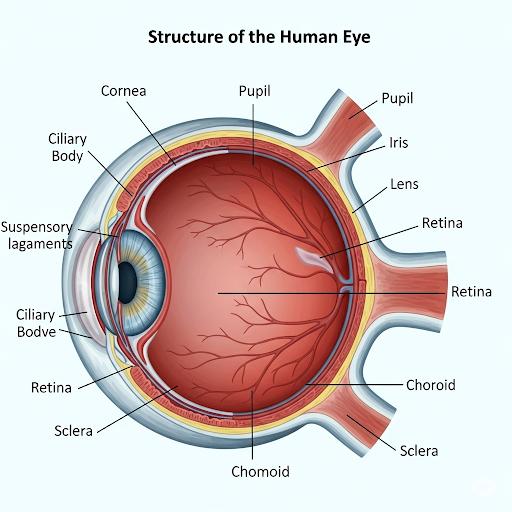
Science is a hands-on subject. Solve a variety of problems from your textbook and question banks. For Physics, practice numericals daily. For Chemistry, write and balance equations. For Biology, practice drawing and labeling diagrams.

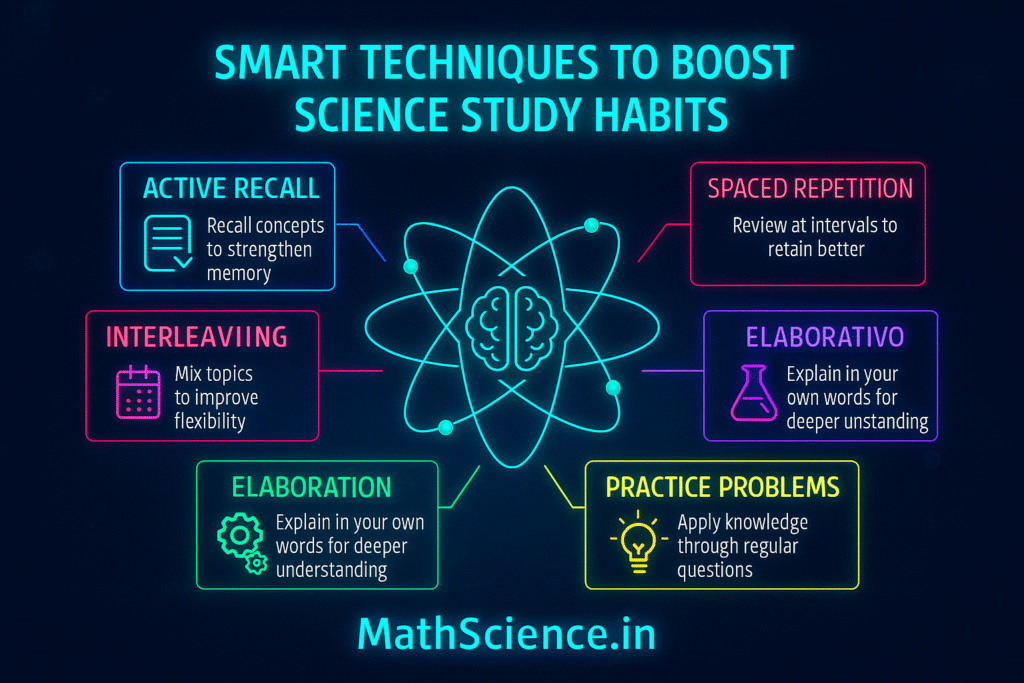
In conclusion, mastering science requires consistency, curiosity, and the right strategies. By applying Smart Techniques to Boost Science Study Habits, students can overcome fear, build confidence, and develop a deeper understanding of concepts. Whether it’s using mind maps, visual learning, or timed practice, these Smart Techniques to Boost Science Study Habits will enhance retention and performance.
Parents and teachers must also encourage students to adopt these Smart Techniques to Boost Science Study Habits in their daily routines. Ultimately, success in science is not about memorizing facts but using Smart Techniques to Boost Science Study Habits that make learning enjoyable and effective. Let every student take a step forward with these Smart Techniques to Boost Science Study Habits and unlock their full potential.



👍👍👍👍