
Class 9 New Science Book Chapter 10 Sound Waves: Overview
Class 9 New Science Book Chapter 10 Sound Waves introduces students to the fascinating world of sound, how it is produced, how it travels through different mediums, and how its properties are used in everyday life. Sound is an essential part of our surroundings, allowing us to communicate, listen to music, and understand the world around us.
In this chapter, students explore the scientific principles behind sound waves and learn how vibrations produce sound. They also discover how sound travels through solids, liquids and gases, and why it cannot travel through a vacuum.
Every sound we hear is produced by vibrations. From the ringing of a bell to the sound of musical instruments, vibrations play a fundamental role in producing sound waves.
Class 9 New Science Book Chapter 10 Sound Waves: Key Concepts
This chapter develops an understanding of the important characteristics of sound waves and their practical applications.
Understand how vibrating objects generate sound.
Explore how sound travels through different mediums.
Learn about amplitude, frequency, wavelength and time period.
Understand how sound speed varies in different materials.
Explore echoes and the reflection of sound waves.
Discover the uses of sound in technology and daily life.
Class 9 New Science Book Chapter 10 Sound Waves: Real-Life Applications
Sound waves have several important applications in science, medicine and modern technology. Technologies such as SONAR use sound waves to measure underwater distances and detect objects. Ultrasound is used in medical imaging to examine internal body structures, while sound-based devices help in navigation, communication and industrial testing.
Why Should You Study Sound Waves?
Studying sound waves helps students connect scientific concepts with real-world experiences. It builds a strong foundation for understanding wave motion, acoustics, musical instruments, communication systems and advanced applications of sound technology.
Which observation best supports the idea that sound is a mechanical wave?
Why are the other options incorrect?
(i) Reflection is a property of waves in general and does not specifically establish that sound is mechanical.
(iii) Frequency is a characteristic of all types of waves, including electromagnetic waves.
(iv) Both mechanical and electromagnetic waves can carry energy.
For a sound wave propagating in a medium, increasing its frequency will increase its:
Why are the other options incorrect?
(i) Wavelength: For a given medium, the speed of sound remains approximately constant. Therefore, increasing frequency decreases wavelength.
(ii) Speed: The speed of sound depends mainly on the properties of the medium, not on its frequency (under ordinary conditions).
(iv) Time period: Time period is inversely proportional to frequency. Hence, increasing frequency decreases the time period.
If 20 compressions pass a point in 4 seconds, the frequency is:
Time = 4 seconds
f = 20 / 4 = 5 Hz
In a room, the reflected sound reaches the ear 0.05 s after its production. Will it produce an echo or reverberation? Justify your answer.
Minimum time interval for a distinct echo = 0.1 s
Conclusion: The reflected sound will produce reverberation because the time interval between the original and reflected sounds is less than 0.1 seconds.
Sound Waves – Questions and Answers
Question 4
In a room, the reflected sound reaches the ear 0.05 s after its production. Will it produce an echo or reverberation? Justify your answer.
Answer 4
It will produce reverberation (or it is a case of reverberation rather than a distinct echo).
Justification: For a distinct echo to be heard by the human ear, the minimum time interval between the original sound and the reflected sound must be at least 0.1 s. Since the time interval given is 0.05 s (which is less than 0.1 s), the reflected sound merges with the original sound, resulting in multiple reflections called reverberation.
Question 5
Graphs representing two sound waves are given in Fig. 10.30. If the scales on the X and Y axes of the two graphs are the same, which of the two sound waves has (i) greater wavelength, and (ii) smaller amplitude?
Fig. 10.30: Graphs representing two sound waves
Answer 5
- (i) Greater wavelength: Wave (a) has a greater wavelength because the distance between two consecutive compressions (or peak-to-peak distance) is longer compared to wave (b).
- (ii) Smaller amplitude: Wave (a) has a smaller amplitude because the maximum displacement (height of the crest from the mean position) is less than that of wave (b).
Question 6
The sound waves emitted by three sources A, B and C are represented in Fig. 10.31. If the frequency of A is maximum and C is minimum, identify the corresponding curves, and mark A, B and C on them.
Answer 6
Frequency is inversely proportional to wavelength, meaning higher frequency waves complete more cycles in a given distance (shorter wavelength/tighter oscillations), while lower frequency waves complete fewer cycles (longer wavelength/wider oscillations).
- Source A (Maximum Frequency): Corresponds to the wave with the maximum number of oscillations (tightest waves) → Green Curve.
- Source B (Intermediate Frequency): Corresponds to the wave with moderate oscillations → Red Curve.
- Source C (Minimum Frequency): Corresponds to the wave with the fewest oscillations (widest wave) → Blue Curve.
Question 7
Draw a graph to represent a sound wave for which the density amplitude is 3 units and wavelength is 4 cm.
Answer 7
To represent this sound wave graphically, we plot Density on the Y-axis against Distance (in cm) on the X-axis.
- Density Amplitude (3 units): This represents the maximum displacement of density (height of the crest and depth of the trough) from the normal/mean density line (dashed line). The Y-axis ranges from -3 to +3.
- Wavelength (4 cm): This is the length of one complete wave cycle. Therefore, one full wave (one crest and one trough) spans a horizontal distance of 4 cm (e.g., from x = 0 cm to x = 4 cm, or x = 4 cm to x = 8 cm).
Graph representing a sound wave with amplitude = 3 units and wavelength = 4 cm
Question 8. In a movie, while showing the explosion of a spacecraft in space, a flash of light is shown along with sound at the same time. What are the errors in this depiction?
- Sound is a mechanical wave that requires a material medium such as air, water or solids to travel.
- Space is almost a vacuum and does not contain sufficient particles to transmit sound waves.
- Light is an electromagnetic wave and does not require a material medium for propagation.
- Therefore, light from the explosion can travel through space and reach an observer, but the sound of the explosion cannot.
Question 9. A source produces a sound wave of wavelength 3.44 m. If the wave travels with a speed of 344 m s⁻¹ find its time period.
- Wavelength (λ) = 3.44 m
- Wave speed (v) = 344 m s⁻¹
- Time period (T) = ?
Question 10. A ship searching for a sunken ship sent a sonar signal and detected an echo after 5 s. If ultrasonic wave travels at 1525 m s⁻¹ in seawater, approximately how far down in the ocean is the wreckage of the sunken ship located?
- Speed of ultrasonic wave (v) = 1525 m s⁻¹
- Total time taken for the echo (t) = 5 s
- Distance to the wreckage (d) = ?
Question 11. A vehicle is fitted with an ultrasonic distance sensor as part of parking assistance system which provides echolocation, while the driver is reversing the vehicle. It emits ultrasonic wave (about 40 kHz) which is reflected by the obstacle. When the warning beep starts sounding at a distance of 1.2 m from the obstacle, how much time is taken by ultrasonic wave to travel to the obstacle and come back? Assume the speed of ultrasonic wave in air to be 345 m s⁻¹.
- Frequency of ultrasonic wave = 40 kHz
- Distance between vehicle and obstacle = 1.2 m
- Speed of ultrasonic wave (v) = 345 m s⁻¹
- Time taken for to-and-fro journey (t) = ?
Note: The given frequency of 40 kHz is not required to calculate the time because the speed and total distance are already provided.
Question 12
The speed of sound in air is about 331 m s-1 at 0 °C and nearly 344 m s-1 at 22 °C. Roughly how much extra time will the sound of thunder take to travel a distance of 1720 m, if the air temperature changes from 22 °C to 0 °C? Assume that all other conditions remain unchanged.
Answer 12
Given Data:
- Distance (d) = 1720 m
- Speed of sound at 22 °C (v1) = 344 m s-1
- Speed of sound at 0 °C (v2) = 331 m s-1
Step 1: Calculate the time taken by sound at 22 °C (t1)
Time (t1) = Distance (d) / Speed (v1)
t1 = 1720 m / 344 m s-1 = 5 seconds
Step 2: Calculate the time taken by sound at 0 °C (t2)
Time (t2) = Distance (d) / Speed (v2)
t2 = 1720 m / 331 m s-1 ≈ 5.196 seconds
Step 3: Calculate the extra time taken
Extra Time = t2 – t1
Extra Time = 5.196 s – 5 s = 0.196 seconds ≈ 0.2 seconds
Conclusion: The sound of thunder will take approximately 0.2 seconds of extra time to travel the distance when the temperature drops from 22 °C to 0 °C.
Question 13
The variation of density of medium for a sound wave propagating with a speed of 340 m s-1 is shown in Fig. 10.32. Calculate the wavelength and frequency of the sound wave.
Answer 13
Given Data:
- Speed of sound (v) = 340 m s-1
- From Fig. 10.32, the total distance given for 2 complete wavelength cycles is 8 cm (2λ = 8 cm).
Step 1: Calculate the Wavelength (λ)
2λ = 8 cm
λ = 8 cm / 2 = 4 cm = 0.04 m
Step 2: Calculate the Frequency (ν)
v = ν × λ ⇒ ν = v / λ
ν = 340 m s-1 / 0.04 m = 8500 Hz (or 8.5 kHz)
Conclusion: The wavelength of the sound wave is 0.04 m (or 4 cm) and its frequency is 8500 Hz.
Question 14
The graphical representation of two sound waves A and B propagating at the same speed of 345 m s-1 is shown in Fig. 10.33. What is the wavelength of each of them? Also, calculate their frequencies.
Answer 14
Given Data:
- Speed of sound (v) = 345 m s-1
- From Fig. 10.33 (X-axis grid scale up to 5.0 cm):
- Wave A (Pink curve): Completes 3 full wave cycles in 5.0 cm ⇒ 3λA = 5.0 cm.
- Wave B (Blue curve): Completes 1 full wave cycle in 5.0 cm ⇒ 1λB = 5.0 cm.
Step 1: Wavelengths of Wave A and Wave B
• For Wave A: λA = 5.0 cm / 3 ≈ 1.67 cm (or 0.0167 m)
• For Wave B: λB = 5.0 cm (or 0.05 m)
Step 2: Calculate Frequencies (νA and νB)
• Frequency of Wave A (νA):
νA = v / λA = 345 m s-1 / 0.0167 m ≈ 20,660 Hz (or 20.66 kHz)
• Frequency of Wave B (νB):
νB = v / λB = 345 m s-1 / 0.05 m = 6900 Hz (or 6.9 kHz)
Conclusion:
- Wave A: Wavelength = 1.67 cm (0.0167 m), Frequency ≈ 20,660 Hz.
- Wave B: Wavelength = 5.0 cm (0.05 m), Frequency = 6900 Hz.
15.Two identical sound sources are placed at A and B — one in air and one submerged in water (Fig. 10.34). Both produce sounds at the same time, which travel horizontally to the vertical side of the cliff and
come back. If the time taken by the sound to return to A is 4.5 times than that of B, what is the ratio between the speeds of sound in air and water?
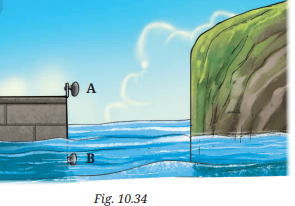
Ratio of Speeds of Sound
Given Data
- Let the distance from sources A and B to the cliff be d.
- Both sound waves travel to the cliff and return. Therefore, total distance travelled by each wave = 2d.
- Time taken by sound in air = tA.
- Time taken by sound in water = tB.
- Given relation: tA = 4.5 × tB.
Write the Speed Formulas
We know that:
Speed of sound in air:
Speed of sound in water:
Calculate the Ratio of Speeds
Taking the ratio of the two speeds:
Cancelling the common distance 2d:
Using the given relation:
Substituting the value:
Therefore, the ratio of the speed of sound in air to that in water is 2 : 9.
Frequency and Time Period
(i) Frequency of the sound wave
(ii) Time period of the sound wave
Number of oscillations (n) = 10
Total time (t) = 2 s
Frequency is the number of oscillations produced per second.
f = 5 Hz
Time period is the time taken to complete one oscillation.
T = 0.2 s
Frequency = 5 Hz and Time period = 0.2 s
Wavelength of Sound
Speed of sound (v) = 344 m/s
Lower frequency (f₁) = 20 Hz
Higher frequency (f₂) = 20 kHz = 20,000 Hz
λ = v / f
λ₁ = 344 / 20
λ₁ = 17.2 m
λ₂ = 344 / 20,000
λ₂ = 0.0172 m
Wavelength at 20 Hz = 17.2 m
Wavelength at 20 kHz = 0.0172 m (1.72 cm)
Distance of a Lightning Strike
Time delay (t) = 5 s
Speed of sound (v) = 340 m/s
d = vt
d = 1700 m
Converting metres into kilometres:
d = 1.7 km
The lightning strike is approximately 1.7 km away.
Distance of a Wall Using Echo
Time taken for echo (t) = 0.5 s
Speed of sound (v) = 340 m/s
d = vt / 2
d = 170 / 2
d = 85 m
Your distance from the wall is 85 metres.
Distance Measurement Using SONAR
Time taken by the SONAR signal (t) = 0.90 s
Speed of sound in seawater (v) = 1530 m/s
d = vt / 2
d = 1377 / 2
d = 688.5 m
The object is approximately 688.5 metres away.
Explain the construction and working of the human ear with a neat, labelled diagram.
1. Labelled Diagram of the Human Ear
2. Construction of the Human Ear
The human ear is divided into three main parts:
A. Outer Ear
The outer ear consists of two main structures:
- Pinna: It is the visible part of the ear. It collects sound waves from the surroundings and directs them into the ear canal.
- Ear Canal (Auditory Canal): It is a tube-like passage that carries sound waves towards the eardrum.
B. Middle Ear
The middle ear is an air-filled cavity containing the eardrum and three tiny bones called ossicles.
- Eardrum (Tympanic Membrane): A thin membrane that vibrates when sound waves strike it.
- Hammer (Malleus): The first tiny bone that receives vibrations from the eardrum.
- Anvil (Incus): The second bone that transfers vibrations from the hammer to the stirrup.
- Stirrup (Stapes): The third and smallest bone, which transmits vibrations to the inner ear through the oval window.
- Eustachian Tube: It connects the middle ear to the throat and helps maintain equal air pressure on both sides of the eardrum.
C. Inner Ear
The inner ear contains the following important structures:
- Cochlea: It is a spiral-shaped, fluid-filled structure containing sensory hair cells. It converts sound vibrations into electrical signals.
- Semicircular Canals: These are three fluid-filled canals that help maintain the balance of the body.
- Auditory Nerve: It carries electrical signals from the cochlea to the brain.
3. Working of the Human Ear
The process of hearing takes place through the following steps:
Collection of Sound Waves
The pinna collects sound waves from the surroundings and directs them through the ear canal towards the eardrum.
Vibration of the Eardrum
When sound waves strike the eardrum, it starts vibrating according to the frequency of the incoming sound.
Amplification of Vibrations
The vibrations are transmitted through the three tiny bones of the middle ear: hammer, anvil and stirrup. These bones amplify the vibrations and pass them to the inner ear through the oval window.
Conversion into Electrical Signals
The vibrations enter the fluid-filled cochlea and produce movement of its fluid. This stimulates sensory hair cells, which convert the mechanical vibrations into electrical signals.
Transmission of Signals to the Brain
The auditory nerve carries these electrical signals to the brain. The brain interprets them as different sounds, enabling us to hear.
4. Flowchart of the Hearing Process
5. Important Parts and Their Functions
| Part of the Ear | Function |
|---|---|
| Pinna | Collects sound waves. |
| Ear Canal | Carries sound waves to the eardrum. |
| Eardrum | Vibrates when sound waves strike it. |
| Ossicles | Amplify and transmit vibrations. |
| Eustachian Tube | Equalises air pressure on both sides of the eardrum. |
| Cochlea | Converts mechanical vibrations into electrical signals. |
| Auditory Nerve | Carries electrical signals to the brain. |
| Semicircular Canals | Help maintain body balance. |
Conclusion
The human ear converts sound waves into electrical signals that are transmitted to the brain through the auditory nerve. The brain interprets these signals as sound. Besides hearing, the inner ear also plays an important role in maintaining body balance.
Class 9 Updated New Science Book 2026 Solutions
Explore chapter-wise solutions, concepts, explanations, and study resources for the Class 9 Updated New Science Book 2026.
📚 Complete Study Resources
Access official NCERT textbooks, class-wise solutions, subject-wise solutions, and NEET Biology MCQs — all in one place.