
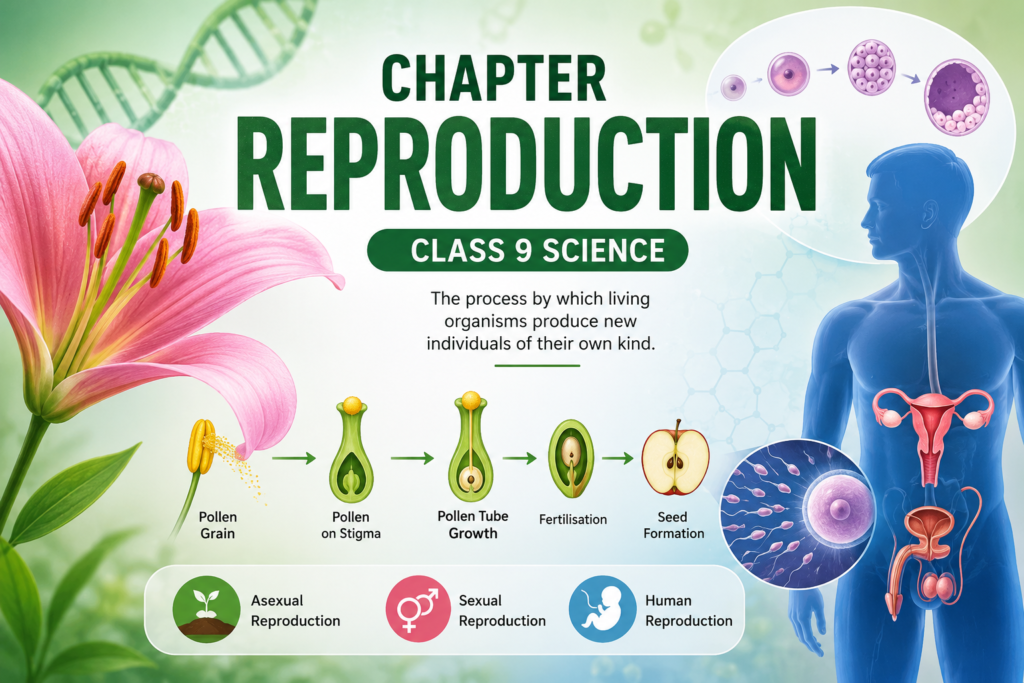
Class 9 Science New Book Chapter 11 Reproduction introduces one of the most important characteristics of living organisms—the ability to produce new individuals of their own kind. This chapter explains the different modes of reproduction, including asexual reproduction and sexual reproduction, along with their advantages and significance. You will also learn about vegetative propagation, pollination, fertilisation, seed formation, menstrual cycle, and human reproduction through simple explanations and diagrams.
On this page, you’ll find complete chapter notes, important definitions, labelled diagrams, NCERT solutions, MCQs, assertion–reason questions, competency-based questions, and exam-oriented practice material to help you prepare confidently for school exams and competitive tests. Whether you’re revising key concepts or learning the chapter for the first time, this guide covers everything you need in one place.
1. Overview of Reproduction
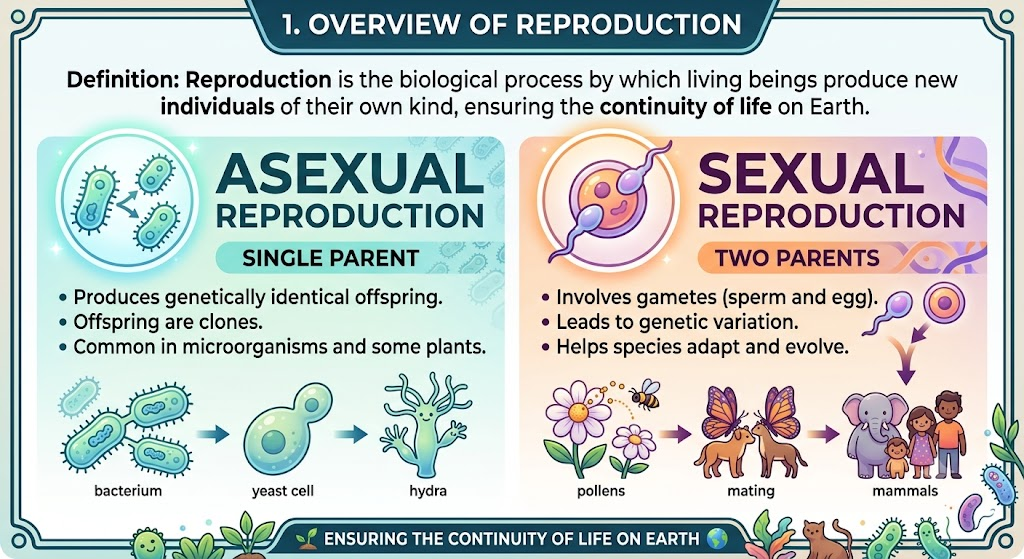
- Definition: Reproduction is the biological process by which living beings produce new individuals of their own kind, ensuring the continuity of life on Earth.
- Two Main Modes:
- Asexual Reproduction: A single parent produces genetically identical offspring (clones).
- Sexual Reproduction: Involves two parents, leading to genetic variation that helps species adapt and evolve
2. Asexual Reproduction
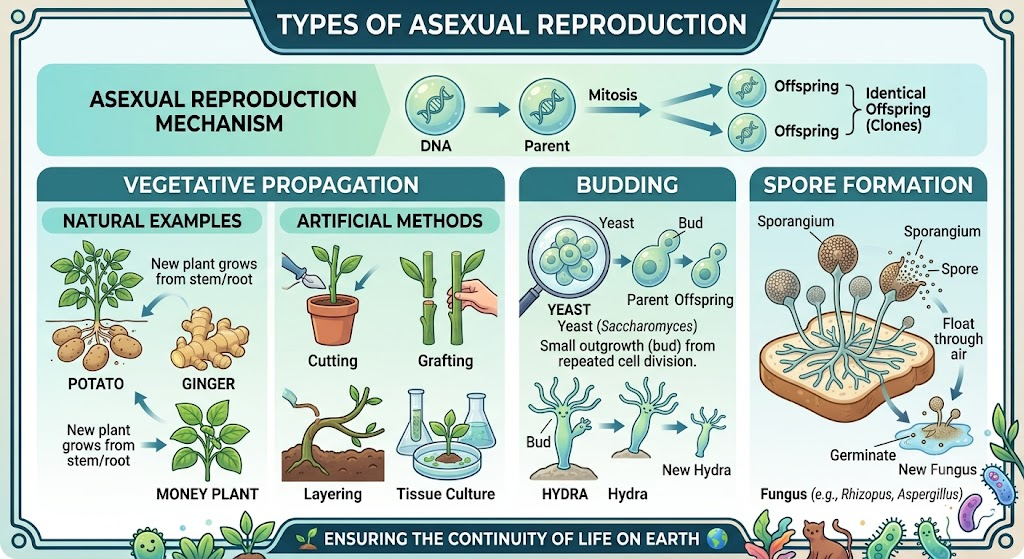
Asexual reproduction involves cell division through mitosis, producing identical offspring.
Common Types:
- Vegetative Propagation (Plants): New plants grow from vegetative parts like stems, leaves, or roots.
- Natural Examples: Potato, ginger, money plant, and Bryophyllum.
- Artificial Methods: Cutting, grafting, layering, and tissue culture.
- Budding: A small outgrowth (bud) forms due to repeated cell division, grows, and eventually detaches from the parent (e.g., Yeast, Hydra).
- Spore Formation: Microscopic, lightweight, single-celled spores develop inside a sac (sporangium) on fungal hyphae and float through the air to germinate in moist, warm conditions (e.g., Rhizopus, Aspergillus).
3. Sexual Reproduction in Plants
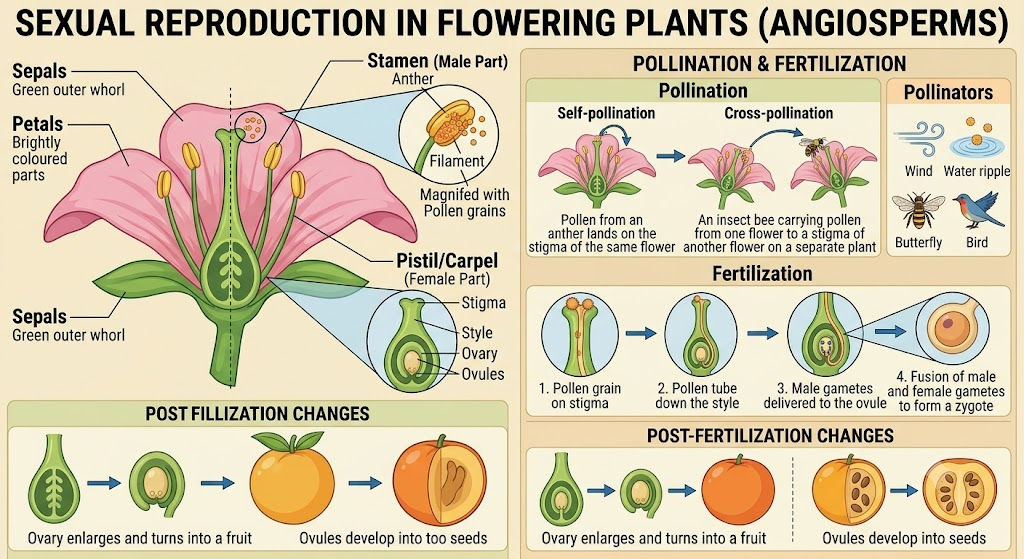
Flowering plants (angiosperms) use flowers as their reproductive organs.
Structure of a Flower:
- Sepals: Green outer whorl that protects the flower in the bud stage.
- Petals: Brightly coloured parts to attract pollinators.
- Stamen (Male Part): Consists of an anther (produces pollen grains) and a filament.
- Pistil/Carpel (Female Part): Consists of the stigma (sticky top), style (long tube), and ovary (contains ovules with egg cells).
Pollination & Fertilisation:
- Pollination: The transfer of pollen grains from anther to stigma.
- Self-pollination: Pollen transferred within the same flower or plant.
- Cross-pollination: Pollen transferred between different plants of the same species.
- Pollinators: Agents like wind, water, insects (bees, butterflies), and birds.
- Fertilisation: The pollen grain grows a tube down the style to deliver the male gamete to the ovule. The fusion of gametes forms a zygote.
- Post-Fertilisation Changes:
- Ovules develop into seeds.
- The ovary enlarges and turns into a fruit.
4. Sexual Reproduction in Animals
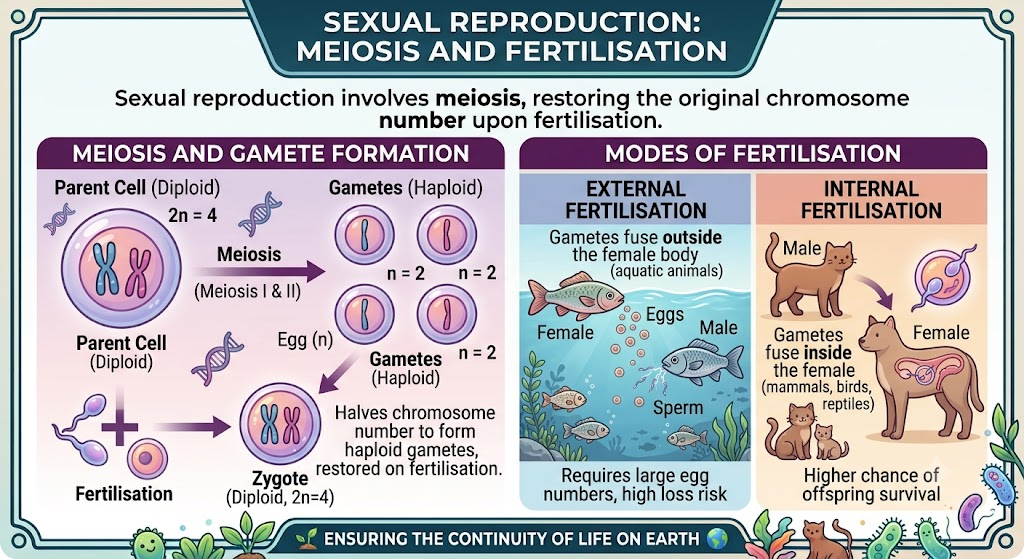
Sexual reproduction involves meiosis, a cell division process that halves the chromosome number to form haploid gametes (sperm and egg), restoring the original chromosome number upon fertilisation.
Modes of Fertilisation:
- External Fertilisation: Gametes fuse outside the female body (common in aquatic animals like fish and frogs). Requires producing large numbers of eggs due to high loss risks.
- Internal Fertilisation: Gametes fuse inside the female body (reptiles, birds, mammals). Higher chance of offspring survival.
5. Human Reproductive System
Male Reproductive System:
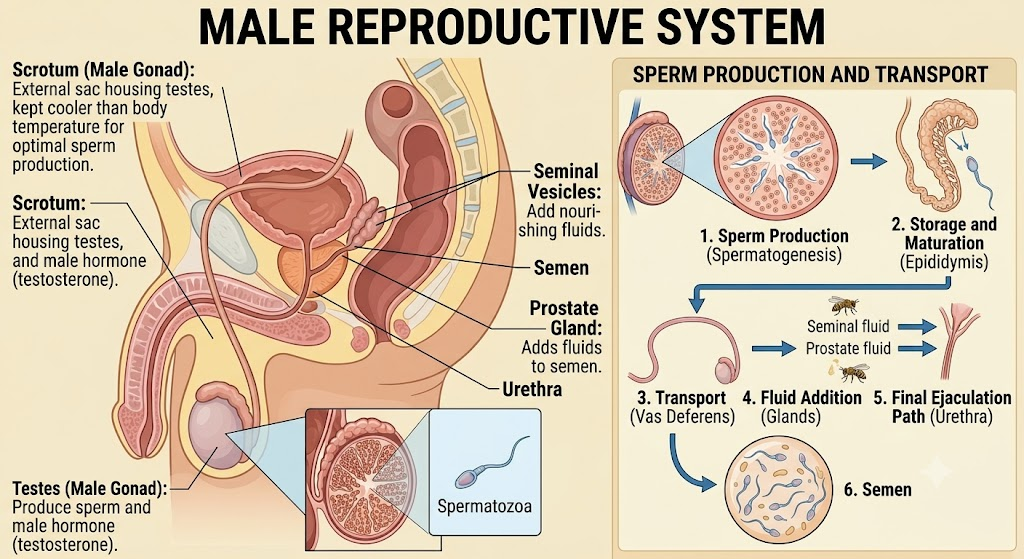
- Testes: Located in the scrotum (kept cooler than body temperature for sperm production) ; produce sperm and male hormones.
- Vas Deferens: Tube carrying sperm to the urethra.
- Glands (Seminal Vesicles, Prostate): Add nourishing fluids to form semen.
Female Reproductive System:
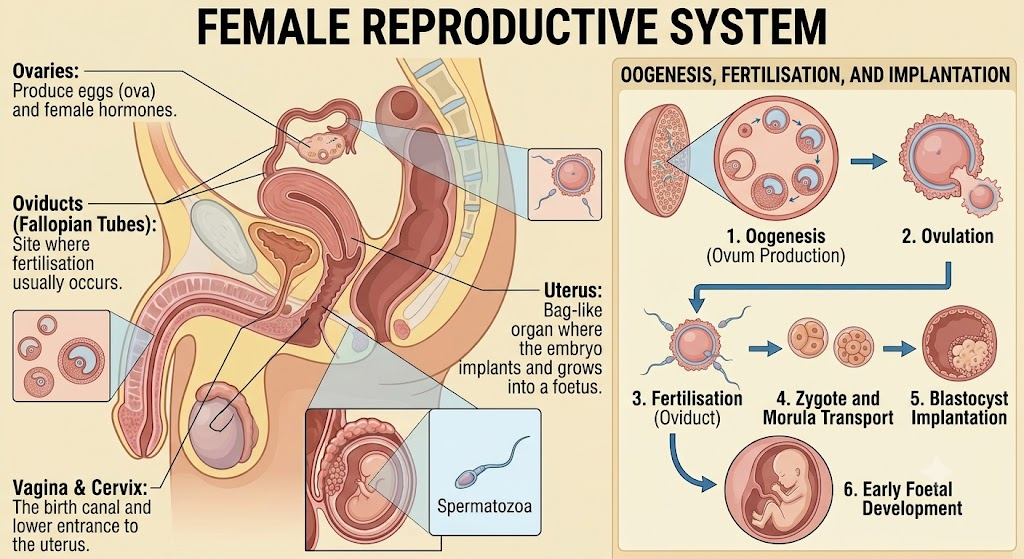
- Ovaries: Produce eggs (ova) and female hormones.
- Oviducts (Fallopian Tubes): Site where fertilisation usually occurs.
- Uterus: Bag-like organ where the embryo implants and grows into a foetus.
- Vagina & Cervix: The birth canal and lower entrance to the uterus.
Menstrual Cycle:
- A 28-day cycle (approx.) regulated by hormones.
- Ovulation: Release of a mature egg around Day 14.
- Menstruation: If fertilisation does not occur, the thick uterine lining breaks down and sheds through the vagina over 3–7 days.
Pregnancy & Childbirth:
- Gestation: Human pregnancy lasts about 9 months, divided into three trimesters.
- Development: Zygote $\rightarrow$ Embryo $\rightarrow$ Foetus.
- Childbirth: Uterine muscle contractions push the baby out through the birth canal.
6. Reproductive Health & Society
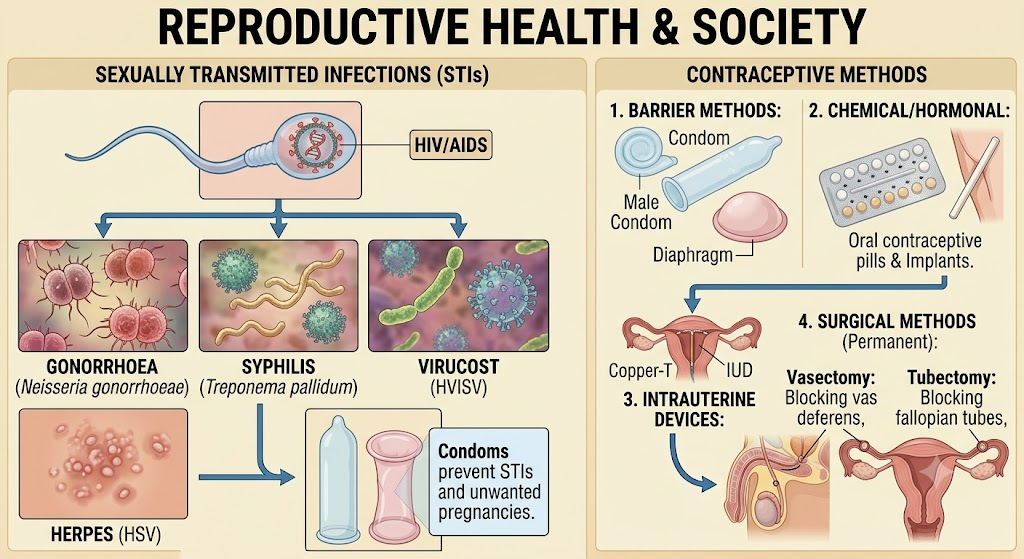
- Sexually Transmitted Infections (STIs): Diseases like HIV/AIDS, gonorrhoea, syphilis, and herpes spread through sexual contact. Condoms help prevent STIs and unwanted pregnancies.
- Contraceptive Methods:
- Barrier Methods: Condoms, diaphragms.
- Chemical/Hormonal: Oral contraceptive pills.
- Intrauterine Devices: Copper-T.
- Surgical Methods: Blocking vas deferens (vasectomy) or fallopian tubes (tubectomy).
Class 9 Science New Book Chapter 11 Reproduction – Exercise Answers
1. A flower’s anthers are removed before it matures. Later, pollen from another plant of the same species is dusted onto its stigma and seeds are produced. Which process has been ensured here?
Answer:
The correct answer is (ii) Cross-pollination.
Explanation:
Removing the anthers prevents the flower from using its own pollen. When pollen from another plant of the same species is placed on the stigma, cross-pollination occurs, leading to fertilisation and seed formation.
2. Arrange the following stages of sexual reproduction in plants in the correct order:
(i) Pollen germination on stigma
(ii) Fertilisation
(iii) Pollination
(iv) Formation of zygote
Answer:
The correct order is:
(iii) Pollination → (i) Pollen germination on stigma → (ii) Fertilisation → (iv) Formation of zygote
3. Assertion (A): The zygote formed after fertilisation immediately attaches to the uterus wall.
Reason (R): The uterus wall is always prepared to receive the zygote.
Answer:
The correct answer is (iv) A is false, but R is true.
Explanation:
The zygote does not immediately attach to the uterus wall. It first divides into an embryo while travelling through the fallopian tube and then implants in the uterus after a few days. The uterus wall is prepared to receive the embryo during the menstrual cycle.
4. Why does asexual reproduction produce offspring that are genetically identical to the parent?
Answer:
Asexual reproduction involves only one parent and no fusion of gametes. The offspring are produced by mitotic cell division, so they receive the same genetic material as the parent. Therefore, the offspring are genetically identical and are called clones.
5. Explain why the menstrual cycle stops during pregnancy.
Answer:
During pregnancy, hormones such as progesterone and estrogen maintain the thick lining of the uterus to support the developing embryo. Since the uterine lining is not shed, menstruation stops until after the baby is born.
6. Why are flowers that bloom at night white or light in colour as compared to flowers that bloom during the day?
Answer:
Night-blooming flowers are usually white or light-coloured because these colours are more visible in dim light. This helps attract night pollinators such as moths and bats for pollination.
7. Why do vegetatively propagated plants tend to be more vulnerable to diseases than sexually reproduced plants?
Answer:
Vegetatively propagated plants are genetically identical to the parent. Since they have little or no genetic variation, a disease that affects one plant can easily spread to all. Sexually reproduced plants have greater genetic diversity, making some plants naturally resistant to diseases.
8. If all flowers in a type of plant were only capable of self-pollination, how would it affect the genetic diversity over several generations? Explain.
Answer:
If plants only self-pollinate, genetic diversity would gradually decrease because the same genes are repeatedly passed on. Reduced genetic variation makes the plants less adaptable to environmental changes and more susceptible to diseases and pests.
9. A farmer wants to produce a large number of genetically identical plants quickly. Suggest suitable reproduction methods and explain why they are effective.
Answer:
The farmer should use vegetative propagation or tissue culture (micropropagation).
Explanation:
- Vegetative propagation produces new plants from stems, roots, or leaves. The new plants are genetically identical (clones) to the parent and retain all desirable traits.
- Tissue culture allows thousands of plants to be produced from a small piece of plant tissue under sterile laboratory conditions. It is a fast method for producing large numbers of healthy, disease-free, genetically identical plants.
10. Suresh prepares slides with pollen grains in different sugar concentrations (0%, 2.5%, 5%, 7.5%, 10%) to study the germination of pollen.
(i) What are the different hypotheses which can be tested using this set-up?
Answer:
The following hypotheses can be tested:
- Different sugar concentrations affect pollen germination.
- There is an optimum sugar concentration at which pollen germination is maximum.
- Very low or very high sugar concentrations reduce pollen germination.
(ii) What parameters should be kept the same in this set-up?
Answer:
The following parameters should be kept constant:
- Type and age of pollen grains.
- Number of pollen grains on each slide.
- Volume of sugar solution used.
- Temperature.
- Time allowed for germination.
- Light conditions.
- Size and cleanliness of the slides and coverslips.
Keeping these factors constant ensures that only the sugar concentration affects the pollen germination results.
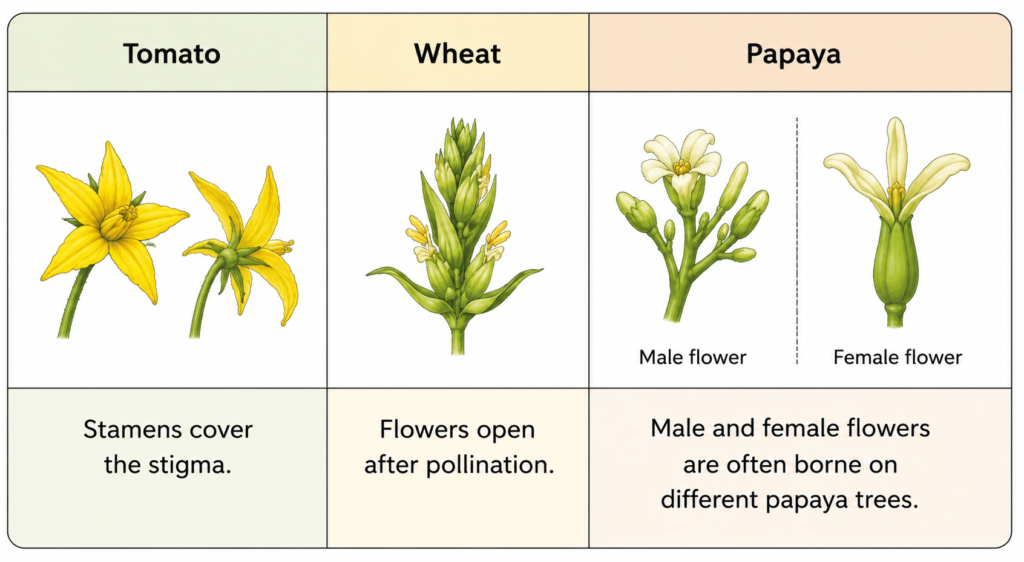
11. Look at the picture given below and think in line with the given prompts and find out which type(s) of pollination might have been followed in these flowers.
Answer:
| Plant | Type(s) of Pollination | Reason |
|---|---|---|
| Tomato | Self-pollination | The stamens cover the stigma, making it easy for pollen to fall onto the stigma of the same flower. |
| Wheat | Self-pollination | The flowers open only after pollination has already taken place, ensuring self-pollination. |
| Papaya | Cross-pollination | Male and female flowers are usually borne on different plants, so pollen must be transferred from a male plant to a female plant. |
Final Answer:
- Tomato: Self-pollination
- Wheat: Self-pollination
- Papaya: Cross-pollination
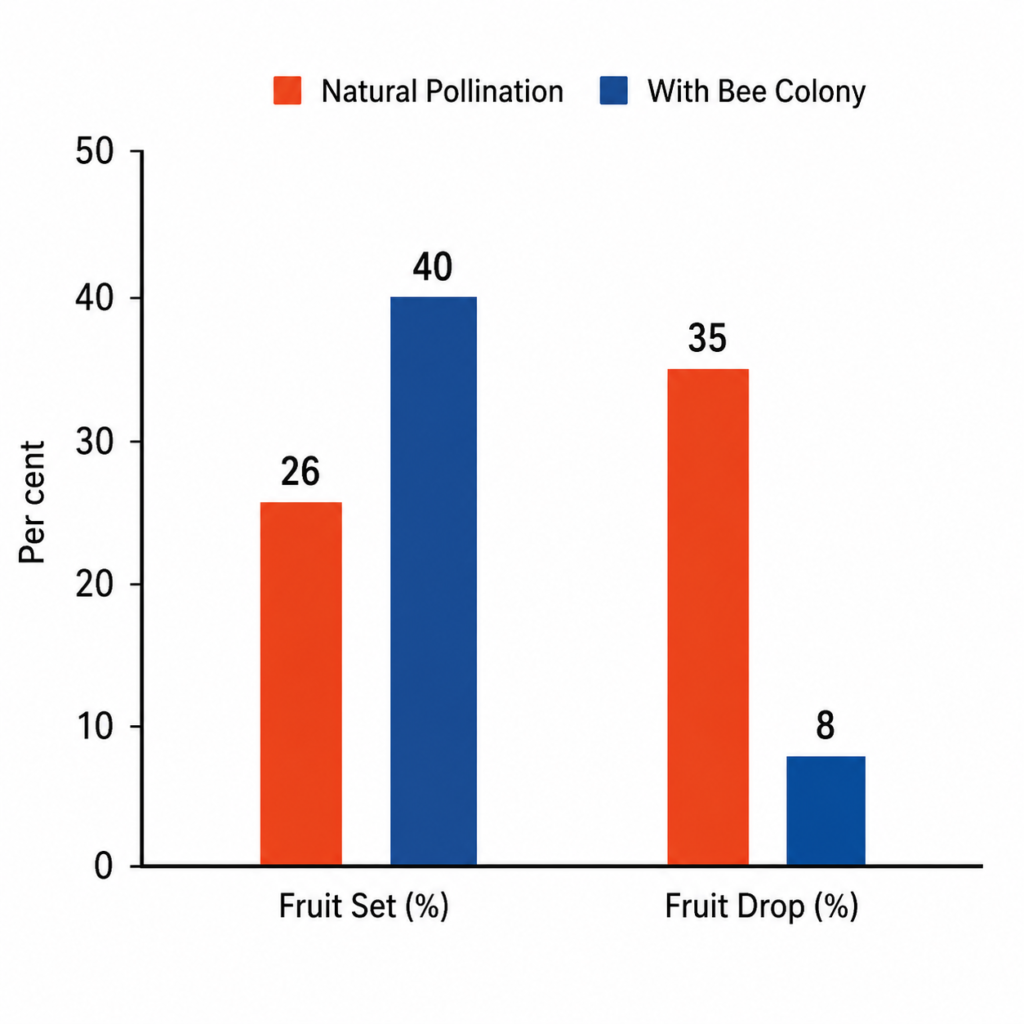
12. In the lower Himalayan region of northern India, apples are an important cash crop that contribute significantly to farmer’s livelihoods. The fruit yield in apple cultivation is declining continuously, associated with climate change and a significant decline in the population of natural pollinators. A researcher-farmer group set up two experimental apple orchards at two distinct locations: Places A and B. In apple orchards at Place A, they allowed natural pollinators Per cent to pollinate the flowers of the apple. In apple orchards at Place B, they applied mixed farming techniques of beekeeping. Along with honey, the farmer yielded apples. The yield of apples is depicted in Fig. 11.24, in terms of fruit setting (number of fruits/the total number of corresponding fruit-bearing branches) and fruit drop (premature falling of developing fruits) in the two types of experimental places of apple orchards.
(i) What are the hypotheses the researcher-farmers group has thought of for this investigation?
Answer:
The following hypotheses can be tested:
- Bee colonies increase the pollination of apple flowers.
- Increased pollination leads to higher fruit set.
- Bee pollination reduces fruit drop and improves apple yield.
(ii) What different parameters are there in the experiment?
Answer:
- Independent variable: Type of pollination (natural pollination and pollination with bee colonies).
- Dependent variables: Fruit set (%) and fruit drop (%).
- Controlled variables: Same variety of apple plants, similar age of trees, equal irrigation, fertilizer, soil conditions, and climatic conditions as far as possible.
(iii) Compare the experimental orchards at Places A and B in terms of high yields of apple fruits.
Answer:
- Place A (Natural Pollination):
- Fruit set ≈ 26%
- Fruit drop ≈ 35%
- Place B (With Bee Colony):
- Fruit set ≈ 40%
- Fruit drop ≈ 8%
Thus, Place B had a higher fruit set and much lower fruit drop, resulting in a higher yield of apples than Place A.
(iv) Based on your analysis, what do you infer from the data?
Answer:
The data show that bee colonies greatly improve pollination in apple orchards. This increases the percentage of fruit set and reduces fruit drop, leading to a much higher apple yield. Therefore, beekeeping is an effective method to improve apple production, especially where natural pollinators are declining.
13. A student claims, “In humans, ovulation always happens on day 14 of the menstrual cycle”. Critically examine this claim and state whether the claim is correct or not. Give at least two reasons for your answer.
Answer:
The claim is not correct.
Reasons:
- Ovulation on day 14 occurs only in a typical 28-day menstrual cycle. Many women have shorter or longer cycles, so ovulation may occur earlier or later.
- The menstrual cycle varies from person to person and even from one cycle to another due to factors such as age, stress, illness, hormonal changes, and lifestyle.
Conclusion:
Ovulation does not always occur on day 14. It varies depending on the length and regularity of the menstrual cycle.
Class 9 Updated New Science Book 2026 Solutions
Explore chapter-wise solutions, concepts, explanations, and study resources for the Class 9 Updated New Science Book 2026.
📚 NCERT Solutions & Study Resources
Explore NCERT solutions, Oxford book solutions, Mathematics, Science, Physics, Chemistry, Biology and more — organized class-wise.
🎓 Class 12 — NCERT Solutions
📘 Class 11 — NCERT Solutions
📗 Class 10 — NCERT Solutions
📕 Class 9 — NCERT Solutions
📙 Class 8 — Solutions
📒 Class 7 — Solutions
📓 Class 6 — Solutions
🏛️ Official NCERT Textbooks
Access the official NCERT textbook portal for Class 10 Mathematics and other NCERT textbooks directly from the NCERT website.
Visit Official NCERT Website ↗