
Class 10 Science Ch 4 Carbon and its Compound – Complete Chapter Overview
Class 10 Science Ch 4 Carbon and its Compound explores the unique properties of carbon, the formation of covalent bonds, and the wide variety of compounds that carbon forms. Carbon is one of the most important elements in nature because it is present in living organisms, fuels, food, medicines, plastics, and many everyday materials.
This chapter explains why carbon forms a large number of compounds, how these compounds are classified, and how their structures determine their properties and uses. It also covers saturated and unsaturated hydrocarbons, functional groups, homologous series, chemical reactions of carbon compounds, ethanol, ethanoic acid, soaps, and detergents.
Key Topics Covered
1. Bonding in Carbon
Learn about tetravalency, covalent bonding, and why carbon forms strong bonds with itself and other elements.
2. Versatile Nature of Carbon
Understand catenation and tetravalency, which enable carbon to form chains, branches, rings, and numerous compounds.
3. Hydrocarbons
Explore saturated hydrocarbons (alkanes), unsaturated hydrocarbons (alkenes and alkynes), and their structures.
4. Functional Groups
Identify functional groups such as alcohol, aldehyde, ketone, carboxylic acid, and halogen groups.
5. Chemical Properties
Study combustion, oxidation, addition, and substitution reactions with suitable chemical equations.
6. Ethanol, Ethanoic Acid, Soaps and Detergents
Understand the properties and uses of ethanol and ethanoic acid, and how soaps and detergents help remove dirt.
Important Concepts to Understand
Tetravalency: Carbon has four valence electrons and generally forms four covalent bonds to achieve a stable electronic configuration.
Catenation: The ability of carbon atoms to bond with one another and form long chains, branched chains, and rings.
Covalent Bonding: A chemical bond formed when atoms share electron pairs. Carbon compounds commonly contain covalent bonds.
Homologous Series: A family of organic compounds with the same functional group and general formula, in which successive members differ by a –CH₂– unit.
Esterification: The reaction of an alcohol with a carboxylic acid to form an ester and water, generally in the presence of concentrated sulphuric acid.
Why Is This Chapter Important?
Class 10 Science Ch 4 Carbon and its Compound is an important chapter for understanding organic chemistry. It helps students learn chemical structures, molecular formulae, nomenclature, functional groups, and reaction equations. These concepts are useful for school examinations and provide a foundation for higher-level chemistry.
Preparation Tips
✓ Practise drawing the electron-dot structures of common carbon compounds.
✓ Learn the differences between saturated and unsaturated hydrocarbons.
✓ Revise functional groups, basic nomenclature, and homologous series.
✓ Practise balanced chemical equations for the major reactions.
✓ Understand the cleansing action of soap and the difference between soaps and detergents.
Study each concept carefully and practise the in-text questions and end-of-chapter exercises to strengthen your understanding of carbon compounds.
Class 10 Science Ch 4 Carbon and its Compound – Textbook Exercise Answers
Question 1
What would be the electron dot structure of carbon dioxide, which has the formula CO₂?
✦ Answer
Carbon has four valence electrons, while each oxygen atom has six valence electrons. Carbon shares two pairs of electrons with each oxygen atom, forming two double covalent bonds. Thus, carbon dioxide has the structure O=C=O.
ELECTRON DOT STRUCTURE OF CO₂
Each oxygen atom has two lone pairs of electrons.
Therefore, the electron dot structure of carbon dioxide is represented as O=C=O, with two shared electron pairs in each C–O bond and two lone pairs remaining on each oxygen atom.
Question 2
What would be the electron dot structure of sulphur, which is made up of eight atoms of sulphur?
✦ Answer
Sulphur exists as an eight-atom molecule, represented by S₈. Each sulphur atom has six valence electrons and forms two single covalent bonds with its neighbouring sulphur atoms. The eight sulphur atoms form a closed ring, with each sulphur atom retaining two lone pairs of electrons.
ELECTRON DOT STRUCTURE OF S₈
Each S–S bond represents one shared pair of electrons. Each sulphur atom has two lone pairs, which are omitted from this simplified ring diagram for clarity.
Therefore, the electron dot structure of S₈ consists of eight sulphur atoms joined in a ring by single covalent bonds, with two lone pairs of electrons on each sulphur atom.
PAGE 68–69
Question 1
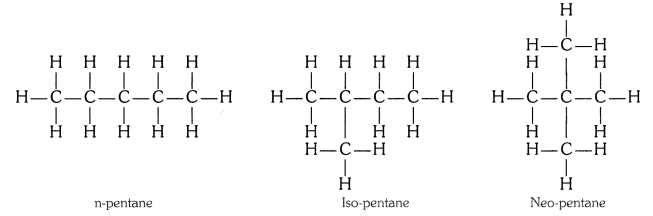
How many structural isomers can you draw for pentane?
✦ Answer
Pentane (C₅H₁₂) has **three structural isomers**. They have the same molecular formula but different arrangements of carbon atoms.
1. n-Pentane (Straight-chain)
CH₃–CH₂–CH₂–CH₂–CH₃
2. Isopentane (2-Methylbutane)
CH₃–CH(CH₃)–CH₂–CH₃
3. Neopentane (2,2-Dimethylpropane)
C(CH₃)₄
Therefore, pentane has three structural isomers.
Question 2
What are the two properties of carbon which lead to the huge number of carbon compounds we see around us?
✦ Answer
(i) Tetravalency: Carbon has a valency of four, so it can form four covalent bonds with other atoms, including carbon, hydrogen, oxygen, and nitrogen.
(ii) Catenation: Carbon atoms can bond with one another to form long chains, branched chains, and rings, resulting in a large variety of compounds.
Question 3
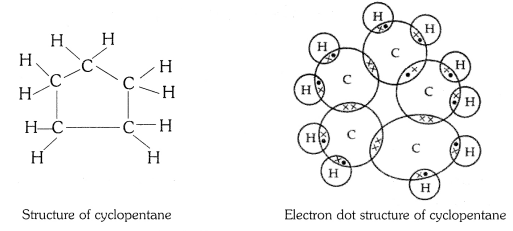
What will be the formula and electron dot structure of cyclopentane?
✦ Answer
Molecular formula: C₅H₁₀
Cyclopentane is a cyclic hydrocarbon consisting of five carbon atoms joined in a ring. Each carbon atom is bonded to two neighbouring carbon atoms and two hydrogen atoms.
STRUCTURE OF CYCLOPENTANE
Each CH₂ group represents one carbon atom bonded to two hydrogen atoms. All bonds shown are single covalent bonds.
Electron dot structure: Each carbon atom shares one electron pair with each neighbouring carbon atom and one electron pair with each of its two hydrogen atoms, completing four covalent bonds. Each hydrogen atom shares one electron pair with carbon.
Question 4
Draw the structures for the following compounds:
✦ Answer
(i) Ethanoic acid
CH₃–C(=O)–OH
Molecular formula: C₂H₄O₂
(ii) Bromopentane (1-bromopentane)
CH₃–CH₂–CH₂–CH₂–CH₂–Br
Molecular formula: C₅H₁₁Br
(iii) Butanone (butan-2-one)
CH₃–C(=O)–CH₂–CH₃
Molecular formula: C₄H₈O
(iv) Hexanal
CH₃–CH₂–CH₂–CH₂–CH₂–CHO
Molecular formula: C₆H₁₂O
Note: “Bromopentane” can have different structural isomers depending on the position of bromine. The structure above represents 1-bromopentane.
(i) Ethanoic acid (CH3COOH)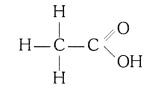
(ii) Bromopentane (C5H11Br)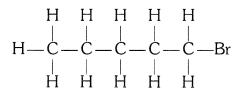
(iii) Butanone (CH3 — CH2 — COCH3)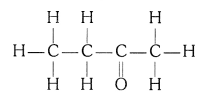
(iv) Hexanal (C5H11CHO)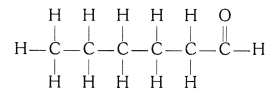
Structural isomers for bromopentane: There are three structural isomers for bromopentane depending on the position of Br at carbon 1, 2, 3.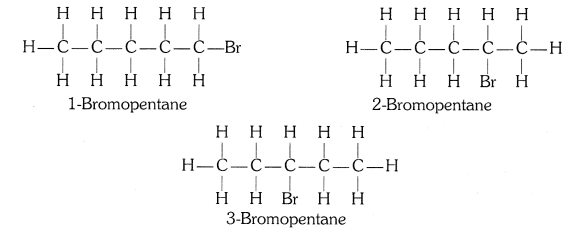
Question 2
A mixture of oxygen and ethyne is burnt for welding. Can you tell why a mixture of ethyne and air is not used?
✦ Answer
Ethyne burns in air with an incomplete combustion and produces a sooty flame that does not generate sufficient heat for welding. When ethyne burns in pure oxygen, it undergoes more complete combustion and produces a very hot flame (about 3,000°C), which is suitable for welding metals.
PAGE 74
Question 1
How would you distinguish experimentally between an alcohol and a carboxylic acid?
✦ Answer
Add a small piece of sodium hydrogen carbonate (NaHCO₃) to each sample.
Carboxylic acid: It produces brisk effervescence due to the release of carbon dioxide gas.
Alcohol: It does not produce carbon dioxide gas with sodium hydrogen carbonate under normal conditions.
Conclusion: The release of carbon dioxide distinguishes a carboxylic acid from an alcohol.
Question 2
What are oxidising agents?
✦ Answer
Oxidising agents are substances that cause oxidation of other substances by supplying oxygen or removing hydrogen. Examples include potassium permanganate (KMnO₄) and potassium dichromate (K₂Cr₂O₇).
PAGE 76
Question 1
Would you be able to check if water is hard by using a detergent?
✦ Answer
No, detergent cannot be used to check whether water is hard. Detergents form lather in both hard and soft water because they do not form insoluble precipitates with calcium and magnesium ions. Soap is more suitable for this test because it forms scum in hard water.
Question 2
People use a variety of methods to wash clothes. Usually after adding the soap, they ‘beat’ the clothes on a stone, or beat it with a paddle, scrub with a brush or the mixture is agitated in a washing machine. Why is agitation necessary to get clean clothes?
✦ Answer
Agitation helps the soap or detergent come into close contact with dirt and grease. Soap molecules form structures called micelles around oily dirt particles. Scrubbing, beating, or machine agitation loosens these particles from the fabric and allows them to remain suspended in water so they can be rinsed away easily.
Question 4
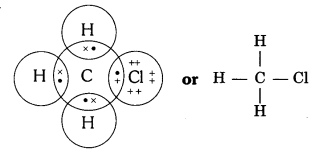
Explain the nature of the covalent bond using the bond formation in CH₃Cl.
✦ Answer
A covalent bond is formed when two atoms share one or more pairs of electrons to achieve a stable electronic configuration.
In chloromethane (CH₃Cl), carbon has four valence electrons, hydrogen has one, and chlorine has seven valence electrons. Carbon shares one electron pair with each of the three hydrogen atoms and one electron pair with the chlorine atom.
STRUCTURE OF CH₃Cl
Each line represents one shared pair of electrons.
As a result:
• Carbon completes its octet by forming four covalent bonds.
• Each hydrogen atom achieves a duplet.
• Chlorine completes its octet and retains three lone pairs of electrons.
Therefore, CH₃Cl is formed by sharing electrons, and all four bonds around the carbon atom are single covalent bonds.
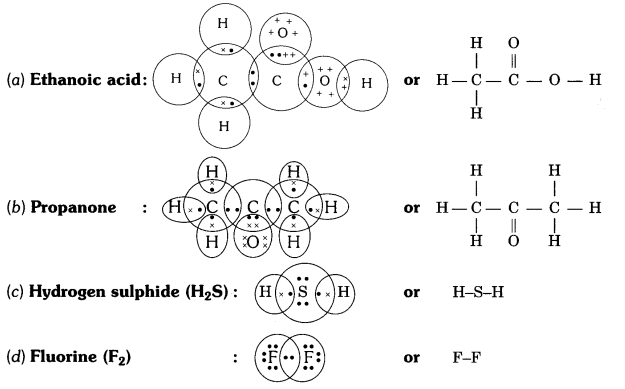
Question 5: Electron Dot Structures
Question: Draw the electron dot structures for:
(a) Ethanoic acid (CH₃COOH)
The structure contains a carbonyl group (C=O) and a hydroxyl group (O–H). Each oxygen atom has two lone pairs.
(b) Propanone (CH₃COCH₃)
The central carbon forms a double covalent bond with oxygen and single covalent bonds with two carbon groups. Oxygen has two lone pairs.
(c) Hydrogen sulphide (H₂S)
Sulphur shares one electron pair with each hydrogen atom and has two lone pairs of electrons.
(d) Fluorine (F₂)
Each fluorine atom shares one electron to form a single covalent bond. Each fluorine atom retains three lone pairs.
Key point: In electron dot structures, dots represent valence electrons. A shared pair of electrons represents a covalent bond.
Question 6: What is a Homologous Series?
Answer
A homologous series is a group of organic compounds having the same functional group and the same general formula, in which any two successive members differ by a –CH₂– group (a mass difference of 14 u). They have similar chemical properties and show a gradual change in physical properties.
Example: Homologous Series of Alkanes
| Name | Molecular Formula |
|---|---|
| Methane | CH₄ |
| Ethane | C₂H₆ |
| Propane | C₃H₈ |
| Butane | C₄H₁₀ |
Explanation: Each successive member differs from the previous one by –CH₂–. For example, methane (CH₄) and ethane (C₂H₆) differ by one –CH₂– group. Alkanes have the general formula CₙH₂ₙ₊₂.
Question 7: Differentiate Between Ethanol and Ethanoic Acid
Ethanol and ethanoic acid can be differentiated on the basis of their physical and chemical properties as follows:
1. Physical Properties
| Property | Ethanol | Ethanoic Acid |
|---|---|---|
| Odour | Alcoholic smell | Vinegar-like smell |
| Melting point | About −114°C | About 16.6°C |
| Nature | Neutral | Acidic |
2. Chemical Properties
Test with Sodium Hydrogen Carbonate (NaHCO₃)
Ethanol: No reaction occurs, and no bubbles are produced.
Ethanoic acid: Reacts with sodium hydrogen carbonate, producing brisk effervescence due to the release of carbon dioxide gas.
Chemical Equation
CH₃COOH + NaHCO₃ → CH₃COONa + H₂O + CO₂↑
Conclusion: Ethanoic acid turns blue litmus red and reacts with sodium hydrogen carbonate to release carbon dioxide, whereas ethanol does not show these acidic reactions.
Question 8: Micelle Formation by Soap
Answer
When soap is added to water, its molecules arrange themselves into spherical structures called micelles above a certain concentration.
Each soap molecule has two parts:
Hydrophilic head: The ionic end that attracts water.
Hydrophobic tail: The hydrocarbon end that repels water but is attracted to oil and grease.
In a micelle, the hydrophobic tails point inward, away from water, while the hydrophilic heads face outward toward the water. The inward-facing tails trap oily dirt, allowing it to be removed during washing.
Will micelles form in ethanol?
Generally, micelles do not form in ethanol in the same way as they do in water. Ethanol can interact with both polar and non-polar parts of soap molecules, so the arrangement needed to form typical micelles is not favoured.
In short: Soap forms micelles in water because its hydrophobic tails avoid water and its hydrophilic heads remain in contact with it. Typical micelle formation is generally not favoured in ethanol.
Question 9: Why are carbon and its compounds used as fuels for most applications?
Answer
Carbon and its compounds are widely used as fuels because they generally have high calorific values and release a large amount of heat when they burn in oxygen. Many of them are readily available, easy to store and transport, and burn at a suitable rate for domestic and industrial applications.
Question 10: Explain the formation of scum when hard water is treated with soap.
Answer
Hard water contains dissolved calcium and magnesium salts. When soap is added, it reacts with calcium and magnesium ions to form insoluble salts that appear as a sticky precipitate called scum. This reduces the formation of lather and wastes soap.
Example equation
2C₁₇H₃₅COONa + CaCl₂ → (C₁₇H₃₅COO)₂Ca↓ + 2NaCl
Question 11: What change will you observe if you test soap with red and blue litmus paper?
Answer
Red litmus paper: Turns blue.
Blue litmus paper: Shows no change.
This happens because a soap solution is generally alkaline (basic) in nature.
Question 12: What is hydrogenation? What is its industrial application?
Answer
Hydrogenation is the process of adding hydrogen to an unsaturated compound in the presence of a catalyst such as nickel, palladium or platinum.
Industrial application: It is used to convert unsaturated vegetable oils into saturated or more saturated fats, such as in the manufacture of vanaspati ghee.
Unsaturated vegetable oil + H₂ → More saturated fat
Catalyst: nickel (Ni)
Question 13: Which hydrocarbons undergo addition reactions?
Answer
The hydrocarbons that undergo addition reactions are:
C₃H₆ and C₂H₂
C₃H₆ (propene) contains a carbon–carbon double bond, while C₂H₂ (ethyne) contains a carbon–carbon triple bond. These unsaturated hydrocarbons can add hydrogen or other atoms across their multiple bonds. The remaining compounds, C₂H₆, C₃H₈ and CH₄, are saturated hydrocarbons and generally undergo substitution reactions instead.
Question 14: Give a test to differentiate chemically between butter and cooking oil.
Answer
Add a few drops of bromine water to separate samples of butter and cooking oil under suitable conditions.
Cooking oil: If it contains unsaturated compounds, it decolourises bromine water due to addition across carbon–carbon double bonds.
Butter: Typically shows much less decolourisation because it contains a higher proportion of saturated fats, although butter also contains some unsaturated fats.
Note: Cooking oils and butter vary in composition, so the result depends on their degree of unsaturation. Bromine should be handled only in a properly equipped laboratory under teacher supervision.
Question 15: Explain the mechanism of the cleaning action of soaps.
OR: Explain the cleansing action of soaps.
Answer
A soap molecule has two parts: a hydrophilic ionic head that is attracted to water and a hydrophobic hydrocarbon tail that is attracted to oil and grease.
Step 1: The hydrophobic tails attach themselves to oily dirt and grease on the surface.
Step 2: The hydrophilic heads remain in contact with the surrounding water.
Step 3: Soap molecules surround the grease particles and form structures called micelles, with the tails directed inward and the heads outward.
Step 4: Rubbing or agitation loosens the dirt, and the suspended grease particles are washed away with water.
Thus, soap helps remove oily dirt by forming micelles and allowing the dirt to be carried away by water.
📚 NCERT Solutions & Study Resources
Explore NCERT solutions, Oxford book solutions, Mathematics, Science, Physics, Chemistry, Biology and more — organized class-wise.
🎓 Class 12 — NCERT Solutions
📘 Class 11 — NCERT Solutions
📗 Class 10 — NCERT Solutions
📕 Class 9 — NCERT Solutions
📙 Class 8 — Solutions
📒 Class 7 — Solutions
📓 Class 6 — Solutions
🏛️ Official NCERT Textbooks
Access the official NCERT textbook portal for Class 10 Mathematics and other NCERT textbooks directly from the NCERT website.
Visit Official NCERT Website ↗Class 9 Updated New Science Book 2026 Solutions
Explore chapter-wise solutions, concepts, explanations, and study resources for the Class 9 Updated New Science Book 2026.