
Exploring Mixtures & Their Separation
A complete chapter overview of mixtures, solutions, solubility, colloids, suspensions and the scientific methods used to separate different components. Learn the concepts clearly and connect them with everyday life.
What will you learn?
This chapter explains how substances can exist together without necessarily forming a new substance, and how their different physical properties can be used to separate them.
Understanding Mixtures
A mixture is formed when two or more substances are combined physically. The substances retain their individual chemical identities and can generally be separated using suitable physical methods.
Homogeneous Mixture
A homogeneous mixture has a uniform composition throughout. Its components are evenly distributed, so different parts of the mixture have the same composition.
- Composition is uniform.
- Components are not easily distinguishable.
- Example: salt solution.
- Example: air.
Heterogeneous Mixture
A heterogeneous mixture does not have a uniform composition. Its different components may be visible or may exist in different regions of the mixture.
- Composition is not uniform.
- Different components may be distinguishable.
- Example: sand and water.
- Example: oil and water.
Key idea to remember
Homogeneous = uniform throughout.
Heterogeneous = non-uniform composition.
Solutions
A solution is a homogeneous mixture in which one substance is uniformly distributed in another.
Solute
The substance that gets dissolved is called the solute. In salt water, salt is the solute.
Solvent
The substance that dissolves the solute is called the solvent. In salt water, water is the solvent.
The resulting mixture is homogeneous because the solute particles are distributed uniformly throughout the solvent.
Concentration of a Solution
Concentration tells us how much solute is present in a given amount of solution or solvent. A solution containing a larger amount of solute is generally more concentrated than one containing a smaller amount.
Common concentration expressions
% by mass = (Mass of solute / Mass of solution) × 100% by volume = (Volume of solute / Volume of solution) × 100% mass by volume = (Mass of solute / Volume of solution) × 100Solubility
Solubility describes how much of a substance can dissolve in a particular solvent under specified conditions.
Unsaturated Solution
An unsaturated solution contains less solute than the maximum amount that can dissolve at a particular temperature. More solute can still dissolve.
Saturated Solution
A saturated solution contains the maximum amount of solute that can dissolve in the solvent at a particular temperature.
Effect of Temperature
For many solid substances, solubility in water increases when temperature increases. However, the exact behaviour depends on the substance. Gases generally become less soluble in liquids as temperature rises.
Solutions, Colloids & Suspensions
The size of dispersed particles affects the appearance, stability and behaviour of a mixture.
| Property | True Solution | Colloid | Suspension |
|---|---|---|---|
| Particle size | Very small | Intermediate | Relatively large |
| Appearance | Usually transparent | Often appears translucent | Usually opaque or cloudy |
| Settling | Particles do not settle | Particles generally do not settle | Particles can settle on standing |
| Filtration | Cannot be separated by ordinary filtration | Not separated by ordinary filtration | Can generally be separated by filtration |
| Example | Salt solution | Milk | Muddy water |
Tyndall Effect
When a beam of light passes through a colloid, the dispersed particles can scatter the light and make the path of the beam visible. This phenomenon is called the Tyndall effect.
Methods of Separation
Different components of a mixture have different physical properties. Scientists use these differences to select an appropriate separation method.
Handpicking
Large, visibly different solid components can be separated manually.
Sieving
Components having significantly different particle sizes can be separated using a sieve.
Filtration
An insoluble solid can be separated from a liquid using a filter medium.
Evaporation
A dissolved solid can be recovered by evaporating the solvent.
Crystallisation
A dissolved substance can be obtained in the form of crystals from a suitable solution.
Distillation
A liquid can be separated from dissolved substances or another liquid by using differences in boiling points and condensation.
Fractional Distillation
Miscible liquids with sufficiently different boiling points can be separated using fractional distillation.
Separating Funnel
Immiscible liquids having different densities can be separated using a separating funnel.
Sublimation
A sublimable solid can be separated from a non-sublimable solid by heating the mixture under suitable conditions.
Centrifugation
Rapid spinning can help separate suspended particles or components having different densities.
Chromatography
Components can be separated because they move at different rates through a stationary medium.
How do you choose the separation method?
The key is to identify the physical property that differs between the components.
Applications in Everyday Life
Separation of mixtures is not just a laboratory activity. Many everyday and industrial processes depend on these principles.
Exam Focus — What You Should Remember
For examinations, focus on definitions, differences, examples, principles behind separation techniques and the reason a particular method works.
Mixtures Can Be Understood — and Separated
The central idea of this chapter is simple: different substances in a mixture retain their physical properties, and these differences can be used to separate them. By understanding particle size, solubility, density, boiling point and other physical properties, we can select the most suitable separation technique.
New NCERT Solutions: Exploring Mixtures and Their Separation (Chapter 5)
To help students stay ahead with the latest curriculum changes, I have updated this page with complete, step-by-step solutions for the new Class 9 New Science Book Ch 5 Exploring Mixtures
Exploring Mixtures & Their Separation
Textbook exercise questions with correct answers and clear explanations based on the concepts of homogeneous mixtures, heterogeneous mixtures, colloids and the Tyndall effect.
Which of the following mixtures are correctly classified as homogeneous (Hm) and heterogeneous (Ht)? Choose the correct option.
✓ Correct Answer: (iv)
The correct classification is: Muddy water — Heterogeneous, Milk — Heterogeneous, Blood — Heterogeneous and Brass — Homogeneous.
Explanation of all options
✗ Option (i) — Incorrect
Air is a homogeneous mixture of gases and sugar solution is also homogeneous. However, smoke contains very fine solid particles dispersed in gases and is not a true homogeneous mixture. Therefore, the classification of smoke as Hm is incorrect.
✗ Option (ii) — Incorrect
Brass is a homogeneous mixture (alloy) of metals and therefore should be classified as Hm. Vinegar is also a homogeneous solution. Muddy water is heterogeneous, not homogeneous. Hence several classifications in this option are incorrect.
✗ Option (iii) — Incorrect
Copper sulfate solution and salt solution are homogeneous. However, milk is a colloidal mixture and is classified as heterogeneous. Therefore, calling milk homogeneous makes this option incorrect.
✓ Option (iv) — Correct
Muddy water contains suspended particles and is heterogeneous. Milk is a colloid and is heterogeneous. Blood contains different components and is heterogeneous. Brass is a homogeneous alloy. Therefore, all classifications in option (iv) are correct.
Key Concept
Homogeneous mixture: composition is uniform throughout.
Heterogeneous mixture: composition is not uniform throughout.
Remember: milk is a colloid, so it is treated as a
heterogeneous mixture.
Which of the following mixtures show the Tyndall Effect?
(a) air and dust particles
(b) copper sulfate and water
(c) starch and water
(d) acetone and water
✓ Correct Answers: (a) and (c)
The mixtures of air and dust particles and starch and water can show the Tyndall effect because they contain particles capable of scattering light.
Explanation of each option
✓ (a) Air + Dust Particles
Shows the Tyndall effect. Dust particles suspended in air can scatter light. This is why a beam of sunlight may become visible when it passes through a dusty room.
✗ (b) Copper Sulfate + Water
Does not show the Tyndall effect. Copper sulfate dissolves in water to form a true solution. The dissolved particles are extremely small and do not scatter visible light sufficiently to produce the Tyndall effect.
✓ (c) Starch + Water
Shows the Tyndall effect. Starch dispersed in water can form a colloidal system. Colloidal particles scatter light, making the path of the light beam visible.
✗ (d) Acetone + Water
Does not show the Tyndall effect. Acetone and water mix uniformly to form a homogeneous solution. The particles are too small to scatter visible light and produce the Tyndall effect.
What is the Tyndall Effect?
The Tyndall effect is the scattering of light by dispersed particles in a colloid or sufficiently fine suspension, making the path of a beam of light visible.
Final Answer
(a) Air and dust particles — Shows Tyndall effect.
(b) Copper sulfate and water — Does not show Tyndall effect.
(c) Starch and water — Shows Tyndall effect.
(d) Acetone and water — Does not show Tyndall effect.
Therefore, the correct options are
(a) and (c).
Question 3
A mixture can be categorised as a solution, a suspension, or a colloid, each possessing distinct properties. Utilise the words or phrases provided in the box to fill in the Table 5.2. Words and phrases may be used more than once.
Complete the Table 5.2.
| Words and Phrases |
|---|
| Large-sized particles; Particles remain evenly distributed; Small-sized particles (less than 1 nm diameter); Moderate-sized particles (1 – 1000 nm); Settles down when left undisturbed (more than 1000 nm in diameter); Does not settle down; Scatters light; Separates by filtration; Transparent; Salt solution; Milk; Sand in water; Smoke; Heterogeneous mixture; Cannot be separated by filtration; Mud; Butter; Brass. |
| Solution | Suspension | Colloid |
|---|---|---|
| Properties _____________________ _____________________ | Properties _____________________ _____________________ | Properties _____________________ _____________________ |
| Examples _____________________ _____________________ | Examples _____________________ _____________________ | Examples _____________________ _____________________ |
Answer
Here is the completed Table 5.2 with the properties and examples correctly categorized based on the provided list:
| Solution | Suspension | Colloid |
| Properties | Properties | Properties |
| * Small-sized particles (less than 1 nm diameter) | * Large-sized particles | * Moderate-sized particles (1 – 1000 nm) |
| * Does not settle down | * Settles down when left undisturbed (more than 1000 nm in diameter) | * Particles remain evenly distributed |
| * Transparent | * Separates by filtration | * Does not settle down |
| * Cannot be separated by filtration | * Heterogeneous mixture | * Scatters light |
| * Cannot be separated by filtration | ||
| Examples | Examples | Examples |
| * Salt solution | * Sand in water | * Milk |
| * Brass | * Mud | * Smoke |
| * Butter |
Exploring Mixtures and Their Separation
Numerical Problem — Concentration of Components in a Mixture
Numerical Problem
The total mass of the mixture is the sum of the masses of all the components.
Step 1: Calculate the total mass of the mixture
Step 2: Express the concentration of sugar
Since the masses are given in grams, the concentration can be expressed as mass percentage (w/w).
Step 3: Express the concentration of all-purpose flour
Step 4: Express the concentration of sodium hydrogencarbonate
Final Answer
Key Concept
When the masses of the components of a solid mixture are given, their concentrations can be expressed as mass percentage (w/w).
The mass percentage tells us how many grams of a particular component are present in every 100 g of the mixture.
Here, the three percentages add up to: 15% + 84% + 1% = 100%, confirming that all components of the mixture have been included.
Question 5: Immiscible Liquids
The label on a cooking oil pack says one litre (910 g). If this oil is mixed with water, will it form a separate layer? If so, which substance will be on top? How will you separate the two layers? Also, draw the diagram of the apparatus used.
Answer:
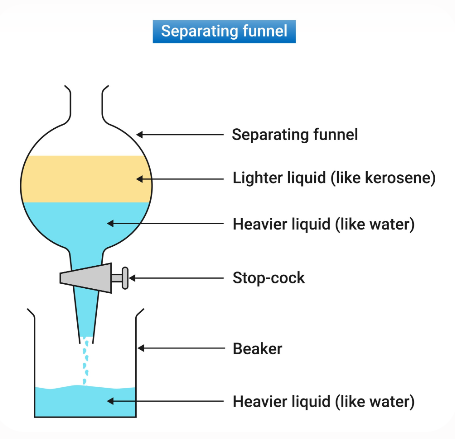
- Layer Formation: Yes, oil and water are immiscible liquids; they do not mix and will form two distinct layers.
- Top Layer: Oil will be on the top layer because its density is lower than the density of water
- Separation Method: These layers are separated using a separating funnel. The heavier liquid (water) is drained out through the stopcock at the bottom, and the stopcock is closed just as the oil layer reaches it.
Exploring Mixtures and Their Separation
Assertion and Reason — Tyndall Effect
Assertion and Reason
Choose the correct option:
(iii) A is true, but R is false.
Detailed Explanation
Why is Assertion (A) true?
The assertion is correct. A true solution does not exhibit the Tyndall effect because the particles of the solute are extremely small and do not scatter visible light. Therefore, the path of a beam of light cannot be seen when it passes through a true solution.
Why is Reason (R) false?
The reason is incorrect. The particles in a true solution are not larger than 100 nm. They are actually much smaller, generally less than 1 nm in diameter. Because these particles are so small, they do not scatter visible light sufficiently to produce the Tyndall effect.
What is the correct reason?
A true solution does not show the Tyndall effect because its solute particles are extremely small, usually less than 1 nm, and therefore they cannot scatter visible light appreciably.
Key Concept: Tyndall Effect
The Tyndall effect is the scattering of light by sufficiently large dispersed particles, making the path of the light beam visible.
True solutions: Particles are generally smaller than 1 nm and do not show the Tyndall effect.
Colloids: Their dispersed particles are large enough to scatter light, so colloidal solutions show the Tyndall effect.
Final Answer
(iii) A is true, but R is false. Solutions do not exhibit the Tyndall effect because their particles are extremely small, generally less than 1 nm in diameter—not larger than 100 nm.
Question
- How would you separate the mixtures given in Table 5.3? Mention the reason for choosing your method. If a mixture cannot be separated, explain why.
Table 5.3
| Mixture | Method of separation | Reason for selection |
| Mud from muddy water | ||
| Plasma from other components in the blood sample | ||
| Naphthalene and sand | ||
| Chalk powder and common salt | ||
| Common salt and water | ||
| Oil from water | ||
| Pigments of the flower |
Answer
Here is the completed Table 5.3 with the appropriate separation methods and scientific reasons.
Table 5.3 (Completed)
| Mixture | Method of separation | Reason for selection |
| Mud from muddy water | Filtration (or Sedimentation and Decantation) | Mud particles are large, insoluble in water, and suspended, so they can be easily trapped by a filter paper. |
| Plasma from other components in the blood sample | Centrifugation | Centrifugation spins the sample rapidly, forcing the denser blood cells to settle at the bottom while the lighter liquid plasma remains on top. |
| Naphthalene and sand | Sublimation | Naphthalene is a sublime substance that converts directly from a solid to a gas upon heating, leaving the non-sublimable sand behind. |
| Chalk powder and common salt | Dissolution in water, followed by Filtration and Evaporation | Salt dissolves in water while chalk powder does not. Filtering removes the chalk, and evaporating the water recovers the salt. |
| Common salt and water | Evaporation (or Distillation) | Water has a much lower boiling point than salt and evaporates into the air (or is condensed and collected in distillation), leaving salt crystals behind. |
| Oil from water | Separating funnel | Oil and water are immiscible liquids that form distinct layers based on their densities (oil is lighter and floats on top). |
| Pigments of the flower | Chromatography | The different colored pigments have different solubilities in a moving solvent, causing them to travel up the chromatography paper at different speeds. |
Exploring Mixtures and Their Separation
Exercise Questions & Detailed Answers
Separation of Two Miscible Liquids
Two miscible liquids, A and B, are present in a mixture. The boiling point of A is 60°C and the boiling point of B is 90°C. Suggest a method to separate them. Also, draw a labelled diagram of the method suggested.
The two liquids can be separated by simple distillation.
Simple distillation is suitable because liquids A and B are miscible but have a sufficiently large difference in their boiling points.
Why is simple distillation suitable?
The boiling point of liquid A is 60°C, while the boiling point of liquid B is 90°C.
Therefore, the difference in their boiling points is:
90°C − 60°C = 30°C
Since the difference is greater than about 25°C, simple distillation can be used effectively to separate the two liquids.
How does the separation take place?
When the mixture is heated, liquid A has the lower boiling point of 60°C. Therefore, A vaporises more readily than B.
The vapour passes through the condenser, where it is cooled and converted back into liquid. This liquid is collected in the receiving flask.
Liquid B, having the higher boiling point of 90°C, remains largely in the distillation flask.
Simple distillation works here because the boiling points of the two miscible liquids differ by 30°C, which is sufficiently large for effective separation.
Labelled Diagram — Simple Distillation
Final Answer
Simple distillation is used to separate liquids A and B. Liquid A boils at 60°C and vaporises first, while liquid B boils at 90°C. The vapour of A is condensed and collected separately.
Comparison of Evaporation, Crystallization and Distillation
Compare evaporation, crystallization and distillation. In which situation, would you prefer each of these over the others?
1. Evaporation
Evaporation is used to separate a dissolved solid from a liquid by removing the liquid as vapour.
It is preferred when we only need to recover the solid solute and there is no need to collect the solvent.
Example: Obtaining salt from salt water by evaporating the water.
2. Crystallization
Crystallization is used to obtain a pure solid in the form of crystals from a solution.
It is preferred over simple evaporation when the aim is to obtain the purest possible solid, especially when the solid may contain impurities.
Crystallization is also preferred when a substance may decompose on strong heating or heating to complete dryness.
Example: Obtaining pure crystals of copper sulfate from a copper sulfate solution.
3. Distillation
Distillation involves heating a liquid to form vapour and then cooling the vapour to obtain the liquid again.
It is preferred when we need to recover the solvent as well as separate it from a dissolved substance.
Distillation is also used to separate miscible liquids having sufficiently different boiling points.
Example: Separating water from a salt solution and collecting the distilled water.
Evaporation → Get the solid, lose the solvent.
Crystallization → Get a purer solid in crystal form.
Distillation → Recover the liquid by condensation.
Final Answer
Evaporation is preferred when only the solid solute is required. Crystallization is preferred when a pure solid is required, particularly when heating to dryness is unsuitable. Distillation is preferred when the solvent needs to be recovered or when miscible liquids with sufficiently different boiling points need to be separated.
Blood as a Colloidal Mixture
Blood is an example of a colloidal mixture.
(i) What would happen if blood behaved like a true suspension inside the body?
(ii) In a blood sample, identify the dispersed phase and the dispersion medium.
(i) What would happen if blood behaved like a true suspension?
If blood behaved like a true suspension, its relatively large particles would gradually settle down under the influence of gravity when the person remained stationary for some time.
This settling would make the blood non-uniform and could interfere with the normal flow of blood through blood vessels.
As a result, the transport of oxygen, nutrients and other essential substances to body tissues would be seriously affected.
If blood cells settled like particles in a suspension, they would not remain evenly distributed throughout the blood, which would seriously interfere with efficient circulation and transport.
(ii) Identify the dispersed phase and dispersion medium
In a blood sample, the cellular components are distributed throughout the liquid part of blood.
In a colloidal system, the substance distributed as particles is called the dispersed phase, while the substance in which those particles are distributed is called the dispersion medium.
Final Answer
(i) If blood behaved like a true suspension, its cells would
tend to settle under gravity when the body was stationary, interfering with
normal circulation and the efficient transport of oxygen and nutrients.
(ii) Dispersed phase: blood cells (RBCs, WBCs and platelets).
Dispersion medium: plasma.
Question 11
You are given a mixture of sand, common salt and naphthalene (Fig. 5.25a). The Fig. 5.25b depicts various steps used to separate the components of this mixture. Identify and write down the correct sequence of separation techniques.
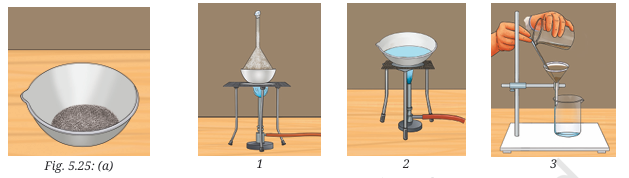
Correct Sequence:
- Step 1: Sublimation: Heat the mixture to recover Naphthalene as it sublimes and deposits on the cool walls of the funnel.
- Step 3: Filtration: Add water to the remaining sand and salt. The salt dissolves. Filter the mixture to remove the Sand as residue.
- Step 2: Evaporation: Heat the remaining salt-water filtrate. The water evaporates, leaving behind the Common Salt.
Solubility of Various Salts
Answer the following questions
Table 5.4: Solubility of various salts
Solubility: Mass of salt dissolved in 100 g of water at different temperatures.
| Salts | 10 °C | 20 °C | 30 °C | 40 °C | 60 °C | 80 °C |
|---|---|---|---|---|---|---|
| Potassium nitrate | 21 | 32 | 45 | 62 | 106 | 167 |
| Sodium chloride | 36 | 36 | 36.3 | 36.5 | 37 | 37 |
| Potassium chloride | 35 | 35 | 37.4 | 40 | 46 | 54 |
| Ammonium chloride | 24 | 37 | 41 | 41 | 55 | 66 |
(i) What mass of potassium nitrate would be needed to prepare its saturated solution in 50 g of water at 40 °C?
(ii) A student makes a saturated solution of potassium chloride in water at 80 °C and leaves the solution to cool at room temperature (25 °C). What would she observe as the solution cools? Explain.
(iii) What is the effect of a change in temperature on the solubility of salts? Also, compare the changes in the solubility of the four given salts with increasing temperature from 10 °C to 80 °C.
Solubility of Salts at Different Temperatures
Answer
Given Information
According to Table 5.4, the solubility of potassium nitrate at 40°C is 62 g per 100 g of water.
We need to calculate how much potassium nitrate will dissolve in 50 g of water.
= 31 g
Observation
Explanation
The solubility of potassium chloride depends on temperature. According to the given table, its solubility is approximately:
Therefore, when a hot saturated solution is cooled, the solubility of potassium chloride decreases. The water can no longer keep all the previously dissolved salt in solution.
The excess potassium chloride separates from the solution as solid crystals.
General Effect of Temperature
However, the amount by which solubility increases is different for different salts. The four salts can be compared from 10°C to 80°C as follows:
This is a very large and rapid increase, so potassium nitrate is the most affected by temperature.
Thus, it shows a significant increase in solubility.
Therefore, it shows a moderate increase in solubility.
Hence, its solubility remains nearly constant even when the temperature rises considerably.
• Potassium nitrate: 31 g is needed for 50 g of water at 40°C.
• On cooling a hot saturated KCl solution, the decreasing solubility can cause excess KCl to separate as crystals.
• In general, the solubility of solids in liquids increases with temperature, but the extent of increase differs from salt to salt.
• KNO₃ shows the greatest temperature dependence, while NaCl shows very little change.
Class 9 New Science Book Ch 5 Exploring Mixtures
Numerical Problem — Mass Percentage of a Solution
Comparing the Concentration of Sugar Solutions
Three students, A, B and C, are preparing sugar solutions for an experiment:
(i) Calculate the mass percentage (% m/m) concentration of sugar in each student’s solution.
(ii) Whose solution is the most concentrated? Explain why.
Formula Used
Here, sugar is the solute and water is the solvent.
Therefore:
Student A
Student A dissolves 20 g of sugar in 80 g of water.
First, calculate the total mass of the solution:
Therefore, the mass percentage of sugar is:
Student B
Student B dissolves 20 g of sugar in 100 g of water.
First, calculate the total mass of the solution:
Therefore, the mass percentage of sugar is:
Student C
Student C dissolves 30 g of sugar in 80 g of water.
First, calculate the total mass of the solution:
Therefore, the mass percentage of sugar is:
(ii) Which solution is the most concentrated?
The concentrations of the three solutions are:
Student A = 20% m/m
Student B = 16.67% m/m
Student C = 27.27% m/m
Since 27.27% is the highest concentration, the solution prepared by Student C is the most concentrated.
This is because Student C has the greatest mass of sugar relative to the total mass of the solution.
Key Concept
The concentration of a solution cannot be compared by looking only at the mass of the solute. We must consider the mass of the entire solution.
Mass percentage tells us the mass of solute present in every 100 g of solution.
Therefore, the solution having the greater mass percentage of sugar is the more concentrated solution.
Final Answer
(i) Student A’s solution = 20% m/m, Student B’s solution = 16.67% m/m, and Student C’s solution = 27.27% m/m.
(ii) Student C’s solution is the most concentrated because it has the highest mass percentage of sugar, 27.27% m/m.
Question 15
Examine Fig. 5.26.
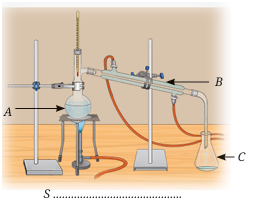
(i) Identify the separation technique marked as ‘S’.
- Answer: S is Distillation (specifically Simple Distillation).
(ii) Label the apparatus A, B and C.
- A: Distillation Flask (containing the mixture)
- B: Water Condenser
- C: Receiver Flask (containing the distillate)
(iii) Which of the following mixtures can be separated by the technique identified above? Use the data given in Table 5.5.
- Mixtures: (a) water—acetone, (b) water—salt, (c) acetone—alcohol, (d) sand—salt, (e) alcohol—chloroform, (f) alcohol—benzene.
- Selection:
- (a) water—acetone: Yes (BP difference: 100°C – 56°C = 44°C).
- (b) water—salt: Yes (Salt is non-volatile; water distills over).
- (e) alcohol—chloroform: Yes (BP difference: 78°C – 61°C = 17°C, though fractional distillation is often preferred for differences under 25°C, simple distillation is fundamentally the technique shown).
- Note: (c) and (f) have boiling point differences of less than 25°C, making them better candidates for fractional distillation rather than simple distillation. (d) is a mixture of solids requiring filtration/evaporation.
Class 9 Updated New Science Book 2026 Solutions
Explore chapter-wise solutions, concepts, explanations, and study resources for the Class 9 Updated New Science Book 2026.
📚 NCERT Solutions & Study Resources
Explore NCERT solutions, Oxford book solutions, Mathematics, Science, Physics, Chemistry, Biology and more — organized class-wise.
🎓 Class 12 — NCERT Solutions
📘 Class 11 — NCERT Solutions
📗 Class 10 — NCERT Solutions
📕 Class 9 — NCERT Solutions
📙 Class 8 — Solutions
📒 Class 7 — Solutions
📓 Class 6 — Solutions
🏛️ Official NCERT Textbooks
Access the official NCERT textbook portal for Class 10 Mathematics and other NCERT textbooks directly from the NCERT website.
Visit Official NCERT Website ↗